

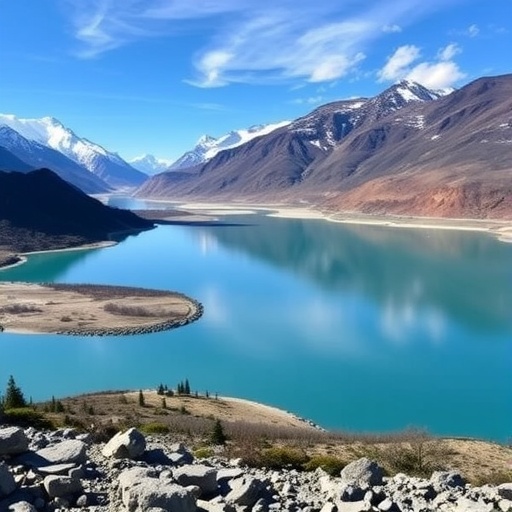
In recent years, the Himalaya region has faced escalating threats from Glacial Lake Outburst Floods (GLOFs), a hazard that arises when the natural dams containing glacial lakes fail, unleashing devastating floods downstream. While the frequency of GLOFs has remained statistically stable over the past three decades, the damage and human toll associated with these events have increased dramatically due to expanding population densities and infrastructure development in vulnerable mountain areas. Recognizing the urgent need for a comprehensive management strategy, an international consortium of scientists led by the Institute of Tibetan Plateau Research at the Chinese Academy of Sciences has unveiled a pioneering framework designed to mitigate GLOF risks effectively across this region.
This framework builds upon China’s Glacial Lake Management System (GLMS), which represents a landmark in systematic glacial lake monitoring and risk reduction. The GLMS integrates advanced hydrodynamic modeling, engineering interventions, and community-based early warning mechanisms to significantly lessen the impact of glacial lake outbursts. The success of GLMS, particularly evidenced by the low incidence of damage and fatalities in China since its 2019 implementation—including successful evacuations facilitated by early warnings—demonstrates its robust potential. Such achievements underscore the feasibility of exporting and adapting this model to other high-risk mountain regions braced by glacial lakes across international borders.
Central to this framework is the concept of combining multiple disciplines and strategies to form a multi-layered defense against GLOFs. Scientific hazard assessments provide the backbone of risk identification, enabling targeted application of engineering methods such as controlled water level drawdown via spillways and reinforcement of natural dams. These physical interventions are complemented by community-driven early warning systems equipped with real-time data fusion capabilities, which analyze upstream and downstream conditions to generate tiered alerts, allowing timely evacuations and minimizing loss of life. Moreover, the framework prioritizes building emergency response capacities within vulnerable communities, ensuring resilience in the face of sudden GLOFs.
Transboundary collaboration emerges as a critical facet of the framework, given that glacial lake failures frequently impact multiple countries along river courses originating in the Himalayas. The proposed system promotes coordinated information sharing, joint hazard assessments, and harmonized emergency protocols among neighboring states. This networked approach not only enhances preparedness but also fosters trust and strategic partnerships necessary for enduring risk management in this highly complex geopolitical landscape.
Hydrodynamic modeling projections provide sobering forecasts: under continued climate warming, glacial lakes are expected to grow substantially, with total lake volumes tripling by the mid-21st century compared with levels observed during 2000–2020. This expansion portends a 27% rise in GLOF exposure among lakes already deemed high-risk, escalating to over 40% in areas devoid of structured lake management. The researchers warn that without urgent and systematic interventions, the consequences in terms of infrastructural damage and human casualties could multiply catastrophically.
Engineering measures inspired by GLMS show quantifiable promise in curtailing these risks. Model simulations indicate that implementing controlled drainage systems and dam fortifications could reduce inundation intensities by up to 24% on average, with reductions almost reaching 30% outside China’s borders. These interventions serve as proactive mechanisms that blunt the force of potential floods while passive defense strategies, such as land use planning and relocation, provide backup safeguards to protect vulnerable settlements.
Integration of these diverse methods into a unified framework is essential because no single intervention is sufficient to confront the multifaceted nature of GLOF hazards. The research team emphasizes that combining engineering, early warning, community education, and international collaboration creates feedback loops wherein government agencies and local stakeholders continuously adapt strategies based on monitoring data and changing conditions. This dynamic process ensures that responses evolve in tandem with environmental and socio-economic complexities.
The GLMS’s efficacy is particularly notable when contrasted with regions outside China, where lack of coordinated management has resulted in catastrophic impacts. After 2005, GLOFs in transboundary areas led to over 26,000 buildings damaged, the destruction of 65 bridges and more than 32 kilometers of roads, and over 6,000 fatalities. This stark disparity highlights the pressing need for establishing similar systematic lake governance elsewhere in the Himalayan belt, tailored to local geopolitical and environmental contexts.
The framework’s prioritization of cost-effective solutions further enhances its appeal for policymakers working under constrained budgets. It recommends concentrating engineering interventions on approximately ten high-risk glacial lakes identified through rigorous assessment, where flood intensity reductions of more than 50% are attainable. Meanwhile, lakes with lower immediate threat levels would benefit more from enhanced monitoring and community preparedness, maximizing resource allocation efficiency across the region.
Underlying this scientific and technical sophistication is an acknowledgment of the profound human dimension of GLOF risk management. Empowering communities through education, early warning dissemination, and emergency capacity building ensures that residents are not passive recipients of protection but active participants in their own safety. This community-centric approach also strengthens social cohesion and resilience, essential attributes in disaster-prone mountain landscapes susceptible to climate-induced transformation.
Finally, the study is a testament to international scientific cooperation, assembling experts from China, Austria, Switzerland, the United Kingdom, India, and Nepal. This collaborative spirit transcends borders and disciplinary silos, reflecting a shared commitment to confronting one of the most acute climate change-related hazards threatening millions across the Himalayas. As glacier retreat accelerates under warming temperatures, implementing this comprehensive framework offers a pathway to safeguard mountain communities from the escalating risks posed by glacial lake outburst floods.
Subject of Research:
Article Title:
News Publication Date:
Web References:
References:
Image Credits: ©Science China Press
Keywords: Glacial Lake Outburst Floods, GLOF mitigation, Himalayan region, glacial lake management, early warning systems, engineering interventions, transboundary collaboration, hydrodynamic modeling, climate change adaptation, disaster risk reduction


