


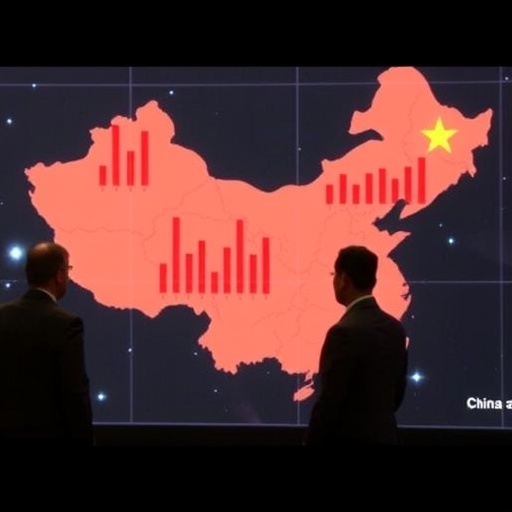
In a groundbreaking study that redefines our understanding of healthcare systems, researchers have unveiled the complex dynamics governing the supply and demand of health resources across China. The investigation elucidates the spatiotemporal patterns and key determinants influencing the coordination between health resource availability and community needs, offering vital insights that could shape public health policy in one of the world’s most populous nations. This research heralds a new era of data-driven healthcare management by mapping how supply-demand synchronization evolves geographically and over time.
China’s healthcare landscape is as vast as its terrain, characterized by stark disparities between rural and urban zones, coastal wealth, and interior poverty. The study meticulously charts how health resources such as medical personnel, infrastructure, and pharmaceutical availability correspond to rising or waning local demands driven by demographic transitions, urbanization, and economic development. By employing advanced spatial analysis techniques, the investigative team dissected the temporal evolution of resource allocation patterns, revealing critical inflection points where coordination either succeeded or faltered.
One of the most compelling revelations of this work is the identification of “coupling coordination” states—a technical term describing the degree to which supply of health resources aligns with actual demand. When supply and demand are harmonized, regions experience efficient healthcare delivery, minimized patient wait times, and optimized use of medical assets. Conversely, mismatches trigger systemic inefficiencies that exacerbate health inequities, particularly affecting vulnerable populations. The researchers’ precise quantification of these states across thousands of Chinese locales provides a granular blueprint for targeted interventions.
This study leveraged a multi-tiered analytical framework, integrating datasets from healthcare facilities, demographic surveys, and economic activity records spanning multiple years. Employing sophisticated geographic information systems (GIS) and coupling coordination models, the research team unveiled not just static snapshots but dynamic trajectories of health resource distribution. This allowed them to track how urban expansion, policy shifts, and population aging collectively impact the healthcare system’s balance and resilience.
Crucially, the work highlights determinants that drive disparities in supply-demand coupling coordination. Among these, regional economic vitality emerges as a primary factor, directly influencing resource availability and infrastructure investment. Human capital components, including the density and education level of healthcare workers, also critically affect coordination. Additionally, policy factors such as governmental funding priorities and healthcare reform initiatives play decisive roles in either ameliorating or exacerbating imbalances.
The temporal dimension reveals that advances in healthcare resource coordination are neither uniform nor guaranteed. Coastal metropolitan areas experienced relatively steady improvement, buoyed by sustained economic growth and focused policy support. In contrast, certain interior provinces displayed fluctuating or stagnant trends, signifying persistent structural challenges and the necessity for adaptive strategies. These temporal distinctions underscore the importance of region-specific planning attuned to local contextual realities.
This comprehensive approach offers unprecedented capability to predict future healthcare demand patterns and resource requirements across Chinese territories. The predictive models developed can simulate potential scenarios driven by factors like migration, aging, or economic shocks. Such foresight is invaluable for policymakers striving to design flexible and equitable healthcare systems capable of responding proactively to shifting needs.
Significantly, the concept of coupling coordination transcends simplistic measures of resource quantity, incorporating qualitative aspects such as system responsiveness and organizational efficiency. By capturing this multidimensionality, the study provides a richer understanding of healthcare system performance, encouraging stakeholders to move beyond volume-centric frameworks toward holistic system optimization.
The implications of this research extend beyond China, offering a replicable methodological framework for other nations grappling with the challenges of allocating finite health resources amid rising demand. The spatiotemporal evolution models and determinant analyses provide universally applicable tools to scrutinize and enhance healthcare supply-demand integration worldwide.
Moreover, the study illuminates the critical role of intersectoral collaboration in improving coupling coordination. Addressing determinants like economic disparities, education, and infrastructure development requires coherent strategies involving healthcare, economic planning, and social welfare sectors. This calls for integrated governance models to realize true equity in health resource allocation.
The researchers also uncovered that technological adoption, including telemedicine and digital health platforms, significantly shifts the supply-demand dynamics by extending healthcare accessibility into under-resourced areas. This technological factor, though emergent, shows promise as a lever to alleviate spatial disparities and improve coupling coordination, suggesting policy areas ripe for investment.
Amidst demographic shifts such as population aging and urban migration, the study stresses the urgent need to incorporate flexibility into health resource planning. Static allocation models fail to accommodate rapidly evolving demand landscapes, risking resource underutilization or shortages. Dynamic coordination mechanisms informed by real-time data may provide more resilient solutions.
Importantly, health equity emerges as a central theme, with the study exposing that uneven coupling coordination perpetuates unequal access to quality healthcare services. Addressing these disparities is critical from both a social justice perspective and public health outcomes standpoint. The authors advocate for policy frameworks that explicitly target underserved regions with tailored resource distribution schemes.
This landmark research not only maps present healthcare supply-demand dynamics with unprecedented detail but also sets a strategic agenda for future health system reform. Its blend of technical rigor and practical policy relevance positions it as a seminal reference point for stakeholders committed to achieving equitable and sustainable healthcare access throughout China’s transformative development.
In summary, by elucidating the intricate spatiotemporal coupling of health resource supply and demand and decoding its underlying determinants, this study offers a powerful lens through which China and the world can envision and enact more effective health system adaptations. Its integration of geographic, demographic, economic, and technological dimensions constitutes a major leap forward in health resource research, fostering hope for more equitable health futures.
Cite Scienmag News
Courtney Benton. (November 25, 2025). China’s Health Resource Supply-Demand Dynamics Explored. Scienmag. https://scienmag.com/chinas-health-resource-supply-demand-dynamics-explored/
Courtney Benton. "China’s Health Resource Supply-Demand Dynamics Explored." Scienmag, 25 November 2025, https://scienmag.com/chinas-health-resource-supply-demand-dynamics-explored/. Accessed 4 September 2026.
Courtney Benton. "China’s Health Resource Supply-Demand Dynamics Explored." Scienmag. November 25, 2025. https://scienmag.com/chinas-health-resource-supply-demand-dynamics-explored/


