


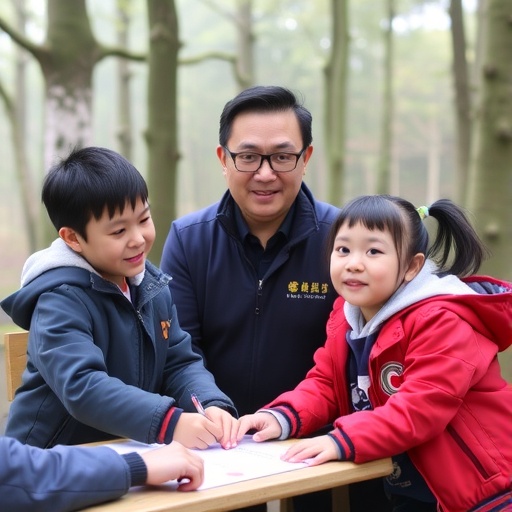
Forest kindergartens are often presented as a simple antidote to indoor, screen-heavy childhood: move learning outdoors, let children explore living landscapes, and allow forests, weather and seasonal change to become part of the curriculum. But a new case study from China suggests that keeping such schools alive requires far more than enthusiasm for muddy boots and outdoor play. The study follows the professional development of a private forest-kindergarten principal and shows how nature-based education can be squeezed by mainstream academic expectations, high operating costs and unclear regulation. Its findings offer a rare inside account of what happens when an alternative educational philosophy meets the practical demands of running a school.
Published in the Early Childhood Education Journal, the study by Fangni Zhao of Yunnan Normal University examines one Chinese principal’s efforts to establish and sustain a forest kindergarten. Rather than measuring children’s test scores or comparing two groups of schools, Zhao used narrative inquiry, a qualitative research approach designed to understand how people interpret and construct meaning through lived experience. The research treats the principal’s professional journey as evidence of how educational ideals develop under pressure. It is a detailed case, not a nationwide survey, but its focus on leadership, regulation and financial survival exposes structural problems that could affect many nature-based early-childhood programs.
Zhao built the account through methodological triangulation, combining several forms of evidence to make the narrative more robust. The principal took part in three progressive interviews, allowing the researcher to revisit earlier accounts and follow changes in her thinking over time. Zhao also conducted participatory observation during a site visit, watched the educational environment in practice, and analyzed relevant documents. Informal communication supplemented these sources. In qualitative research, triangulation does not produce statistical representativeness; instead, it allows researchers to compare what participants say with what they do and with the institutional records surrounding their work. That combination helped Zhao trace the evolution of the principal’s professional identity and strategic decisions.
The principal’s development unfolded in three broad phases. The first was the germination of an educational ideal: a conviction that young children should learn through sustained contact with the natural world rather than encounter nature only as an occasional backdrop for classroom lessons. In place-based learning, the setting is not merely a location where teaching happens. It becomes part of the knowledge system. A woodland, garden or wetland supplies materials, events and relationships that children can investigate directly. Weather can alter a plan, plants can provide changing objects of observation, and local ecological features can connect abstract ideas to physical experience. For the principal, this approach formed the philosophical foundation of the kindergarten.
The second phase was pragmatic navigation. The ideal of forest education collided with the position of nature-based learning on the margins of China’s mainstream early-childhood curriculum. Families and education systems may value creativity, health and environmental awareness, yet schools are still often judged through conventional expectations about structured instruction, academic preparation and visible learning outcomes. Outdoor exploration can look unplanned to observers unfamiliar with its pedagogy, even when teachers are deliberately supporting language, motor development, social negotiation and scientific reasoning. The principal therefore had to translate a flexible, experience-driven model into language that parents, staff and authorities could recognize as legitimate education.
This translation problem is central to the study because forest kindergartens do not simply exchange a classroom for a forest. They reorganize how teaching, assessment and risk are understood. In a conventional lesson, educators may control the materials, timing and physical environment. In a forest setting, children encounter variable terrain, uncertain weather, living organisms and manageable hazards. Teachers must continuously balance autonomy with supervision. That demands specialized professional judgment: recognizing when a challenge supports confidence and problem-solving, when it becomes unsafe, and how to intervene without eliminating meaningful exploration. Zhao’s account indicates that many educators lack substantial preparation in nature-education skills, leaving principals to develop professional capacity while the school is already operating.
The financial challenge is equally fundamental. Nature-based schools commonly require access to suitable land, transportation, safety equipment, weather-resistant facilities and staffing ratios that can support close supervision outdoors. Maintaining a site and managing logistical risks can be more expensive than operating a conventional kindergarten in a purpose-built urban facility. Those costs are particularly difficult for a private school that must remain affordable enough to attract families while paying for infrastructure and trained personnel. The principal responded by seeking fiscally sustainable operating models rather than treating financial planning as separate from educational philosophy. In practice, the study suggests, the survival of an alternative pedagogy depends on whether its business model can protect the time, space and expertise that make the pedagogy possible.
Regulation adds another layer of uncertainty. Zhao identifies a lack of substantive policy support and, in particular, ambiguity over how sites used by forest kindergartens should be regulated. A school operating across forested or semi-natural land may encounter unclear rules concerning site use, construction, safety responsibilities and institutional oversight. Regulatory uncertainty can discourage investment, complicate long-term planning and expose schools to disputes with agencies or communities. It can also push principals into a defensive posture, spending energy interpreting rules instead of improving teaching. The study does not argue that outdoor schools should be exempt from safety or environmental regulation. Rather, it highlights the need for rules that clearly define how legitimate nature-based early education can operate without forcing every program into an indoor-school template.
The principal’s response was not to abandon the model but to build relationships around it. Community partnerships helped connect the kindergarten with local resources and create wider legitimacy for its work. Developing sustainable finances provided a buffer against the high costs of outdoor provision. The principal also engaged in advocacy, seeking to influence policy discussions and press for clearer regulatory guidance. These actions represent a shift from seeing school leadership as the management of internal routines to understanding it as institutional entrepreneurship: the creation of networks, narratives and conditions that allow an alternative organization to survive. The principal had to be an educator, business strategist, community builder and policy advocate at the same time.
The study’s conclusion is both hopeful and cautionary. Forest kindergartens can preserve the core principles of nature-based education while adapting them to local cultural expectations, but neither element can be neglected. Copying a model developed elsewhere without considering Chinese families, communities, regulations and educational traditions could weaken its relevance. At the same time, excessive adaptation could turn nature education into a marketable label stripped of its central commitment to sustained, meaningful engagement with the living world. Zhao argues that targeted policy intervention is needed, including clearer site-use regulations, professional-development opportunities for teachers and support for financially sustainable school models. The case suggests that the future of forest kindergartens will not be decided by the appeal of outdoor learning alone, but by whether institutions can create the conditions in which that appeal becomes durable educational practice.
Cite Scienmag News
Courtney Benton. (August 28, 2026). China’s Forest Kindergarten Principal Reveals Professional Challenges and Strategic Solutions. Scienmag. https://scienmag.com/chinas-forest-kindergarten-principal-reveals-professional-challenges-and-strategic-solutions/
Courtney Benton. "China’s Forest Kindergarten Principal Reveals Professional Challenges and Strategic Solutions." Scienmag, 28 August 2026, https://scienmag.com/chinas-forest-kindergarten-principal-reveals-professional-challenges-and-strategic-solutions/. Accessed 11 September 2026.
Courtney Benton. "China’s Forest Kindergarten Principal Reveals Professional Challenges and Strategic Solutions." Scienmag. August 28, 2026. https://scienmag.com/chinas-forest-kindergarten-principal-reveals-professional-challenges-and-strategic-solutions/


