


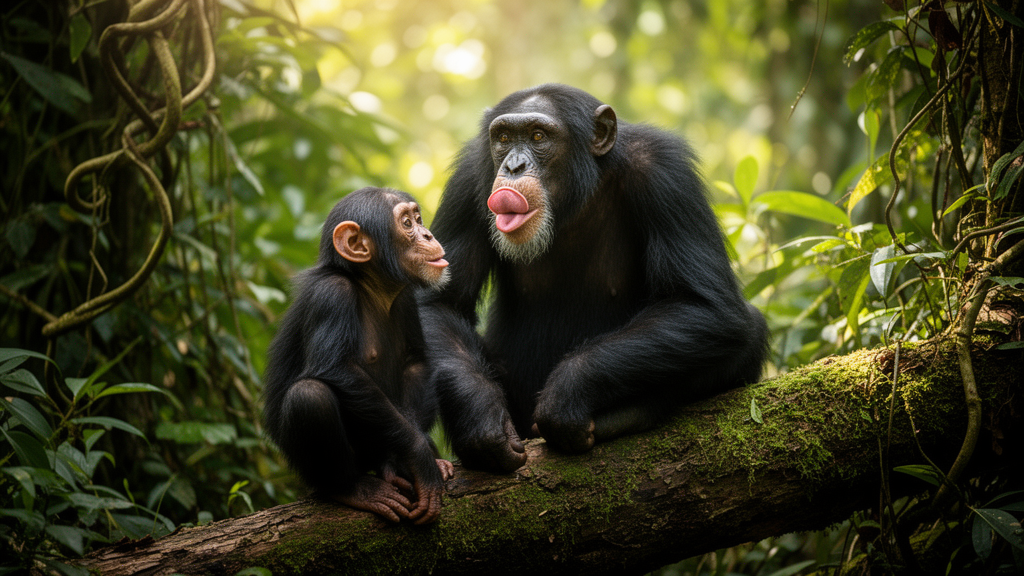
A comparative investigation published in the Proceedings of the National Academy of Sciences has established the first empirical evidence of arbitrary, learned vocal conventions in wild chimpanzees, demonstrating that these primates learn when and how to deploy specific acoustic signals rather than relying entirely on biologically fixed repertoires. Led by researchers at the CNRS Institute of Cognitive Sciences in Lyon, the Max Planck Institute for Evolutionary Anthropology, and the Taï Chimpanzee Project in Côte d’Ivoire, the peer-reviewed research challenges the long-standing scientific view that non-human primate vocalizations are strictly hardwired and unmodifiable. By tracking an unvoiced acoustic signal that resembles blowing a raspberry across wild forest communities and sanctuary-housed orphan groups, investigators demonstrated that the functional communicative meaning of this call is culturally acquired from social experience. This observation provides direct documentation of vocal signal conventions operating within natural ape groups, narrowing the perceived evolutionary gap separating chimpanzee communication systems from human language traditions.
For decades, primatologists and anthropologists operated under the premise that wild chimpanzee vocal repertoires were entirely inherited, genetically determined, and resistant to social modification. According to this traditional view, non-human primates lacked the vocal flexibility necessary to assign arbitrary meanings or social functions to their calls, leaving acoustic behaviors bound to rigid species-wide biological inheritance. In linguistics and animal behavior, an acoustic signal cannot be classified as arbitrary if it is completely unlearned, because animal callers lacking learning cannot choose to repurpose the same underlying vocalization for divergent social goals or distinct behavioral contexts. However, the newly documented findings from the Taï Chimpanzee Project and their partners directly challenge these foundational assumptions regarding key portions of the chimpanzee vocal repertoire. The team discovered that while the physical production mechanics of certain acoustic sounds may remain innate, the social rules governing their deployment are flexible, culturally transmitted, and shaped through social immersion within the community.
This newly demonstrated vocal plasticity in apes exhibits striking conceptual parallels to the structural mechanisms defining human languages, where words function as arbitrary linguistic conventions. In human linguistic communication, words are predominantly both learned and arbitrary, meaning that within an alternate historical trajectory, different vocal tokens could easily signify identical objects or social actions. Human societies adhere to specific linguistic conventions entirely because peers observe those same communal standards, promptly adjusting speech patterns whenever collective community norms shift over time. For example, if English speakers had historically adopted the German word Hund or the French term chien instead of dog, those alternative conventions would have become fully entrenched without altering the underlying conceptual reality. This foundational linguistic arbitrariness was famously captured by William Shakespeare in Romeo and Juliet, observing that a rose would smell as sweet regardless of the arbitrary name applied to it. Until this study, researchers believed wild chimpanzees lacked this capacity for arbitrary conventionalization.
To test whether chimpanzee vocalizations could sustain arbitrary conventions, doctoral student Antoine Valet and a collaborative team led by Catherine Crockford designed a comparative study examining 91 individual chimpanzees spanning ages from infancy to 55 years. The experimental design strategically contrasted individuals living under natural ecological conditions with peers raised in environments lacking adult behavioral models. Specifically, the scientists collected acoustic and behavioral data across four distinct wild chimpanzee communities located within Taï National Park in Côte d’Ivoire, alongside four captive groups of orphaned, peer-raised chimpanzees residing at the Tacugama Chimpanzee Sanctuary in Sierra Leone. By directly comparing the acoustic behaviors of wild subjects developing alongside experienced multi-generational community members against sanctuary orphans maturing solely alongside age-matched peers, the researchers constructed an empirical framework to isolate the direct influence of social learning and cultural transmission from innate biological maturation across the study cohort.
The focal point of the behavioral analysis was an unvoiced vocal signal resembling the sound of someone blowing a raspberry, an acoustic sound known to exist within the natural repertoires of wild and captive chimpanzees. Because the call is physically produced by wild communities and captive apes alike, previous researchers frequently assumed that its functional role in everyday chimpanzee life was universally uniform and biologically hardwired. By concentrating their empirical investigation on this specific call, Antoine Valet and Catherine Crockford evaluated whether chimpanzees across fundamentally different social rearing environments utilized the identical physical sound for identical behavioral functions, or whether the operational meaning of the call varied depending on the presence of older cultural tutors.
The empirical results revealed a stark behavioral dichotomy between the wild communities of Côte d’Ivoire and the sanctuary orphans of Sierra Leone. Among the wild chimpanzees observed in Taï National Park, individuals deployed the raspberry call almost exclusively while actively grooming their social partners, integrating the acoustic sound into focused, prosocial hygienic routines. In contrast, the orphaned juveniles at the Tacugama Chimpanzee Sanctuary used the identical raspberry call chaotically across a broad, unpredictable assortment of unrelated social interactions, showing no preferential association with grooming behavior. The authors emphasized that if the communicative function of the raspberry call were unlearned and genetically predetermined, all chimpanzee groups would inevitably exhibit identical behavioral patterns regardless of rearing history. Because the sanctuary orphans utilized the call without specific contextual constraints, the researchers concluded that the specialized grooming function observed in the wild is not innate, but must instead be acquired through social learning.
To confirm that younger chimpanzees actively acquire communicative conventions from experienced community members, the researchers conducted a second phase of investigation focusing on the behavioral impact of adult role models at Tacugama. The team systematically documented communicative patterns after introducing an adult chimpanzee into one of the previously unstructured orphan peer groups. Over time following this introduction, the young orphans’ previously chaotic deployment of the raspberry call became markedly more uniform, progressively converging onto the precise grooming-associated pattern exhibited by the newly integrated adult. This behavioral shift demonstrated that young chimpanzees do not merely invent call functions in isolation, but instead learn conventional usage patterns directly from mature community role models, mirroring the social transmission seen in human developmental learning. As study co-author and University of Warwick philosopher Richard Moore highlighted, these findings demonstrate that there is substantially more continuity between chimpanzee vocal learning and our own species’ linguistic acquisition than evolutionary scientists previously suspected.
The discovery that the call’s function is learned raises an intriguing evolutionary question: why do all surveyed wild populations appear to share the same grooming convention rather than exhibiting the broad cultural divergence typical of human languages? The study authors proposed that the raspberry call may possess an ancestral non-communicative origin that made it especially prone to being incorporated into grooming contexts. In natural wild settings, chimpanzees utilize specific physical oral actions during hygiene routines, such as lip protrusion and blowing air to part fur while extracting ectoparasites from group members. The researchers suggested that these routine mechanical grooming actions could have evolved into an intentional communicative signal simply through the addition of sound. Different wild communities likely discovered this functional communicative adaptation independently, converging on an identical convention over evolutionary time. Crucially, the authors noted that this shared origin does not negate the conventional nature of the call, because separate groups could theoretically have established alternative communicative signals.
The investigation into the raspberry call aligns with emerging evidence indicating that primate vocal complexity extends well beyond isolated, reflexive utterances, encompassing broader structural flexibility across wild populations. Recent field studies have documented noticeable geographic variation in how wild chimpanzees combine individual acoustic units into larger call sequences, reinforcing the view that vocal learning plays an underappreciated role in ape communication. First author Antoine Valet observed that even aspects of the chimpanzee vocal repertoire that historically appeared fixed and genetically unlearned may actually be sculpted by ongoing learning processes, leaving much to be uncovered about their communication systems. Senior author Cédric Girard-Buttoz similarly noted that recent research strongly suggests wild chimpanzees can learn to assemble distinct calls into ordered sequences. Nevertheless, important biological boundaries remain evident: unlike human language learners who readily coin entirely novel acoustic sounds, chimpanzees appear unable to produce novel vocal forms, suggesting that innate evolutionary constraints govern sound production while learning guides usage.
Ultimately, the research indicates that the evolutionary divide between human speech and non-human primate communication is considerably more porous than past scientific models suggested, with shared developmental mechanisms underlying vocal conventions. While humans alone combine unlimited vocal flexibility with open-ended acoustic learning, chimpanzees clearly share the capacity to acquire communicative rules from mature group members. However, scientists caution that many open questions remain regarding the exact degree to which social learning shapes the full chimpanzee vocal repertoire compared to other animal species. As Roman Wittig, director of the Taï Chimpanzee Project and senior author of the study, emphasized, preserving endangered wild chimpanzee populations remains essential if science hopes to unravel how these primates acquire, maintain, and perpetuate their rich communication systems across generations. Without long-term conservation of intact wild forest communities, researchers risk losing the irreplaceable cultural and behavioral diversity necessary to reconstruct the evolutionary origins of vocal learning and social communication in our closest living relatives.
Subject of Research: Vocal learning and arbitrary communication conventions in wild and sanctuary chimpanzees
Article Title: Chimpanzees learn when to use some of their calls – with parallels to how humans learn words
Article References: Chimpanzees learn when to use some of their calls – with parallels to how humans learn words. Original publication (Bibliographic details unavailable.)
Image Credits: AI Generated
DOI: Not provided
Keywords: chimpanzee vocalizations, vocal learning, linguistic conventions, raspberry call, Taï National Park, Tacugama Chimpanzee Sanctuary, social grooming, adult role models, unvoiced calls, primate communication, Antoine Valet, Catherine Crockford, Richard Moore, Cédric Girard-Buttoz, Roman Wittig, Taï Chimpanzee Project, call combinations, Proceedings of the National Academy of Sciences
Cite Scienmag News
Courtney Benton. (November 11, 2026). Chimpanzees Learn Social Context for Raspberry Calls From Group Role Models. Scienmag. https://scienmag.com/chimpanzees-learn-social-context-for-raspberry-calls-from-group-role-models/
Courtney Benton. "Chimpanzees Learn Social Context for Raspberry Calls From Group Role Models." Scienmag, 11 November 2026, https://scienmag.com/chimpanzees-learn-social-context-for-raspberry-calls-from-group-role-models/. Accessed 16 November 2026.
Courtney Benton. "Chimpanzees Learn Social Context for Raspberry Calls From Group Role Models." Scienmag. November 11, 2026. https://scienmag.com/chimpanzees-learn-social-context-for-raspberry-calls-from-group-role-models/




