


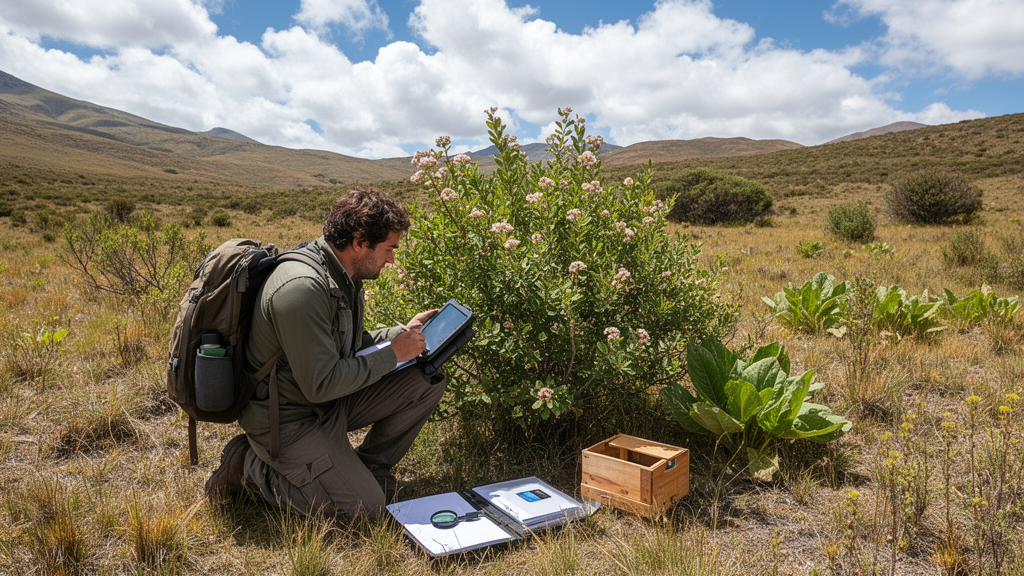
A national-scale review of Chilean vegetation has assembled 1,776 vegetation-plot observations from 37 publications, creating the first broad database for testing the country’s Braun-Blanquet syntaxonomy against the EcoVeg formation system. The compilation documents 29 classes, 43 orders, 66 alliances and 175 associations, while revealing major geographic gaps in field data and substantial mismatches between the two ways of classifying plant communities. Chile contains 4,655 native vascular-plant species, of which 2,145 are endemic, a diversity that reflects the country’s approximately 4,000-kilometre north–south extent, rugged topography and wide range of climates.
Elevations reach about 3,000 metres above sea level in the northern coastal range and around 7,000 metres in the Andes, helping produce environments ranging from tropical to antiboreal and from ultraperarid to ultraperhumid. Yet knowledge of vegetation has remained uneven, with some regional studies detailed but few attempts to examine plant communities systematically across the entire country. The review addresses that imbalance by reconstructing a syntaxonomic database from published plot observations.
The researchers began with the regional database “sudamerica,” searched scientific literature in Spanish, English and German, screened reference lists, and followed citations associated with named syntaxonomic units. They included studies that recorded plant abundance in plots and assigned those observations to associations. The analysis considered only header information such as elevation, coordinates, publication source and community assignment, avoiding the time-intensive process of digitizing complete abundance tables and reassessing species nomenclature and synonymy.
The resulting database therefore identifies where classified vegetation records exist without reproducing all floristic data from the original publications. Where coordinates were absent, researchers inferred locations from study-site descriptions, place-name records, road directions and maps. Annual temperature and total annual precipitation were extracted from CHELSA version 1.2 to describe the bioclimatic context of the plots.
The syntaxonomic structure began with the classification developed by Oberdorfer in 1960 and was expanded and adjusted as later publications were assessed. Class, order, alliance and association served as the principal ranks, while secondary ranks were also retained. Gaps remain in seven classes because an order or alliance had not yet been defined.
The records were managed and assessed in R, with the final data stored in a PostgreSQL database and linked to an online syntaxonomy resource. The plot records extend from northern Chile to its southern extremes, but their distribution is highly uneven. Large gaps remain north of 30° south and south of approximately 45° south.
The area between 25° and 32° south contains only one recorded azonal class, Lemnetea minoris. The current database consequently covers less than half of Chile’s surface. The authors note that sparse access, rugged terrain, severe weather and low population density may contribute to the southern gap, while north-central Chile had already been identified as one of the least thoroughly studied parts of the country.
These figures describe gaps in the evidence base, not an absence of vegetation in the unstudied areas. Wintero-Nothofagetea was the richest class, with 31 associations, followed by Lithraeo causticae-Cryptocaryetea albae with 15 and Myrteolo nummulariae-Sphagnetea magellanici with 14. Other classes represented communities with markedly different biogeographic origins.
Lemnetea minoris, Phragmito-Magnocaricetea and Potametea include aquatic and semi-aquatic vegetation with broadly cosmopolitan native distributions, characterized more by physiognomy and ecology than by shared species. Molinio caerulae-Arrhenatheretea elatioris, Plantaginetea majoris and Stellarietea mediae contain grassland, ruderal and weed communities in which introduced plants are often dominant, although native and introduced species commonly occur together. Wintero-Nothofagetea and Nothofagetea pumilionis-antarcticae instead represent temperate South American forests and woodlands.
When each plot was translated into the EcoVeg system, the observations occupied seven formation classes, 10 subclasses and 20 formations. The largest category by number of assigned associations was Shrub and Herb Vegetation, with 66, followed by Forest and Woodland with 50, Polar and High Montane Scrub, Grassland and Barrens with 16, Agricultural and Developed Vegetation with 15, Aquatic Vegetation with 11, Desert and Semi-Desert with nine, and Open Rock Vegetation with one. At formation level, Cool Temperate Forest and Woodland accounted for 33 associations, Temperate to Polar Bog and Fen for 17, Fallow Field and Weed Vegetation for 15, Tropical High Montane Scrub and Grassland for 15, and Temperate Grassland and Shrubland for 14.
The comparison showed that the two systems do not correspond one-to-one. Eleven of the 29 phytosociological classes were linked to more than one EcoVeg formation, and 12 of the 20 formations were linked to more than one class. Nineteen of the 66 alliances also crossed formation boundaries.
Wintero-Nothofagetea was associated with five formations, Phragmito-Magnocaricetea with four, and Parastrephio lepidophyllae-Fabianetea densae and Potametea with three. A major example is Wintero-Nothofagetea: although it chiefly corresponds to Cool Temperate Forest and Woodland, it also includes swamp forests classified in EcoVeg as Temperate Flooded and Swamp Forest. The authors associate this mismatch with physiognomic heterogeneity within broad phytosociological classes, including communities that differ from the dominant vegetation structure represented by the class.
Braun-Blanquet classification organizes communities through species composition, ecological characteristics and hierarchical syntaxonomic units, with associations as its fundamental rank. EcoVeg also uses a hierarchy, but its higher formation ranks are based strictly on physiognomy and bioclimatic patterns, while intermediate levels incorporate constant species, structure and ecological preferences. Braun-Blanquet syntaxa can include intrazonal and azonal communities, explaining why they encompass more ecological variety than a classification restricted to zonal vegetation formations.
The authors identify the separation of swamp forests from Wintero-Nothofagetea as one possible response to the observed discrepancy and note that analogous comparisons have been made in Europe. The review presents the database as a record of current knowledge and a research tool rather than a definitive national inventory. It can support the consolidation of syntaxonomic classifications at national or continental scales, provide access to floristic tables for meta-analysis, inform expert systems and complement vegetation maps.
The database also covers other South American countries and is accessible through the syntaxonomy website, although the study states that public access to the underlying data was planned for the future. Further comparisons could include EcoVeg’s intermediate and lower levels, the Ellenberg and Mueller-Dombois formation system, and lower EcoVeg units for alliances and associations. Together, the compiled observations and their geographic limitations show both the breadth of Chile’s documented vegetation diversity and the incomplete spatial foundation from which that diversity has been classified.
Subject of Research: Comparison of Braun-Blanquet syntaxonomy and EcoVeg plant formations in Chilean vegetation
Article Title: Chilean vegetation in the context of the Braun-Blanquet approach and a comparison with EcoVeg formations
Article References: Alvarez, M., & Luebert, F. (2022). Chilean vegetation in the context of the Braun-Blanquet approach and a comparison with EcoVeg formations. Vegetation Classification and Survey, 3, 45-52. https://doi.org/10.3897/vcs.72194
Image Credits: AI Generated
DOI: 10.3897/VCS.72194
Keywords: Chilean vegetation, Braun-Blanquet classification, EcoVeg formations, phytosociology, vegetation plots, syntaxonomy, plant formations, floristic diversity, vegetation database, biogeography, Chilean, vegetation
Cite Scienmag News
Margaret Porter. (October 20, 2026). Chilean vegetation database reveals classification and survey gaps. Scienmag. https://scienmag.com/chilean-vegetation-database-reveals-classification-and-survey-gaps/
Margaret Porter. "Chilean vegetation database reveals classification and survey gaps." Scienmag, 20 October 2026, https://scienmag.com/chilean-vegetation-database-reveals-classification-and-survey-gaps/. Accessed 20 October 2026.
Margaret Porter. "Chilean vegetation database reveals classification and survey gaps." Scienmag. October 20, 2026. https://scienmag.com/chilean-vegetation-database-reveals-classification-and-survey-gaps/


