


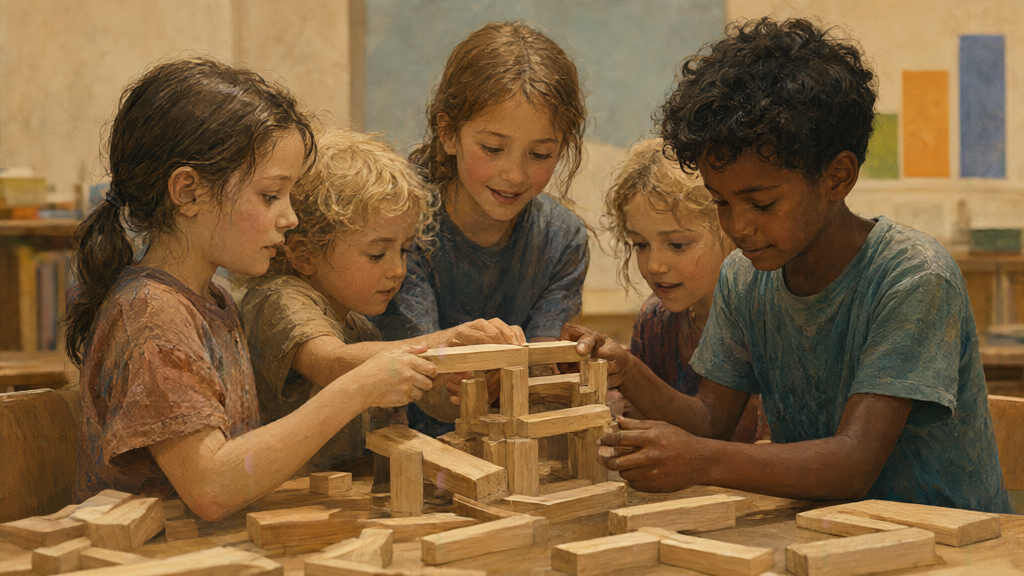
An international research team has published the first systematic cross-cultural comparison of how children help their peers. The study, conducted by researchers from the Max Planck Institute for Evolutionary Anthropology, Sapienza University of Rome, Leipzig University, the University of Portsmouth, the University of Plymouth, and Duke University, examines the social dynamics of childhood cooperation across diverse global contexts. While previous investigations into prosocial behavior have predominantly focused on interactions between children and adults, often within family structures, this new work highlights the critical yet underexplored role of peer interactions in children’s social development. The findings suggest that while the impulse to assist others is a universal aspect of childhood, the specific methods used to provide that assistance are shaped by local cultural norms and upbringing.
The study involved 336 children aged four to nine from six distinct cultural groups. The participants included children from Germany, as well as the Wichí of Argentina, the ≠Akhoe Hai||om of Namibia, and the Samburu and Kikuyu of Kenya, and the Quechua of Bolivia. This diverse sample allowed the researchers to examine helping behavior across a wide spectrum of social and economic environments, ranging from large-scale industrialized societies to small-scale foraging, farming, and pastoralist communities. By selecting populations with such varied lifestyles, the team aimed to determine whether the foundations of cooperative behavior are consistent across different human societies or if they vary significantly based on environmental and cultural factors.
To capture spontaneous helping behavior in a manner that felt natural to children in all settings, the researchers designed a playful experimental setup centered on a marble game. Pairs of children of the same age took turns playing, with one child observing the other encounter specific difficulties. These difficulties included a box that would not open or a container that spilled its marbles onto the floor. The observing child had previously learned how to solve both problems and was given the choice to help by explaining the solution, solving the problem hands-on, or doing both simultaneously. This task provided a direct and comparable measure of how children choose to assist their peers when given the opportunity, allowing for a standardized assessment across all six cultural groups.
The results indicated that helping behavior was consistent across all six cultures. Children reliably helped their partners, and they did so more frequently when the assistance was genuinely necessary. For instance, children were more likely to help a peer who was struggling to open a box than a peer who was picking up scattered marbles, a task that could easily be completed alone. This sensitivity to the partner’s actual needs became more pronounced with age. Younger children tended to help in both situations at similar rates, whereas older children increasingly reserved their assistance for moments when it clearly made a difference, demonstrating a growing ability to assess the necessity of intervention.
The manner in which children provided help also evolved with age. Younger children primarily relied on practical assistance, choosing to perform the task for their peer rather than instructing them. In contrast, older children increasingly offered informational support, explaining how a problem could be solved rather than solving it themselves. This shift suggests a developmental trajectory in which children move from direct physical aid to more cognitive and instructional forms of cooperation as they mature, reflecting a broader understanding of their peers’ capabilities and the nature of the tasks at hand.
Despite the overall consistency in the frequency and necessity of helping, the study revealed subtle yet reliable cultural differences in helping styles. German children were significantly more likely than those in any other group to provide both types of help simultaneously, solving the problem while also explaining the solution. Conversely, Kikuyu children were somewhat less inclined to provide practical assistance compared to children in other cultures. These variations highlight that while the underlying motivation to help is universal, the expression of that motivation is filtered through cultural lenses that emphasize different modes of interaction and support.
The researchers suggest that these patterns mirror the everyday interactions that children are familiar with in their respective communities. In many rural, subsistence-based communities, children often learn largely by observing and helping out, with little verbal explanation involved. In contrast, in Germany and similar industrialized settings, parents tend to combine hands-on demonstrations with detailed verbal instructions. The study indicates that children seem to apply these familiar approaches when helping their peers, effectively replicating the communication styles they have absorbed from their primary caregivers and social environments.
Importantly, the researchers found no meaningful differences in helping behavior between boys and girls, challenging any assumptions that prosocial behavior might be gendered in early childhood. Furthermore, the cultural differences that did emerge were modest in scale. None of the six populations stood out as clearly different from the overall cross-cultural pattern, suggesting that the shared foundations of helping behavior are robust enough to withstand significant cultural variation. This finding underscores the idea that while local customs shape the details of social interaction, the core capacity for cooperation remains a stable feature of human development across diverse societies.
Daniel Haun, a senior author of the study and director at the Max Planck Institute for Evolutionary Anthropology, noted that helping is one of the clearest expressions of the species’ capacity for cooperation. The data show that this capacity reliably emerges in children everywhere but is fine-tuned by the specific social world in which each child grows up. The study concludes that children do not just learn whether to help; they also learn how to help in ways that make sense within their own community. This nuanced understanding provides rare insight into how deeply rooted yet flexible children’s helping behavior really is, offering a new perspective on the interplay between universal human tendencies and local cultural practices.
Subject of Research: Developmental Psychology
Article Title: Children from six cultures reliably help their peers – but in different ways
Article References: Children from six cultures reliably help their peers – but in different ways. (n.d.). Original publication
Image Credits: AI Generated
DOI: Not provided
Keywords: child development, cross-cultural study, prosocial behavior, cooperation, anthropology, Children, cultures, reliably, help, peers, different, ways
Cite Scienmag News
Courtney Benton. (October 2, 2026). Children Across Six Cultures Help Peers, but Helping Styles Differ. Scienmag. https://scienmag.com/children-across-six-cultures-help-peers-but-helping-styles-differ/
Courtney Benton. "Children Across Six Cultures Help Peers, but Helping Styles Differ." Scienmag, 2 October 2026, https://scienmag.com/children-across-six-cultures-help-peers-but-helping-styles-differ/. Accessed 4 October 2026.
Courtney Benton. "Children Across Six Cultures Help Peers, but Helping Styles Differ." Scienmag. October 2, 2026. https://scienmag.com/children-across-six-cultures-help-peers-but-helping-styles-differ/


