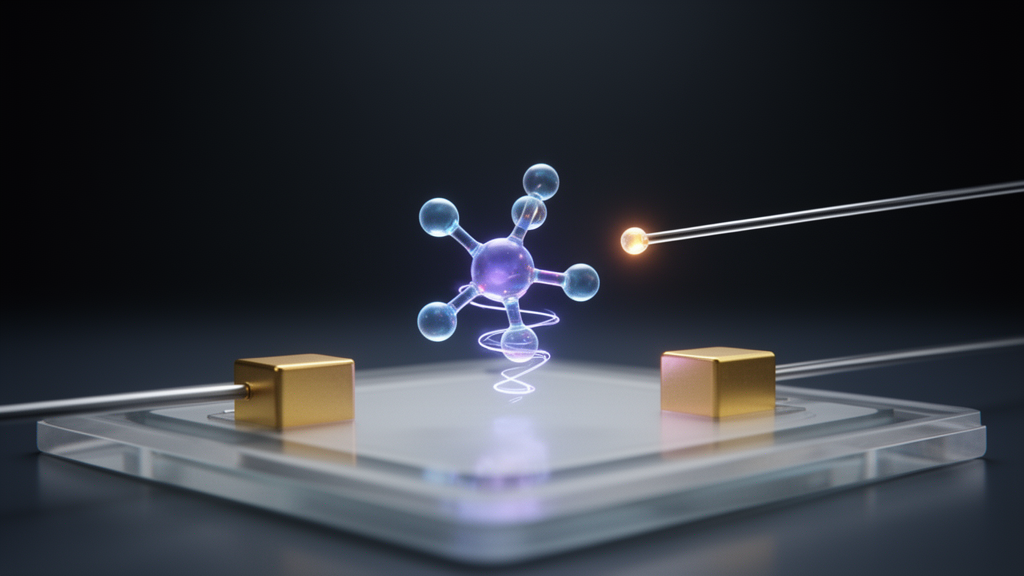
Physicists have long dreamed of linking the delicate quantum states of individual spins to particles of light, the raw currency of quantum networks. Now a team reporting in Nature has shown that a single molecule — a triplet ground-state carbene tucked inside a carefully matched host crystal — can do exactly that. The molecule combines bright fluorescence, spectral stability stretching beyond an hour, spin-selective optical transitions and single-molecule magnetic resonance, a combination that until now had not been demonstrated at the single-molecule level in a chemically designed system.
The work, led by researchers including Simon Roggors, Matthias Pfender, Philipp Neumann and Ilai Schwartz, positions molecular qubits as a credible platform for single-emitter quantum optics while preserving the appeal of bottom-up chemical synthesis. Solid-state atomic defects such as colour centres in diamond currently lead the field of spin–photon interfaces because of their inherent spin and optical coherence. But molecules offer something defects cannot: precise atomic control and consistent bottom-up assembly, which chemists can tune molecule by molecule.
The challenge has been that most molecular emitters fail on at least one of the key requirements. The new carbene molecule, embedded in a structurally matched host crystal, sidesteps this trade-off. At a temperature of 4.5 kelvin, the team measured narrow zero-phonon lines, spectral stability over more than an hour, and spin relaxation times in the tens of milliseconds — long enough, in quantum information terms, to be genuinely useful.
Coherent control of the single molecular spin was demonstrated with standard pulsed magnetic resonance techniques. Dynamical decoupling sequences extended the coherence time to the millisecond scale, and the researchers observed Rabi oscillations driven by microwaves delivered through a fine copper wire positioned across the crystal. Optically detected magnetic resonance — reading out the spin state through changes in fluorescence — worked at the level of a single molecule, a milestone that brings molecular systems into the same experimental regime as defect-based qubits.
The optical quality of the emitter was verified with photon correlation measurements. The second-order autocorrelation function showed strong anti-bunching, the signature of a true single-photon source, with a fitted value of g(2)(0) of 0.142 at zero delay, and the underlying value expected to be lower once instrumental timing jitter is accounted for. The fitted anti-bunching timescale of 28 nanoseconds matched the excited-state lifetime, indicating that the optical excitation was operating below saturation. A slower bunching component, with a timescale of about 245 nanoseconds, reflected spin polarization into a dark spin sublevel under resonant excitation of one particular optical transition.
That shelving into a dark state is not merely a nuisance; the team turned it into a tool. When resonant optical excitation on one transition parks the molecule in the dark spin state T0z, applying a resonant microwave pulse on a spin transition retrieves it, restoring continuous fluorescence. This microwave-assisted cycling strongly influences the achievable saturation count rate and underpinned several of the reported experiments, including the fluorescence excitation spectra and continuous-wave optically detected magnetic resonance measurements.
The experimental apparatus is a study in cryogenic precision. A custom-built confocal microscope operates with the sample mounted at approximately 4.5 kelvin inside a closed-cycle optical cryostat. The microscope objective sits at room temperature within the vacuum shroud, separated from the cold sample by a metal plate thermalized at 50 kelvin with a small aperture. A tunable dye laser covering 570 to 620 nanometres provides excitation, with off-resonant activation at 580 nanometres and resonant readout requiring only a few nanowatts of power. An acousto-optical modulator switches the laser on and off within tens of nanoseconds, and an electro-optical modulator provides the faster switching needed for lifetime measurements.
The chemistry behind the qubit is equally deliberate. Doped crystals were grown by solution-based crystallization under red light to avoid slow decomposition of the diazomethane precursor, and the resulting air-dried crystals remain stable in a freezer at minus 22 degrees Celsius for at least six months. A doped crystal of roughly one cubic millimetre, with a doping ratio of 25 parts per million, was selected for its optical flawlessness and mounted on the cryogenic cold finger. The crystal was oriented so that the transition dipole moment of the relevant optical transition lay within the polarization plane of the laser beam.
Computational modelling played a central role in understanding the spin physics. The team used multiscale ONIOM calculations on an 837-atom system derived from the experimental single-crystal structure, treating the carbene and its immediate surroundings with density functional theory while handling a second shell of matrix molecules with a semiempirical tight-binding method. Spin dynamics predictions came from state-averaged complete active space self-consistent field calculations corrected by perturbation theory, which predicted an oblate zero-field-splitting tensor in the ground triplet state and a prolate tensor in the excited state. The crystallographic data have been deposited with the Cambridge Structural Database under accession number 2542406.
The significance of the result lies in what it unlocks. A molecular platform that simultaneously delivers bright single-photon emission, hour-scale spectral stability and millisecond-scale spin coherence gives quantum engineers a new building block that can be synthesized, modified and incorporated into processable materials rather than grown into rigid crystals. For now, the demonstration establishes that a single molecule, designed atom by atom in a flask, can hold its own as a quantum node candidate — a prospect that could reshape how quantum networks are built.
Subject of Research: Single-molecule spin–photon interfaces based on carbene molecular qubits
Article Title: A single-molecule spin–photon interface
Article References: Roggors, S., Unden, T., Aubele, A., Mentzel, P., Bayer, G., Salhov, A., Scharpf, J., Plenio, M. B., Retzker, A., Jelezko, F., Eichhorn, T. R., Schaub, T. A., Pfender, M., Neumann, P., & Schwartz, I. (2026). A single-molecule spin–photon interface. Nature, 658(8138), 1153-1159. https://doi.org/10.1038/s41586-026-11147-6
Image Credits: AI Generated
DOI: 10.1038/s41586-026-11147-6
Keywords: molecular qubits, spin–photon interface, quantum networking, single-molecule spectroscopy, optically detected magnetic resonance, carbene, zero-phonon line, spin coherence, quantum optics, cryogenic microscopy, host crystal, single-photon emission
Cite Scienmag News
Katie Riggs. (October 28, 2026). Chemists build a working spin–photon interface from a single molecule. Scienmag. https://scienmag.com/chemists-build-a-working-spin-photon-interface-from-a-single-molecule/
Katie Riggs. "Chemists build a working spin–photon interface from a single molecule." Scienmag, 28 October 2026, https://scienmag.com/chemists-build-a-working-spin-photon-interface-from-a-single-molecule/. Accessed 1 November 2026.
Katie Riggs. "Chemists build a working spin–photon interface from a single molecule." Scienmag. October 28, 2026. https://scienmag.com/chemists-build-a-working-spin-photon-interface-from-a-single-molecule/