


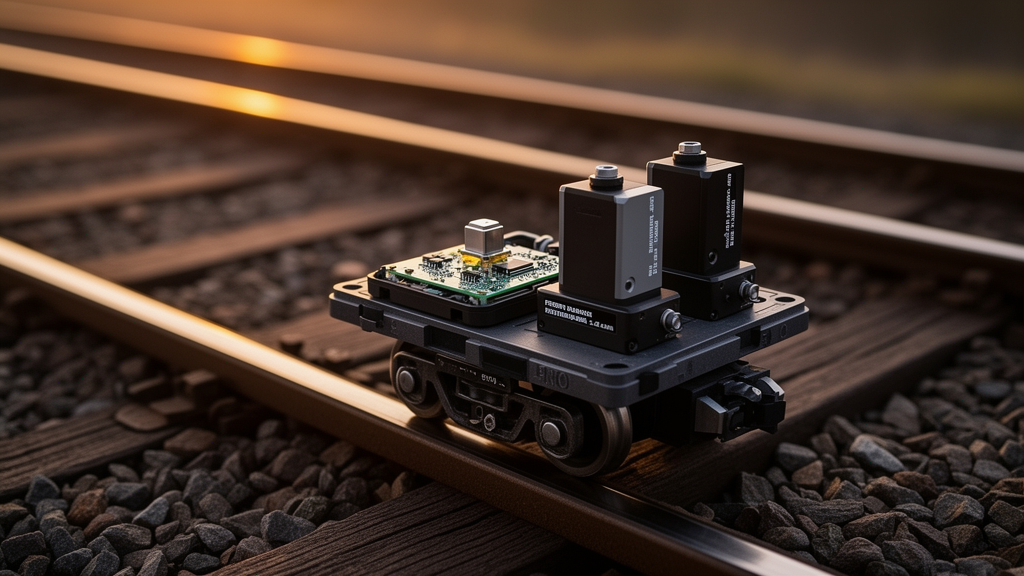
Onboard railway track inspection systems that combine 2D laser sensors with inertial measurement units (IMUs) mounted on in-service trains could deliver accurate measurements at lower cost, according to a study published in Scientific Reports. The research evaluated how the accuracy of dynamic track geometry inspection depends on the grade of the IMU used, and found that a tactical-grade unit, after constant bias calibration, has the potential to achieve measurement accuracies for gauge, cross level, and lateral and vertical irregularities comparable to those obtained with a more expensive navigation-grade IMU, satisfying the requirements of the relevant Chinese national standards.
Railway track irregularity inspection is critical for operational safety and ride comfort, but inspection time windows are becoming increasingly constrained, which has drawn attention to onboard systems mounted on in-service trains as a way to improve inspection efficiency. In such systems, IMUs integrated with laser sensors provide an effective solution for measuring track geometry dynamically, particularly when high-grade IMUs are available. The obstacle is economic: the high cost of high-grade IMUs limits large-scale deployment, which motivated the authors to test whether cheaper sensor grades could do the job.
The team assessed systems built around 2D laser sensors paired with IMUs of different grades, together with different processing schemes, under a semi-physical evaluation framework based on signal grafting. Within this framework and after constant bias calibration, the tactical-grade IMU combination reached accuracies for gauge, cross level, and lateral and vertical irregularities comparable to the navigation-grade benchmark and met the Chinese national standard requirements.
The picture changes for micro-electro-mechanical system (MEMS) IMUs, the lowest grade tested. When MEMS units were integrated with the same laser sensors, the accuracy of cross level measurement was found to be inherently constrained by the accuracy of attitude estimation. For the other track geometry parameters, however, acceptable measurement accuracy could still be maintained after removing constant biases and omitting attitude-based gravity compensation, a step that mitigates attitude-error amplification. The authors are explicit that this adjustment should be regarded as a trade-off that may reduce the waveform fidelity of the measured irregularity signals.
The authors frame these results as clarifying the achievable measurement capability of IMUs of different grades within the adopted semi-physical evaluation framework, and as providing practical guidance for the design of cost-effective onboard track irregularity inspection systems. Because the evaluation was conducted under this specific framework, the findings describe what these sensor combinations can attain under its conditions rather than a universal guarantee for every operating environment. Even with that caveat, the study maps out a clear engineering trade space: navigation-grade-level accuracy at tactical-grade cost, or broad but partial parameter coverage at MEMS-grade cost, with the choice between waveform fidelity and attitude-error mitigation left as an explicit design decision for system builders.
Subject of Research: Accuracy evaluation of bogie-mounted IMUs of different grades for onboard railway track irregularity inspection
Article Title: Accuracy evaluation of railway track irregularity inspection using bogie-mounted IMUs of different grades
Article References: Guan, Y., Li, H., Wang, H., Sheng, Y., Chai, J., & Chen, Q. (2026). Accuracy evaluation of railway track irregularity inspection using bogie-mounted IMUs of different grades. Scientific Reports. https://doi.org/10.1038/s41598-026-77713-0
Image Credits: AI Generated
DOI: 10.1038/s41598-026-77713-0
Keywords: railway track inspection, inertial measurement units, IMU grades, track geometry, MEMS sensors, onboard inspection, laser sensors, railway safety, tactical-grade IMU, navigation-grade IMU, cross level, signal grafting
Cite Scienmag News
Denise Maddox. (October 26, 2026). Cheaper inertial sensors could match high-end units for onboard railway track inspection. Scienmag. https://scienmag.com/cheaper-inertial-sensors-could-match-high-end-units-for-onboard-railway-track-inspection/
Denise Maddox. "Cheaper inertial sensors could match high-end units for onboard railway track inspection." Scienmag, 26 October 2026, https://scienmag.com/cheaper-inertial-sensors-could-match-high-end-units-for-onboard-railway-track-inspection/. Accessed 26 October 2026.
Denise Maddox. "Cheaper inertial sensors could match high-end units for onboard railway track inspection." Scienmag. October 26, 2026. https://scienmag.com/cheaper-inertial-sensors-could-match-high-end-units-for-onboard-railway-track-inspection/


