


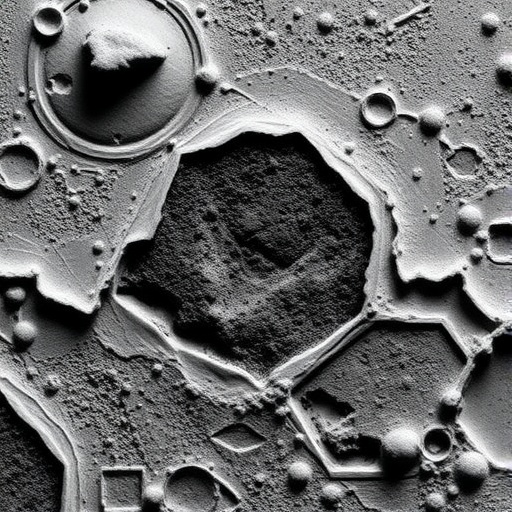
A groundbreaking discovery in lunar geology has emerged from a collaborative effort between researchers at the Institute of Geochemistry of the Chinese Academy of Sciences (IGCAS) and Shandong University. This research, which was published in the prestigious journal Science Advances on November 14, presents compelling evidence of the existence of crystalline hematite (α-Fe2O3) and maghemite (γ-Fe2O3) in lunar soil samples obtained during China’s Chang’e-6 mission. This mission focused its efforts on the South Pole–Aitken (SPA) Basin, an area characterized by its significant geological history and the potential for deep insights into lunar oxidation processes.
Historically, redox reactions have held a pivotal role in the formation and evolution of planetary bodies. However, previous studies indicated a reduction-centric perspective of the Moon’s geology, with multivalent iron primarily observed in ferrous (Fe2+) and metallic (Fe0) states. The prevailing assumption was that the lunar environment was not conducive to oxidation, leading scientists to conclude that the Moon maintained an overall reduced state. Despite these established ideas, recent advances in orbital remote sensing techniques have ignited curiosity regarding the potential for oxidized materials on the lunar surface, especially hematite detected in high-latitude regions.
The findings from the Chang’e-5 mission laid foundational work by identifying sub-micrometer magnetite (Fe3O4) and signs of Fe3+ in impact glasses, suggesting the existence of local oxidizing conditions resulting from impact events. This critical realization hinted at a complex interaction between impacts and lunar surface modification, fuelling debates about the presence of strongly oxidized minerals like hematite on the Moon. However, conclusive mineralogical evidence remained elusive for years, highlighting the need for focused investigations into the SPA Basin, a prime target for studying the Moon’s geological history.
The SPA Basin represents one of the largest and oldest impact basins in the Solar System, characterized by its unique geological features and complex impact history. The Chang’e-6 mission, launched in 2024, aimed to recapture lunar soil samples from this particular region to search for evidence of high oxidation substances formed by impactful events. The research team seized this opportunity to analyze the lunar soil, ultimately identifying micron-sized grains of hematite for the first time. Their investigative techniques included advanced methods such as electron microscopy, electron energy loss spectroscopy, and Raman spectroscopy, which confirmed the minerals’ crystalline structure and distinct characteristics, verifying that they are intrinsic to lunar geology.
The implications of this discovery extend beyond mere mineral identification. The research team proposed that the formation of hematite is intricately tied to major impact events that have shaped the lunar landscape throughout its history. The extraordinarily high temperatures produced during large impacts would have vaporized the surface materials, thereby creating a transient environment rich in oxygen that favored the oxidation of iron. As these surface materials vaporized, they were subjected to conditions that caused desulfurization of troilite, resulting in the release of iron ions, which were subsequently oxidized in this high-fugacity environment. The vapor-phase deposition of these iron oxides led to the formation of micron-sized crystalline hematite, coexisting with maghemite and magnetite.
Despite long-held views of the Moon as a reduced planetary body, this research introduces a nuanced understanding of oxidizing processes at play in its geological evolution. The discovery of hematite adds to the mounting evidence suggesting that localized environments of oxidation have existed on the Moon’s surface, phenomena that could illuminate the genesis of magnetic anomalies prevalent in various lunar regions, particularly the northwestern SPA Basin.
These findings not only challenge the conventional perspective of lunar geology but also enhance our understanding of the evolutionary history of lunar magnetic anomalies and the intricate details behind large impact events. By providing sample-based evidence of oxidized minerals like hematite, this research opens new avenues for exploring the mechanisms through which the Moon has evolved and transformed over billions of years.
The integration of advanced analytical techniques with empirical sample analysis presents a promising paradigm for future lunar exploration. As scientists continue to unravel the complexities of the Moon’s geological past, this study serves as a critical reference point for understanding the interplay between impact events, oxidation processes, and mineral evolution. The journey from sample collection to the revelation of hematite underscores the immense potential of lunar missions like Chang’e-6 to alter our understanding of celestial bodies and their development.
Looking forward, ongoing research and lunar exploration missions could soon elucidate further aspects of the Moon’s history and the intricate processes that have governed its geological identity. The insights gleaned from this study are bound to resonate within the scientific community, enriching discussions about the Moon’s redox conditions and providing essential context for future missions aimed at unraveling the enduring mysteries of our closest celestial neighbor.
This pivotal research underscores the importance of continuous exploration and examination of lunar materials to understand better the characteristics and conditions that define not only the Moon’s environment but also the broader mechanisms of planetary formation and evolution across our Solar System.
Keywords
Lunar geology, redox reactions, hematite, maghemite, Chang’e-6 mission, South Pole–Aitken Basin, planetary formation, extraterrestrial materials, lunar surface evolution.
Cite Scienmag News
Violet Maxwell. (November 15, 2025). Chang’e-6 Uncovers First Evidence of Impact-Formed Hematite and Maghemite on the Moon. Scienmag. https://scienmag.com/change-6-uncovers-first-evidence-of-impact-formed-hematite-and-maghemite-on-the-moon/
Violet Maxwell. "Chang’e-6 Uncovers First Evidence of Impact-Formed Hematite and Maghemite on the Moon." Scienmag, 15 November 2025, https://scienmag.com/change-6-uncovers-first-evidence-of-impact-formed-hematite-and-maghemite-on-the-moon/. Accessed 4 September 2026.
Violet Maxwell. "Chang’e-6 Uncovers First Evidence of Impact-Formed Hematite and Maghemite on the Moon." Scienmag. November 15, 2025. https://scienmag.com/change-6-uncovers-first-evidence-of-impact-formed-hematite-and-maghemite-on-the-moon/


