


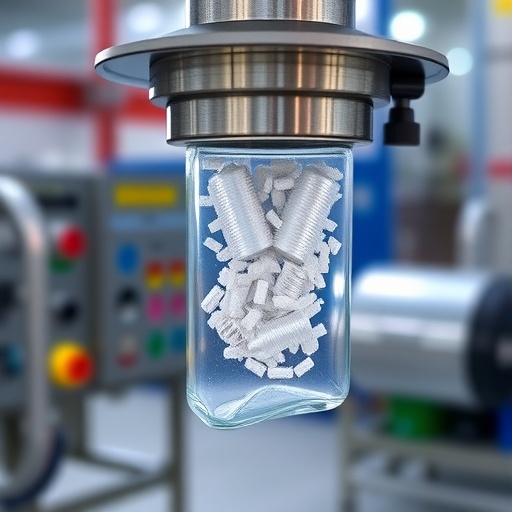
In the rapidly evolving landscape of advanced materials engineering, the manufacturing of highly filled polymers emerges as a compelling frontier that promises revolutionary impacts across diverse industries. These composite materials, characterized by the incorporation of substantial volumes of particulate or fibrous fillers within a polymer matrix, offer unprecedented mechanical, thermal, and functional properties. However, as the latest research illuminates, the journey from conceptualization to scalable production is laden with intricate challenges that require innovative solutions bridging material science, processing technology, and industrial manufacturing paradigms.
Highly filled polymers, by virtue of their composition, manifest unique complexities in their rheological behavior during processing. The presence of high filler loadings, often exceeding 50% by volume, significantly alters the flow dynamics, viscosity, and particulate dispersion characteristics of the polymer matrix. This fundamentally challenges conventional manufacturing techniques such as extrusion, injection molding, and additive manufacturing. For instance, the increased viscosity leads to higher shear stresses within processing equipment, necessitating advanced machinery capable of withstanding these conditions without compromising production throughput or energy efficiency.
Central to the manufacturing conundrum is the delicate balance between filler content and the resultant composite properties. While utilizing high filler loadings enhances stiffness, thermal conductivity, and wear resistance, it concurrently imposes constraints on the material’s processability and final structural integrity. Aggregation tendencies of fillers often result in inhomogeneous dispersion, threatening mechanical reliability and leading to anisotropic behavior in the end products. Addressing this, researchers have explored novel surface treatments and compatibilizers that improve filler-polymer interfacial adhesion, thereby ensuring uniform stress transfer and minimizing defects.
Another notable complication resides in the thermal management during processing. Highly filled polymers exhibit altered thermal conductivity and specific heat capacities, which critically influence cooling rates and crystallization behaviors. Rapid solidification or uneven cooling can induce internal stresses and warpage, deleteriously affecting dimensional accuracy and performance. Consequently, process parameters demand meticulous optimization, incorporating real-time monitoring and feedback control systems to mitigate these effects. Advanced simulation tools have shown promise in predicting material flow and thermal profiles, enabling designers to foresee manufacturability challenges proactively.
The design of processing equipment itself has undergone transformative enhancements driven by the unique demands of highly filled polymers. Conventional screw geometries and mold designs are insufficient for handling materials with dramatically altered rheological and thermal profiles. Innovations such as specialized screw elements, high-torque extruders, and adaptive mold temperature controls cater to these challenges. These tools not only sustain material integrity but also ensure energy-efficient processing, crucial for scaling up production without compromising sustainability goals.
In the context of industrial applications, highly filled polymers hold immense potential in sectors ranging from automotive to electronics, aerospace, and medical devices. For example, the enhanced thermal conductivity of such composites is invaluable in managing heat dissipation in electronic housings. Similarly, their elevated mechanical strength and reduced weight enable structural components with improved performance-to-weight ratios, pivotal for fuel efficiency in transportation. Realizing these opportunities depends on surmounting manufacturing barriers to achieve consistent, high-quality production at economically viable scales.
Material selection emerges as a pivotal factor in this landscape, as not all polymers are equally amenable to high filler concentrations. Thermoplastics with intrinsic toughness and flexibility tend to accommodate fillers better, but trade-offs in mechanical or thermal properties are often inevitable. Experimental investigations into novel polymer chemistries and hybrid matrix systems are underway to engineer materials tailored for optimal filler compatibility. Such innovations are poised to expand the functional window of highly filled composites, enabling applications previously deemed impractical.
From a sustainability viewpoint, highly filled polymers introduce intriguing possibilities and challenges. The fillers, often derived from naturally abundant minerals or recycled by-products, contribute to the circular economy by valorizing waste streams. However, the energy intensity associated with their processing and the end-of-life recyclability of highly filled composites remain areas necessitating further inquiry. Future advances in biodegradable polymers and filler technologies may reconcile performance demands with environmental imperatives, reshaping material life cycles drastically.
The characterization methodologies employed to analyze highly filled polymers have also evolved, reflecting the complexity of these materials. Techniques such as rheometry under high shear conditions, advanced microscopy including tomography, and thermal analysis adapted for heterogeneous systems provide insights into filler dispersion, orientation, and matrix interactions. These data feed into predictive models that inform process design and quality control, forming an integrated approach to materials engineering.
Furthermore, interdisciplinary collaboration plays a critical role in addressing the multifaceted challenges of manufacturing highly filled polymers. Material scientists, mechanical engineers, process technologists, and computational modelers converge to decode the interplay between filler characteristics, polymer behavior, and processing dynamics. This synergy accelerates the translation of laboratory innovations into industrial realities, fostering new standards and best practices in composite manufacturing.
Emerging technologies such as additive manufacturing (3D printing) add another dimension to this field. The ability to fabricate complex geometries with tailored filler distributions opens pathways to bespoke components with location-specific properties. Nonetheless, the intrinsic viscosity and flow-induced alignment constraints of highly filled polymers impose unique constraints on printability and structural consistency. Overcoming these hurdles demands specialized printer designs and feedstock formulations, areas currently under intensive research.
Economic considerations remain central to the widespread adoption of highly filled polymers. The cost implications of filler materials, processing adaptations, and quality assurance must align with the value added through enhanced properties. As manufacturing efficiency improves and supply chains mature, it is anticipated that the cost-performance ratio will become increasingly favorable. This economic viability is crucial for penetration into competitive markets and ensuring long-term industrial relevance.
In conclusion, the manufacturing of highly filled polymers stands at the nexus of opportunity and challenge. Its promise to deliver materials with exceptional properties is counterbalanced by the intricate technical hurdles inherent in processing and scale-up. The concerted efforts documented in recent research highlight a roadmap replete with innovations spanning material chemistry, process engineering, equipment design, and sustainability frameworks. As these endeavors coalesce, highly filled polymers are poised to redefine the material foundations of future technologies and products.
This unfolding narrative exemplifies the transformative potential of materials science when synergized with manufacturing expertise. The journey is complex and demands holistic approaches, yet the rewards—a new generation of high-performance composites reshaping myriad industries—are profound. Keeping pace with these advances will require continuous innovation, collaboration, and commitment to overcoming the nuanced challenges of highly filled polymer manufacturing.
Brettmann, B.K., Kalman, J., McCollum, J.M. et al. Challenges and opportunities in manufacturing highly filled polymers. npj Adv. Manuf. 2, 34 (2025). https://doi.org/10.1038/s44334-025-00046-9
Cite Scienmag News
Denise Maddox. (July 26, 2025). Challenges and Opportunities in High-Filled Polymer Manufacturing. Scienmag. https://scienmag.com/challenges-and-opportunities-in-high-filled-polymer-manufacturing/
Denise Maddox. "Challenges and Opportunities in High-Filled Polymer Manufacturing." Scienmag, 26 July 2025, https://scienmag.com/challenges-and-opportunities-in-high-filled-polymer-manufacturing/. Accessed 4 September 2026.
Denise Maddox. "Challenges and Opportunities in High-Filled Polymer Manufacturing." Scienmag. July 26, 2025. https://scienmag.com/challenges-and-opportunities-in-high-filled-polymer-manufacturing/


