

Friday, May 22, 2026
Science
No Result
View All Result
  • Login
  • HOME
  • SCIENCE NEWS
  • CONTACT US
  • HOME
  • SCIENCE NEWS
  • CONTACT US
No Result
View All Result
Scienmag
No Result
View All Result
Home Science News Chemistry

Cells putting on a face

April 12, 2024
in Chemistry
Reading Time: 3 mins read
0
Neural crest cells for good jaws
66
SHARES
599
VIEWS
Share on FacebookShare on Twitter
ADVERTISEMENT

Kyoto, Japan — Mother Nature is an artist, but her craft of creating animal faces requires more than a paintbrush and palette. Such highly complex shapes originate from their respective transient neural crest cells. 

Neural crest cells for good jaws

Credit: KyotoU/Mototsugu Eiraku and Yusuke Seto

Kyoto, Japan — Mother Nature is an artist, but her craft of creating animal faces requires more than a paintbrush and palette. Such highly complex shapes originate from their respective transient neural crest cells. 

These embryonic pluripotent cells within the facial primordium—the early development form—may be necessary for forming proper facial structures. However, analyzing the molecular mechanisms in such early stages of development poses many technical challenges.

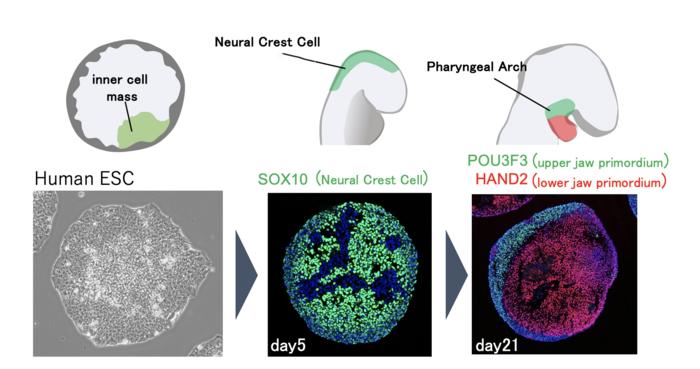
Now, a group of Kyoto University researchers have produced neural crest cell-rich aggregates from human pluripotent stem cells and developed a method to differentiate them in cell populations with a branchial arch-like gene expression pattern. 

“After the cell populations differentiate into precursors of maxillary and mandibular cells in response to external signalling factors, these populations spontaneously form patterns of the facial primordium,” explains Yusuke Seto of KyotoU’s Institute for Medical and Biological Research.

This cartilage-like structure, reminiscent of Meckel’s cartilage, is formed locally within the aggregates.

“We aim to establish a model for studying early facial development by using the properties of human pluripotent stem cells to generate in vitro tissue resembling the bronchial arch of the primordial face,” adds Ryoma Ogihara, also of the Institute.

Researchers are examining the various developmental processes that cause interspecific and individual differences in facial structure to explain conditions such as craniofacial disorders.

“Using our in vitro model could help us better understand and control signal integration during the fate determination of the branchial arch and cartilage formation in the face and elsewhere. We hope our technology can contribute to the development of cellular materials for new regenerative medicine,” adds Mototsugu Eiraku, also of the Institute.

###

The paper “In vitro induction of patterned branchial arch-like aggregate from human pluripotent stem cells” appeared on 14 February 2024 in Nature Communications, with doi: 10.1038/s41467-024-45285-0  

About Kyoto University
Kyoto University is one of Japan and Asia’s premier research institutions, founded in 1897 and responsible for producing numerous Nobel laureates and winners of other prestigious international prizes. A broad curriculum across the arts and sciences at undergraduate and graduate levels complements several research centers, facilities, and offices around Japan and the world. For more information, please see: 


Journal

Nature Communications

DOI

10.1038/s41467-024-45285-0

Method of Research

Experimental study

Subject of Research

Cells

Article Title

In vitro induction of patterned branchial arch-like aggregate from human pluripotent stem cells

Article Publication Date

14-Feb-2024

COI Statement

The authors declare no competing interests.

Share26Tweet17
Previous Post

University of Oklahoma engineer receives $3.1M grant for clean hydrogen technologies

Next Post

Softer tumours fuel more aggressive spread of triple-negative breast cancer

Related Posts

Scientists Achieve Breakthrough in Molecular ‘Sandwich’ Assembly — Chemistry
Chemistry

Scientists Achieve Breakthrough in Molecular ‘Sandwich’ Assembly

May 21, 2026
Advancing In Vivo and In Situ Monitoring: Science Bulletin Highlights Host-Based Antifouling Gold Nanotube Sensor for Selective Detection of Mechanically Sensitive Serotonin Release in Intestinal Mucosa — Chemistry
Chemistry

Advancing In Vivo and In Situ Monitoring: Science Bulletin Highlights Host-Based Antifouling Gold Nanotube Sensor for Selective Detection of Mechanically Sensitive Serotonin Release in Intestinal Mucosa

May 20, 2026
How Magnetic Orientation Could Influence the Building Blocks of Life — Chemistry
Chemistry

How Magnetic Orientation Could Influence the Building Blocks of Life

May 20, 2026
Breaking a 200-Year-Old Belief: Novel Surface Design Achieves Two Distinct Wetting States on One Substrate — Chemistry
Chemistry

Breaking a 200-Year-Old Belief: Novel Surface Design Achieves Two Distinct Wetting States on One Substrate

May 20, 2026
Unveiling Sound Waves: Scientists Discover Hidden Behaviors in Acoustic Phenomena — Chemistry
Chemistry

Unveiling Sound Waves: Scientists Discover Hidden Behaviors in Acoustic Phenomena

May 20, 2026
Thermal Imaging Uncovers Altermagnetic Domains in RuO2 for the First Time, Paving the Way for Advanced Spintronic Technologies — Chemistry
Chemistry

Thermal Imaging Uncovers Altermagnetic Domains in RuO2 for the First Time, Paving the Way for Advanced Spintronic Technologies

May 20, 2026
Next Post
Cancer cells gathering lipid droplets

Softer tumours fuel more aggressive spread of triple-negative breast cancer

  • Mothers who receive childcare support from maternal grandparents show more parental warmth, finds NTU Singapore study

    Mothers who receive childcare support from maternal grandparents show more parental warmth, finds NTU Singapore study

    27647 shares
    Share 11055 Tweet 6910
  • University of Seville Breaks 120-Year-Old Mystery, Revises a Key Einstein Concept

    1050 shares
    Share 420 Tweet 263
  • Bee body mass, pathogens and local climate influence heat tolerance

    679 shares
    Share 272 Tweet 170
  • Researchers record first-ever images and data of a shark experiencing a boat strike

    543 shares
    Share 217 Tweet 136
  • Groundbreaking Clinical Trial Reveals Lubiprostone Enhances Kidney Function

    528 shares
    Share 211 Tweet 132
Science

Embark on a thrilling journey of discovery with Scienmag.com—your ultimate source for cutting-edge breakthroughs. Immerse yourself in a world where curiosity knows no limits and tomorrow’s possibilities become today’s reality!

RECENT NEWS

  • Innovative Reusable Brick Walls Revolutionize Construction Industry
  • Nonlinear Atomic Tunneling Enhanced by Bright Squeezed Vacuum
  • Label-Free Super-Resolution Imaging of Live Cells
  • Genetic Insights from 619,372 Metabolic Profiles

Categories

  • Agriculture
  • Anthropology
  • Archaeology
  • Athmospheric
  • Biology
  • Biotechnology
  • Blog
  • Bussines
  • Cancer
  • Chemistry
  • Climate
  • Earth Science
  • Editorial Policy
  • Marine
  • Mathematics
  • Medicine
  • Pediatry
  • Policy
  • Psychology & Psychiatry
  • Science Education
  • Social Science
  • Space
  • Technology and Engineering

Subscribe to Blog via Email

Success! An email was just sent to confirm your subscription. Please find the email now and click 'Confirm Follow' to start subscribing.

Join 5,146 other subscribers

© 2025 Scienmag - Science Magazine

Welcome Back!

Login to your account below

Forgotten Password?

Retrieve your password

Please enter your username or email address to reset your password.

Log In
No Result
View All Result
  • HOME
  • SCIENCE NEWS
  • CONTACT US

© 2025 Scienmag - Science Magazine
