


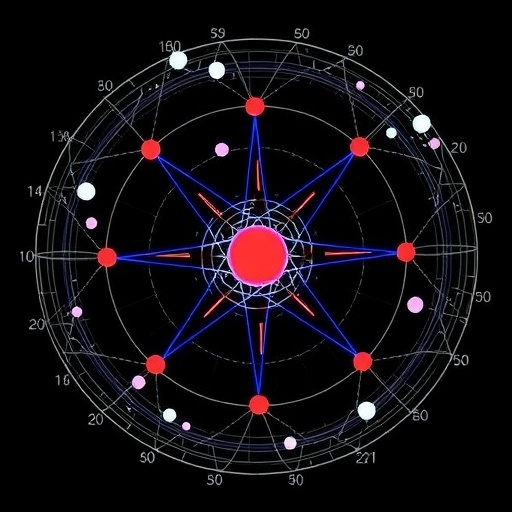
A theoretical study has proposed a new way to describe the simplest atom in nature, arguing that the electron in hydrogen may follow previously unconsidered trajectories within a causal, or “pilot-wave,” framework of quantum mechanics. The work does not report a new particle, a new measurement, or an experimentally observed violation of established atomic physics. Instead, it revisits the mathematical structure of the hydrogen atom and reinterprets the relationship between electron motion, angular momentum and the quantum potential. The authors say this approach produces new electron orbits while preserving the central quantum predictions that make hydrogen one of the most accurately understood systems in physics. The proposal is likely to attract attention because it tackles a question that has fascinated physicists for a century: whether quantum objects possess definite paths that exist beneath the probabilities calculated by conventional quantum theory.
The study, published in Foundations of Physics, develops a causal model building on earlier work by Chris Dewdney and Zia Malik, who used a similar framework to investigate angular-momentum measurements and the Einstein–Podolsky–Rosen, or EPR, experiment. The new paper, by P. N. Kaloyerou, M. Chiboli and M. Mukutulu, takes the formulae associated with that earlier model and interprets them differently. The result is a family of trajectories that the authors identify as new electron orbits. In the standard teaching model, an electron is often pictured as occupying a cloud-like orbital around the nucleus rather than circling it along a sharply defined track. That image reflects the rules of ordinary quantum mechanics, in which the square of a wavefunction gives the probability of finding the electron at a particular location. The causal interpretation explored in this study instead treats the electron as having a position and motion, guided by a wave-like quantum structure.
The distinction between an orbit and an orbital is crucial. In the planetary analogy, an orbit is a path through space, while an orbital is a mathematical description of the probability distribution associated with a quantum state. Hydrogen’s familiar 1s state, for example, is represented by a spherically symmetric wavefunction, meaning that measurements find the electron with equal probability in every direction at a given distance from the nucleus. Conventional quantum mechanics does not require the electron to be moving along a hidden classical path inside that distribution. In a Bohmian or de Broglie–Bohm-style description, however, the wavefunction contributes to a velocity field that guides the particle. The particle’s trajectory is not simply a miniature version of a planet’s orbit: it is determined by the wavefunction and by an additional term commonly called the quantum potential. This potential can produce behavior with no straightforward classical counterpart, including motion shaped by the global structure of the wavefunction.
The hydrogen atom provides an unusually demanding test for any causal interpretation because its energy levels and angular-momentum states are known with exceptional precision. A hydrogen atom consists of a positively charged proton and a negatively charged electron bound by the electromagnetic attraction between them. In the nonrelativistic approximation, its stationary states are obtained by solving the Schrödinger equation, which yields discrete energy levels. Those levels arise because only certain wave patterns remain self-consistent around the nucleus. The causal model does not discard this wave equation. Rather, it supplements the wave description with an account of how a particle might move under the influence of the wave and the quantum potential. According to the paper’s abstract, the authors develop the relationship between electron orbits, angular momentum and the quantum potential in detail, then use that relationship to derive trajectories that differ from the familiar pictures associated with earlier causal models.
Angular momentum is at the center of the proposal. In classical mechanics, angular momentum is the vector product of position and momentum, and a particle moving around a center generally sweeps out an orbit. In quantum mechanics, angular momentum is quantized: measurements yield specific values rather than an unlimited continuum, and the components of angular momentum obey noncommuting algebraic rules. This means that measuring one component, such as angular momentum along the z-axis, affects what can be said about the others. The study focuses on how those measurement results can be represented within a causal account. Rather than treating angular momentum solely as an abstract operator acting on a wavefunction, the authors examine how it can be connected to the geometry and dynamics of an electron trajectory. Their reinterpretation leads to orbit structures that are not identical to the paths generated by the earlier Dewdney–Malik treatment.
The quantum potential is the mechanism that makes such trajectories fundamentally different from classical paths. In causal quantum models, the wavefunction can be expressed in terms of an amplitude and a phase. Substituting that form into the Schrödinger equation separates the equation into a continuity equation, which describes the flow of probability, and a modified Hamilton–Jacobi equation, which resembles a classical equation of motion but contains an extra quantum-potential term. The quantum potential depends on the spatial curvature of the wavefunction’s amplitude. It is therefore not simply a force that weakens with distance in the same way as gravity or electrostatic attraction. It can redirect a particle even where the ordinary classical forces would suggest a different path, and it can encode information about the overall quantum state. In the hydrogen model presented by the researchers, this term is used to explain how the electron’s proposed motion remains compatible with the atom’s wavefunction and quantized angular momentum.
That compatibility is the most important claim—and also the point that requires the greatest care. A new trajectory in a causal interpretation is not automatically a new observable prediction. If two formulations produce the same probabilities for all possible measurements, they may differ in their underlying pictures while remaining experimentally equivalent. The source article describes the trajectories as new electron orbits, but its abstract does not report an experiment distinguishing them from standard quantum mechanics, nor does it announce a measured discrepancy in hydrogen spectroscopy. The work is therefore best understood as a foundational and mathematical investigation. It asks what kinds of motion can be consistently assigned to the electron when the quantum potential and angular momentum are treated in a particular way. Whether the proposed orbits lead to experimentally testable differences remains a separate question, one that would require explicit calculations of measurable quantities and carefully designed observations.
The connection to the EPR problem places the paper within a long-running debate over what quantum theory says about reality. The 1935 EPR argument challenged the completeness of quantum mechanics by highlighting correlations between separated systems. Decades later, Bohmian approaches offered a deterministic account in which particles possess definite properties, while the guiding wave can exhibit nonlocal behavior. The source article’s notes refer to this broader causal interpretation and to work on the causal interpretation of the electromagnetic field, in which the field—not individual photon particles—is treated as fundamental, despite retaining nonclassical properties such as nonlocality. The authors also distinguish their approach from interpretations of experiments in which reconstructed “photon trajectories” may instead represent flow lines of an electromagnetic field. These connections do not turn the hydrogen model into an EPR experiment, but they show why a seemingly narrow calculation about atomic orbits touches one of quantum physics’ deepest questions: whether the theory describes an objective process unfolding in space and time or only the outcomes of measurements.
The researchers report that no datasets were generated or analyzed, and the work relies on calculations and programming rather than a new laboratory apparatus. According to the author information, Kaloyerou wrote the article and carried out the calculations and programming, while Chiboli and Mukutulu independently repeated the calculations and programs as part of their postgraduate studies. That independent repetition is important for a result whose significance depends on the correctness of a chain of mathematical assumptions, definitions and numerical procedures. The paper includes ten figures and develops its model in detail, but the available article information does not provide an experimental validation or a direct comparison showing that the new orbits alter a measured hydrogen spectrum. The proposal’s eventual impact will depend on whether its trajectories merely provide an alternative visualization of known quantum states or generate distinctive, falsifiable consequences. For now, the study offers an intriguing reimagining of the atom: not a replacement for the successful quantum orbital, but a challenge to physicists to examine what may lie beneath the probability cloud.
Cite Scienmag News
Katie Riggs. (August 29, 2026). Causal Model Reveals New Electron Orbits in the Hydrogen Atom. Scienmag. https://scienmag.com/causal-model-reveals-new-electron-orbits-in-the-hydrogen-atom/
Katie Riggs. "Causal Model Reveals New Electron Orbits in the Hydrogen Atom." Scienmag, 29 August 2026, https://scienmag.com/causal-model-reveals-new-electron-orbits-in-the-hydrogen-atom/. Accessed 11 September 2026.
Katie Riggs. "Causal Model Reveals New Electron Orbits in the Hydrogen Atom." Scienmag. August 29, 2026. https://scienmag.com/causal-model-reveals-new-electron-orbits-in-the-hydrogen-atom/


