

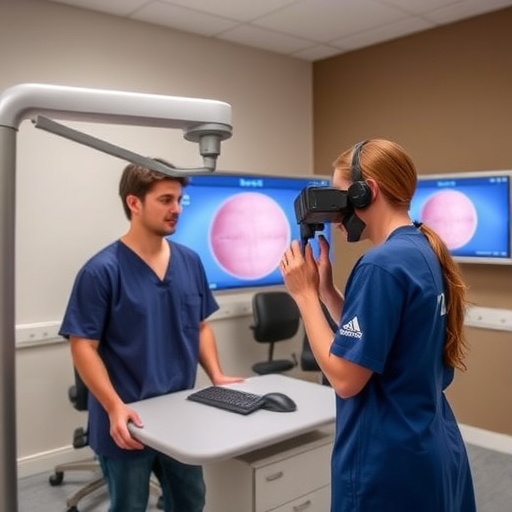
The realm of medical education has undergone significant transformations in recent years, particularly with the advent of advanced technologies that create new opportunities for learning and training. Among these innovations, virtual simulation systems are emerging as powerful tools for teaching complex medical procedures. A recent study, set to be published in 2025 in the journal BMC Medical Education, delves into the efficacy of a virtual simulation system specifically designed for cataract education targeted at medical undergraduates. Conducted by a team of researchers led by Zhang et al., this prospective quasi-experimental study seeks to determine how effective these virtual systems are in preparing future ophthalmologists.
Cataracts remain one of the leading causes of vision impairment and blindness worldwide, making thorough education in this area crucial for medical students who will eventually offer care to patients. The research highlights an increasing demand for effective training modules that not only enhance traditional learning but also provide hands-on experience in a safe, controlled environment. The study’s goal was to evaluate whether a virtual simulation system could be as effective, if not more so, than conventional teaching methods.
Virtual simulation systems utilize computer-generated environments to mimic real-life surgical scenarios, allowing students to practice skills without the risks associated with live patients. This innovative approach promises not only to bolster proficiency but also to boost the confidence of medical undergraduates as they prepare for real-world applications of their knowledge. The study initially set out to assess the technical aspects of the virtual system, including its usability and the degree to which it engages students.
To properly evaluate the virtual simulation system’s impact on cataract education, Zhang et al. engaged a diverse population of medical students. By incorporating a mix of first and second-year students, the study aimed to measure the system’s effectiveness across varying levels of familiarity with surgical concepts. A quasi-experimental design allowed researchers to track improvements in knowledge and skill retention, comparing data from students who used the virtual system with those who received traditional instruction.
After administering the virtual simulation system to a cohort of students, researchers implemented a battery of assessments to gauge outcomes. These included both theoretical knowledge tests and practical skill evaluations. The results indicated a striking improvement in student performance in those who utilized the virtual system. Not only did they demonstrate greater knowledge retention, but they also displayed a higher degree of competence in simulated surgical techniques.
Critical to the study was the feedback from the students themselves. Many reported that the interactive nature of the virtual simulation made learning more engaging and enjoyable, fostering a deeper interest in the subject matter. This subjective experience is just as important as quantitative scores, as it speaks to the long-term viability of educational interventions. The study also sought to identify any potential barriers to widespread implementation of such systems in medical education curricula.
Cost considerations, technology accessibility, and faculty training were among the constraints discussed by Zhang et al. The research team acknowledged that while virtual simulation systems show immense promise, their adoption in medical education could be slowed by these external factors. Nonetheless, the enthusiasm reported by students indicates a readiness for change in how cataract surgery education might be delivered in the future.
Furthermore, the study emphasizes the broader implications of integrating virtual reality into medical education beyond just cataract surgery. As technology continues to evolve, there is an opportunity to adapt these systems for various surgical specialties, enhancing the training landscape for medical students across disciplines. The scalability of virtual simulation systems could provide significant educational benefits, offering all students, regardless of geographic or socioeconomic barriers, access to cutting-edge learning tools that were previously confined to elite institutions.
As virtual simulation technology becomes increasingly sophisticated, it is anticipated that medical education will continue to embrace these innovations. The encouraging findings of the Zhang et al. study could serve as a catalyst for further research into the applications of virtual tools across multiple medical fields. The study’s results not only underline the significance of virtual simulations in cataract education but also mark a pivotal moment in the shift towards modernizing medical curricula.
As medical educators and institutions reflect on these findings, they must consider how such technologies align with the overall goals of medical training. The emphasis should be placed on not merely knowing medical information but ensuring that future physicians are equipped with the necessary practical skills to perform effectively in real-world scenarios where patients depend on them.
Ultimately, Zhang et al.’s insights contribute to a critical conversation on how to take full advantage of technological advances in the field of medical education. As we move forward into a more technologically integrated era, the positive implications of the study hold potential not only for medical education but also for enhancing health outcomes on a global scale.
Innovation in medical education through virtual simulation is paving the way for a future where medical graduates enter the workforce thoroughly prepared to handle the complexities of patient care. By continuing to push boundaries and explore the possibilities of technology in learning environments, institutions might ensure that the next generation of doctors is not just informed but exceptionally trained.
The findings of this research will undoubtedly inspire discussions among policymakers, educators, and technology developers about the future priorities in medical training. The successful integration of virtual simulations into medical education could ensure that students not only possess theoretical knowledge but also the practical skills essential for their practice.
In conclusion, Zhang et al.’s study on virtual simulation systems in cataract education encapsulates a significant step toward revolutionizing medical training. As this field evolves, continuous inquiry and research will be vital in ensuring that educational strategies keep pace with technological advancements and meet the needs of future healthcare practitioners.
Subject of Research: The effectiveness of a virtual simulation system in cataract education for medical undergraduates.
Article Title: Virtual simulation system in cataract education for medical undergraduates: a prospective quasi-experimental study.
Article References:
Zhang, Ml., Bai, W., Yan, Zp. et al. Virtual simulation system in cataract education for medical undergraduates: a prospective quasi-experimental study. BMC Med Educ (2025). https://doi.org/10.1186/s12909-025-08497-6
Image Credits: AI Generated
DOI: 10.1186/s12909-025-08497-6
Keywords: virtual simulation, cataract education, medical undergraduates, quasi-experimental study, medical training.


