


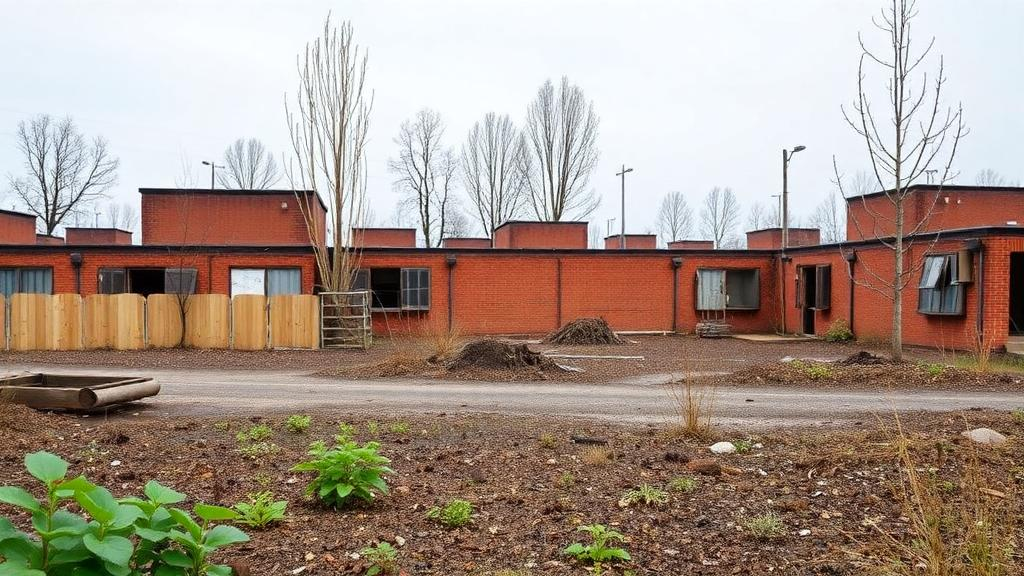
A peer-reviewed case study identifies five types of “war brownfields” and proposes site-specific regeneration strategies that account for security, environmental damage, heritage, recovery potential and emotional effects. The research, published in Landscape Architecture and Sustainability, rejects the idea that every war-affected landscape is primarily a contaminated site requiring a uniform cleanup response. Instead, it classifies places according to their dominant wartime legacy: remnant military fortifications, craters, ammunition-contaminated sites, radioactively contaminated sites, and military storage and toxic-contamination sites.
These categories can occur in cities, agricultural land, forests, industrial areas and natural ecosystems. The proposed classification broadens the interpretation of post-war landscapes beyond physical destruction and contamination. A surviving fortification may be an architectural artifact, cultural landscape and historical resource as well as a place that could be unsafe to enter.
By contrast, unexploded ammunition makes clearance and risk management prerequisites for redevelopment. Radioactive contamination can require long-term restrictions on human access and land use. The classification therefore depends on the principal legacy produced by warfare rather than the site’s present function, allowing two areas used for similar purposes to fall into different categories if their war-related characteristics differ.
Based on these distinctions, the researchers developed a decision-making framework built around five considerations: security risk, environmental consequences, heritage value, regeneration potential, and emotional or psychological impact. The framework connects landscape architecture with environmental management and heritage conservation, treating regeneration as a site-specific assessment rather than a single technical process. Security may dominate the initial planning of an ammunition-contaminated area, while cultural significance may be central to the future of a former fortification.
Potential applications differ accordingly. Fortifications judged to have strong heritage value could be considered for reuse as museums, memorial parks or educational spaces. Crater landscapes may support ecological restoration, wetland development or other uses where their physical and environmental conditions allow.
Sites containing unexploded ammunition would require clearance and risk management before redevelopment, while radioactively contaminated areas may remain under sustained access and land-use restrictions. The authors also emphasize that different forms of war legacy can coexist within one location. A single site might combine a historic defensive structure, contaminated soil, unexploded ordnance and memories or psychological effects associated with conflict, requiring a tailored combination of measures rather than selection from a single category.
The study presents a conceptual basis for moving war-affected sites from prolonged abandonment or restricted use toward more sustainable forms of recovery. Its contribution is a classification and decision framework, not evidence that a common intervention has been tested across all five types or that any particular reuse will produce uniform environmental, economic or social benefits. The available research description identifies the work as a case study but does not state the number or geographic range of the cases, the period covered, or whether the framework has been independently validated.
The proposed strategies should consequently be understood as planning options that require assessment of local conditions, including safety and contamination risks, rather than as demonstrated outcomes or a universal redevelopment model.
Subject of Research: Classification and regeneration strategies for war brownfields
Article Title: War leaves five types of contaminated landscapes with different paths to recovery
Article References: War leaves five types of contaminated landscapes with different paths to recovery. Original publication (Bibliographic details unavailable.)
Image Credits: AI Generated
DOI: Not provided
Keywords: war brownfields, landscape architecture, post-conflict recovery, land regeneration, unexploded ammunition, radioactive contamination, military fortifications, heritage conservation, ecological restoration, environmental management, leaves, five
Cite Scienmag News
Russell Cooper. (October 21, 2026). Case study classifies five war-brownfield types and links them to tailored regeneration. Scienmag. https://scienmag.com/case-study-classifies-five-war-brownfield-types-and-links-them-to-tailored-regeneration/
Russell Cooper. "Case study classifies five war-brownfield types and links them to tailored regeneration." Scienmag, 21 October 2026, https://scienmag.com/case-study-classifies-five-war-brownfield-types-and-links-them-to-tailored-regeneration/. Accessed 21 October 2026.
Russell Cooper. "Case study classifies five war-brownfield types and links them to tailored regeneration." Scienmag. October 21, 2026. https://scienmag.com/case-study-classifies-five-war-brownfield-types-and-links-them-to-tailored-regeneration/


