


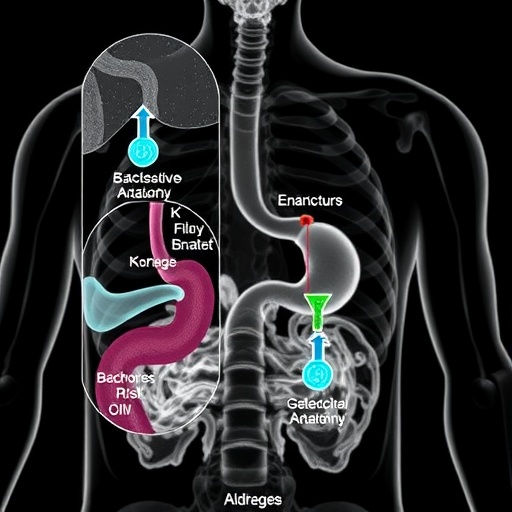
The recent advancements in artificial intelligence (AI) and deep learning continue to resonate through various fields, particularly in medical imaging. A groundbreaking study conducted by a team of researchers spearheaded by Tan et al. presents a novel methodology known as SIG-CFFNet—an acronym for Structural Information-Guided Cascaded Feature Fusion Network. The researchers’ objective was to enhance the classification of gastrointestinal anatomy through innovative imaging techniques and advanced neural network architectures. This pioneering work marks a significant leap forward in the domain of biomedical engineering and introduces an effective tool for improving diagnostic procedures involving gastrointestinal ailments.
In the realm of gastrointestinal anatomy, accurate classification is crucial for effective diagnosis and treatment planning. The traditional methods employed in fabricating and analyzing such comprehensive datasets often face significant challenges, including inter-class variation and the complex structure of the gastrointestinal tract itself. The introduction of SIG-CFFNet presents a robust solution by leveraging structural information as a guiding mechanism. The framework focuses on consistently enhancing the quality of feature extraction from various imaging modalities through cascaded processes, thereby achieving a higher level of classification accuracy.
At the heart of SIG-CFFNet is its unique architecture, intertwining the concepts of feature fusion and structural guidance. This special configuration allows the model to effectively utilize multi-scale features of the anatomical structures from input images. The cascading feature fusion approach aggregates essential information at different levels, thus maximizing the utilization of learned representations. By integrating contextual information into the classification process, the researchers have significantly improved the interpretability of the results, leading to better insights and understanding of the underlying anatomical landmarks.
The success of the research was substantially bolstered by rigorous training and validation phases, wherein the model was subjected to numerous datasets of gastrointestinal images, encompassing a wide array of anatomical variations. The dataset comprised both synthetic and real clinical images, providing a balanced foundation for training the neural network. Enhanced data augmentation techniques were also applied, which not only enriched the training data but also improved the model’s resilience against overfitting—an issue common in deep learning models when confronted with limited data.
The results presented by the authors indicate that SIG-CFFNet outperformed several existing models in terms of classification accuracy and speed. Benchmarked against conventional convolutional neural networks and state-of-the-art methods, SIG-CFFNet demonstrated superior efficacy—particularly in cases with complex anatomical structures where even minute variations could lead to erroneous classifications. This performance is largely attributed to the model’s ability to intelligently fuse relevant features through its guided mechanism, which significantly amplifies its capability to differentiate between closely related anatomical classes.
Moreover, the findings underscore the potential implications of deploying SIG-CFFNet in clinical settings. By offering enhanced visualization and classification of gastrointestinal anatomy, this methodology could facilitate more accurate diagnoses, potentially leading to improved patient outcomes. Health professionals, particularly radiologists and gastroenterologists, could benefit immensely from incorporating such advanced AI tools into their workflow, as these tools promise to reduce human error and improve diagnostic precision.
Another significant aspect of this research is its intention to bridge technological advancements with clinical applicability. By focusing on the usability of the developed model, the authors have engaged with healthcare stakeholders throughout the developmental process. Feedback from practitioners was integral in refining the model’s performance and ensuring that it meets clinical demands. Such collaboration between technology developers and healthcare professionals highlights a progressive paradigm towards integrating AI solutions in medicine.
One must also consider the ethical dimensions associated with deploying AI technologies in healthcare settings. The authors of the study cautiously recognize the importance of transparency in AI decision-making processes and advocate for the necessity of interpretability. The deployment of AI tools in a sensitive domain such as healthcare necessitates thorough understanding and demonstrations of accountability, particularly in high-stakes scenarios. As SIG-CFFNet continues to evolve, ongoing discussions around ethical AI use will become increasingly vital.
As the study stands at the intersection of art, science, and technology, it catalyzes a broader discussion regarding the future of medical imaging. Significant investments in AI-driven technologies are poised to reshape practices in medical diagnostics, potentially leading to more personalized and effective treatments for patients. The agile adaptability evidenced by models like SIG-CFFNet indicates that the healthcare landscape will continue to evolve rapidly, supported by the power of machine learning algorithms and advanced imaging techniques.
What’s more, the insights and methodologies presented in this research may serve as a foundation for subsequent innovations in biomedical engineering. Researchers and technologists could utilize the architecture of SIG-CFFNet as a benchmark, paving the way for future studies that extend beyond gastrointestinal anatomy. The implications of this work signal exciting prospects, inviting other disciplines within medical imaging to explore similar pathways for enhancing their diagnostic frameworks.
As discussions surrounding artificial intelligence’s role in healthcare gain momentum, the work of Tan et al. raises critical questions about the balance between human expertise and automated systems. As machines begin to take on more complex tasks traditionally performed by healthcare professionals, society must remain vigilant in addressing potential challenges while celebrating the advancements made. This includes fostering an environment of continuous learning and adaptation as we navigate through this transformative era.
In summary, the introduction of SIG-CFFNet represents an important milestone in the application of deep learning to biomedical engineering, specifically in gastrointestinal anatomy classification. This innovative approach not only showcases the effective integration of structural information but also demonstrates the power of cascaded feature fusion techniques. The study positions itself as a significant contributor to both scientific literature and clinical practice, heralding a new age of accuracy and efficiency in diagnostic imaging.
The future of gastrointestinal diagnostics may well be shaped by these emerging technologies, and SIG-CFFNet stands at the forefront of this revolution. As we begin to realize the full potential of integrating advanced technologies in healthcare, continuous exploration, and validation will be instrumental in overcoming existing barriers and realizing a vision of enhanced, AI-driven patient care.
Tan, X., Gong, X., Fan, L. et al. SIG-CFFNet: Structural Information-Guided Cascaded Feature Fusion Network for Gastrointestinal Anatomy Classification.
Ann Biomed Eng (2025). https://doi.org/10.1007/s10439-025-03920-x
Cite Scienmag News
Ophelia Keating. (November 29, 2025). Cascaded Network Transforms Gastrointestinal Anatomy Classification. Scienmag. https://scienmag.com/cascaded-network-transforms-gastrointestinal-anatomy-classification/
Ophelia Keating. "Cascaded Network Transforms Gastrointestinal Anatomy Classification." Scienmag, 29 November 2025, https://scienmag.com/cascaded-network-transforms-gastrointestinal-anatomy-classification/. Accessed 3 September 2026.
Ophelia Keating. "Cascaded Network Transforms Gastrointestinal Anatomy Classification." Scienmag. November 29, 2025. https://scienmag.com/cascaded-network-transforms-gastrointestinal-anatomy-classification/


