

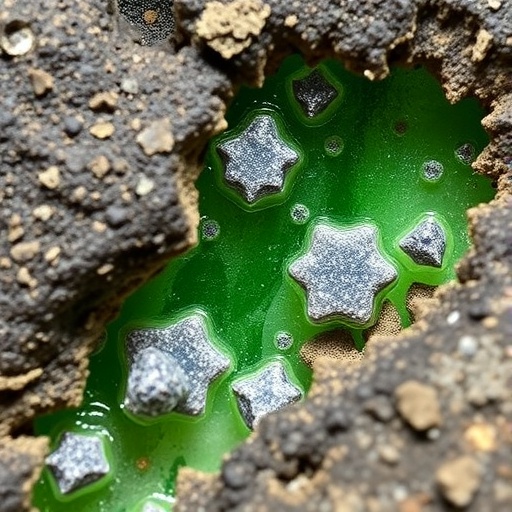
In the relentless quest to understand Earth’s deep carbon cycle, a groundbreaking discovery has emerged from the collective efforts of geoscientists led by Carter, E.J., O’Driscoll, B., and Burgess, R. Their recent work, published in Nature Communications in 2026, uncovers an enigmatic reservoir lurking deep within Earth’s mantle: carbonated mantle peridotites. This revelation not only challenges existing paradigms in geosciences but also reshapes our understanding of how carbon dioxide (CO₂) behaves during subduction and its eventual sequestration deep beneath the crust. Unraveling the mysteries of this hidden carbon sink may fundamentally impact climate models and future predictions of carbon fluxes within the Earth system.
At the heart of this discovery lies the complex mineralogy of the Earth’s upper mantle, specifically the peridotite rock that dominates this region. Peridotite is primarily composed of olivine, pyroxenes, and other silicate minerals that traditionally have been understood as relatively poor in carbon storage. However, the team’s intensive geochemical analyses reveal that when these mantle rocks interact with descending slabs of oceanic crust, rich in carbonate minerals, they undergo a remarkable process called carbonation. This involves the transformation of portions of the mantle into carbonated peridotites, essentially locking away CO₂ in stable mineral phases at depths previously underestimated.
The subduction zones, where oceanic plates plunge beneath continental or other oceanic plates, act as immense conduits transporting surface materials, including carbon-rich sediments, from the crust into Earth’s depths. Conventional wisdom has emphasized the potential release of CO₂ through volcanic activity and metamorphic degassing as slabs melt or dehydrate. However, Carter and colleagues’ research presents compelling evidence that far more carbon than anticipated may remain immobilized within the mantle not as free gas but chemically bound within carbonated peridotites. This revision introduces a hidden reservoir that could sequester carbon for millions of years, significantly influencing long-term carbon budgets.
Methodologically, the study leverages state-of-the-art petrological experiments combined with in situ isotopic and spectroscopic analyses. By replicating the extreme pressures and temperatures characteristic of subduction zone depths, the researchers simulated interactions between carbonated fluids and mantle peridotite. Mineralogical transformations were meticulously documented via synchrotron X-ray diffraction and advanced electron microscopy, revealing the formation of stable carbonate minerals such as magnesite and dolomite embedded within a modified peridotite matrix. These experimental results echo observations from natural samples collected from subduction-related mantle xenoliths, bridging experimental petrology with field geology.
Beyond its petrological significance, the identification of carbonated peridotites as a substantial carbon reservoir introduces important ramifications for global carbon cycling. Subduction is a key mechanism by which Earth recycles volatiles, including greenhouse gases, between the surface and interior. If carbon is being effectively trapped in the mantle, then the volatile fluxes emitted via arc volcanism may represent only a fraction of the total carbon delivered by subducting slabs. This could imply that Earth’s deep carbon storage capacity is greater than previously thought, thereby modulating atmospheric CO₂ levels over geological timescales and influencing climate regulation.
Furthermore, this research may compel a re-examination of the chemical evolution and thermal structure of Earth’s interior. The presence of carbonated phases within the mantle affects physical properties including density, viscosity, and melting behavior. Carbonates reduce the melting temperature of mantle rocks, potentially promoting localized zones of partial melt that influence magma genesis and volcanic activity. Such carbonated domains could also impact seismic wave velocities, providing new interpretive frameworks for geophysical imaging studies aiming to map compositionally distinct mantle regions.
The implications ripple into the field of mineral physics and geodynamics as well. Carbonated peridotites exemplify how carbon’s geochemical pathways transcend simple surface-atmosphere exchanges, cascading into the solid Earth’s architecture. The durability of these carbonated phases under mantle conditions invites fresh questions on how stable or dynamic these reservoirs may be through mantle convection cycles. Could tectonic forces eventually release trapped carbon? Do carbonated peridotite domains contribute to plume chemistry emerging at hotspot volcanism? Addressing these questions could illuminate the fate of deep-seated carbon as Earth continues to evolve.
On a practical scale, insights gleaned from this study may influence approaches toward carbon sequestration technologies. Nature’s ability to chemically bind CO₂ and lock it within stable mantle minerals serves as a compelling paradigm for engineered carbon capture and storage (CCS). Understanding the physicochemical conditions that enable such mineral carbonation at depth can inform novel strategies that mimic these natural processes at accessible depths or in artificial geothermal settings, potentially enhancing efforts to curb atmospheric greenhouse gas concentrations.
In addition, this newfound reservoir challenges the simplistic conceptions of the mantle being a passive medium in global biogeochemical cycles. Instead, it asserts the mantle’s active role as a dynamic participant in controlling Earth’s carbon balance. The interplay between subduction-driven carbon influx and mantle storage capacity underscores the complexity of Earth’s self-regulating systems. By elucidating mechanisms of deep carbon sequestration, the study redefines the mantle from a mere repository of inert rock to a chemically vibrant environment mediating carbon fluxes over eons.
The study further highlights the necessity of interdisciplinary approaches incorporating geochemistry, mineralogy, tectonics, and climate science. Only by integrating geochemical data with geophysical observations and numerical models can the role of carbonated peridotites in Earth’s carbon budget be fully quantified. This work thus sets the stage for collaborative advances bridging Earth sciences and environmental concerns, ultimately enriching our understanding of Earth’s sustainability and resilience.
Amidst escalating concerns over anthropogenic climate change, such fundamental research provides crucial context. If Earth’s interior can trap and store large volumes of carbon subducted from the surface, it offers hope that natural processes may buffer some extent of atmospheric CO₂ perturbations over geological periods. Nevertheless, the balance between carbon sequestration and release remains delicate and sensitive to tectonic and mantle dynamics, underlining the importance of carefully delineating these processes before extrapolating to climate mitigation strategies.
Looking ahead, the team anticipates expanding investigations into the spatial distribution and volumetric significance of carbonated mantle domains globally. Advancements in seismic tomography and geochemical fingerprinting promise to detect these reservoirs with greater precision. Moreover, experimental studies at even higher pressures corresponding to the lower mantle may reveal whether similar carbonation processes extend deeper, potentially identifying a vast, yet untapped, carbon storehouse.
Ultimately, this pioneering research by Carter, O’Driscoll, Burgess, and colleagues redefines our conception of Earth’s carbon cycle, unveiling a hidden mantle reservoir capable of significant long-term carbon storage. It invites the scientific community to reimagine subduction zones not merely as sites of material recycling and volatile release but as complex arenas where carbon’s subterranean fate is written in mineralogical and geochemical codes. Such insights deepen our grasp of Earth’s inner workings and reinforce the intricate connections between deep Earth processes and surface environmental change.
As further studies build upon these findings, the prospect of unraveling the full implications of carbonated mantle peridotites holds exciting promise for Earth sciences and climate research alike. This discovery reminds us that beneath the surface of our familiar planet, profound secrets await, with the power to shape the very chemistry of our atmosphere and the future trajectory of Earth’s climate system.
Subject of Research:
Deep carbon cycle, subduction zone geochemistry, mantle petrology, carbon sequestration in mantle peridotites.
Article Title:
Carbonated mantle peridotites represent a hidden sink for subducted CO₂.
Article References:
Carter, E.J., O’Driscoll, B., Burgess, R. et al. Carbonated mantle peridotites represent a hidden sink for subducted CO₂. Nat Commun (2026). https://doi.org/10.1038/s41467-026-68646-3
Image Credits:
AI Generated


