

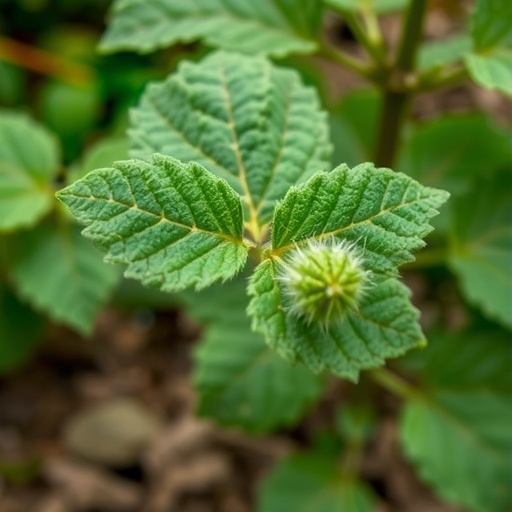
In a groundbreaking study recently published in the prestigious journal New Phytologist, researchers have unveiled a paradigm-shifting aspect of plant nutrition: the acquisition of essential nutrients directly from atmospheric dust deposited on foliage. Traditionally, plant nutrition science has focused predominantly on nutrient uptake from soil substrates through root systems. However, this new research elucidates the significant role of foliar uptake, where nutrient-rich dust settles on leaves, dissolves in the leaf surface moisture, and becomes bioavailable to plants.
This multidisciplinary study, conducted in a Mediterranean ecosystem, simulated natural dust deposition events to observe how atmospheric particles influence nutrient concentrations within plant tissues. Researchers found that when dust particles, loaded with macro- and micronutrients such as phosphorus and iron, settled on the leaves, these elements were rapidly solubilized by the mildly acidic leaf surface microenvironment. This solubilization facilitated direct absorption through the leaf cuticle and stomata, effectively bypassing soil-mediated nutrient pathways.
The implications of these findings challenge entrenched views in plant ecology and physiology. Traditionally, soils have been seen as the primary, if not exclusive, source of nutrients for plant growth and metabolism. However, this study positions the plant canopy itself as an active interface for nutrient uptake from the atmosphere, suggesting an alternative or complementary nutritional route. Particularly in ecosystems with nutrient-poor soils or where soil nutrient availability fluctuates seasonally, the significance of foliar nutrient acquisition from atmospheric dust may be profound.
Quantitative analyses integrated field observations with dust deposition rates and soil nutrient datasets from diverse biogeographical regions. The results revealed that during dust storm events or periods of increased atmospheric particulate matter flux, the nutrient input to plants via foliar pathways could rival or even surpass the nutrient uptake from the soil. This phenomenon underscores atmospheric dust as a potentially underappreciated global vector for nutrient cycling, with ecosystem-wide consequences.
Researchers also highlighted that leaves, due to their biochemical and structural properties, provide a conducive interface for capturing and processing dust particles. The leaf surface typically maintains a mildly acidic pH, a condition which promotes the dissolution of mineral elements embedded in dust. This acidity, coupled with leaf surface moisture and the presence of extracellular enzymes, accelerates the conversion of insoluble mineral forms into ionic species that plants can assimilate.
The team conducted controlled experiments alongside in situ field trials to validate their hypotheses. By artificially applying dust mimicking natural deposition events onto plant foliage, they were able to monitor nutrient uptake dynamics using advanced spectroscopic and isotopic tracing techniques. These methods confirmed the translocation of atmospheric-derived nutrients from the leaf surface into internal plant tissues, substantiating the physiological relevance of foliar nutrient absorption.
This newly elucidated foliar pathway carries important ramifications, especially in the context of global climate change and desertification. As dust storm frequency and intensity are modulated by changing climate patterns, the flux of airborne mineral particles could alter nutrient availability landscapes, potentially offsetting nutrient limitations in some terrestrial ecosystems. Such a mechanism may also influence plant community compositions and productivity, contributing to resilience against soil degradation.
Furthermore, the research sheds light on yet another intricate aspect of plant-environment interactions. By acting as active ‘filters’ or ‘sinks’ for atmospheric dust, plant canopies not only enhance their nutrient budgets but also participate in biogeochemical cycling processes at scales ranging from local to global. This dual role positions plants as integral mediators between the lithosphere, atmosphere, and biosphere.
The collaborative effort was led by Anton Lokshin, a postdoctoral researcher at Ben-Gurion University of the Negev, Israel, with contributions from experts across multiple institutions, including Ariel University, Tel Aviv University, Bar Ilan University, and the International Institute for Applied Systems Analysis (IIASA). Their collective expertise in plant physiology, ecology, soil science, and atmospheric chemistry allowed for a comprehensive examination of this novel nutrient acquisition pathway.
This discovery aligns with a growing body of literature recognizing the complexity of nutrient cycling mechanisms beyond root absorption and soil chemistry. It invites a reassessment of nutrient budgeting models in plant ecology and suggests that atmospheric inputs via foliar uptake should be incorporated for more accurate predictions of ecosystem productivity and sustainability.
As the global scientific community continues to explore the nuances of plant-nutrient interactions, findings such as these emphasize the importance of considering multifaceted environmental inputs. Atmospheric dust, once primarily regarded as a vector of pollutants or abiotic stressors, now emerges as a critical component in nutrient dynamics, with the potential to transform our understanding of plant nutrition under varying environmental conditions.
In closing, the research presented in New Phytologist represents a seminal advancement that expands the conceptual framework of plant nutrient acquisition. It opens new avenues for future studies investigating the ecological significance of foliar nutrient uptake across diverse climates and biomes, and its potential applications in enhancing agricultural productivity and ecosystem management amid global environmental change.
Subject of Research: Plant nutrient acquisition from atmospheric dust via foliar uptake
Article Title: Atmospheric dust is a global nutrient source for plants via foliar uptake
News Publication Date: 8-Apr-2026
Web References:
- New Phytologist journal: https://nph.onlinelibrary.wiley.com/journal/14698137
- DOI link: http://dx.doi.org/10.1111/nph.71112
Keywords: Plant sciences, Plant physiology, Plants, Horticulture, Climate change


