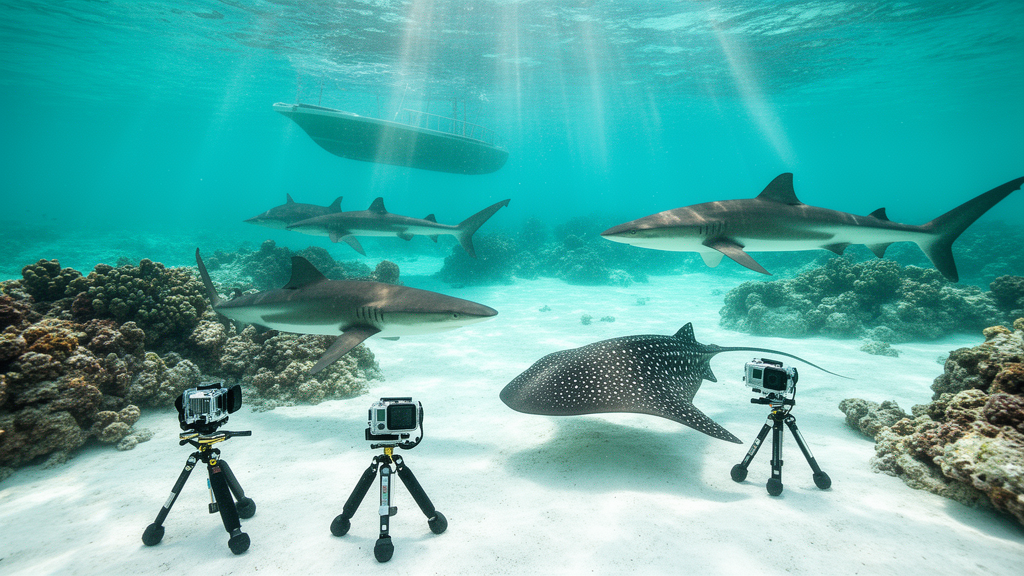
An oceanic atoll in the southern Maldives has been revealed as a refuge for sharks and rays, according to the first quantitative study of its elasmobranch populations. Researchers used remote timelapse cameras at three shallow forereef sites around Fuvahmulah Atoll, a highly exposed oceanic atoll recently designated a UNESCO Biosphere Reserve partly for its extraordinary marine megafauna, to quantify daylight sightings between March and August 2022.
The team analyzed 1,629,756 images and found elasmobranchs were sighted almost every day, appearing on 95 percent of the 60 survey days and during 72 percent of the 550 hours sampled. In total, the cameras recorded four ray species and seven shark species. Whitetip reef sharks were the most consistently present, seen in 327 hours across 56 days, while pelagic thresher sharks appeared in the most images, 27,447, reflecting the long periods this species spent at one site known to be a cleaning station.
The study documented significant differences in species’ occurrences, relative abundances measured as MaxN, and frequency of occurrence across the daily cycle, among sites, and between seasons. The highest shark sighting rates overall, and specifically for grey reef, whitetip reef, and tiger sharks, were observed within the Farikede marine protected area, for which management plans are currently in development.
The findings underscore the importance of Fuvahmulah Atoll and of protected areas for ensuring the persistence of these oceanic and reef-associated megafauna, which have experienced widespread declines in the Indian Ocean and globally despite their ecological and socioeconomic importance.
Subject of Research: Camera-based survey of shark and ray populations at Fuvahmulah Atoll in the southern Maldives
Article Title: Oceanic atoll in southern Maldives offers refuge for elasmobranch species amidst global declines
Article References: Zerr, K. M., Hilbourne, S., Gregr, I. R., Zareer, I. H., Stevens, G. M. W., & Baum, J. K. (2026). Oceanic atoll in southern Maldives offers refuge for elasmobranch species amidst global declines. Scientific Reports. https://doi.org/10.1038/s41598-026-66225-6
Image Credits: AI Generated
DOI: 10.1038/s41598-026-66225-6
Keywords: sharks, rays, elasmobranchs, Maldives, Fuvahmulah Atoll, timelapse cameras, marine protected area, conservation, Indian Ocean, UNESCO Biosphere Reserve, Oceanic, atoll
Cite Scienmag News
Margaret Porter. (October 28, 2026). Cameras Reveal Maldivian Atoll Is a Shark and Ray Hotspot. Scienmag. https://scienmag.com/cameras-reveal-maldivian-atoll-is-a-shark-and-ray-hotspot/
Margaret Porter. "Cameras Reveal Maldivian Atoll Is a Shark and Ray Hotspot." Scienmag, 28 October 2026, https://scienmag.com/cameras-reveal-maldivian-atoll-is-a-shark-and-ray-hotspot/. Accessed 29 October 2026.
Margaret Porter. "Cameras Reveal Maldivian Atoll Is a Shark and Ray Hotspot." Scienmag. October 28, 2026. https://scienmag.com/cameras-reveal-maldivian-atoll-is-a-shark-and-ray-hotspot/