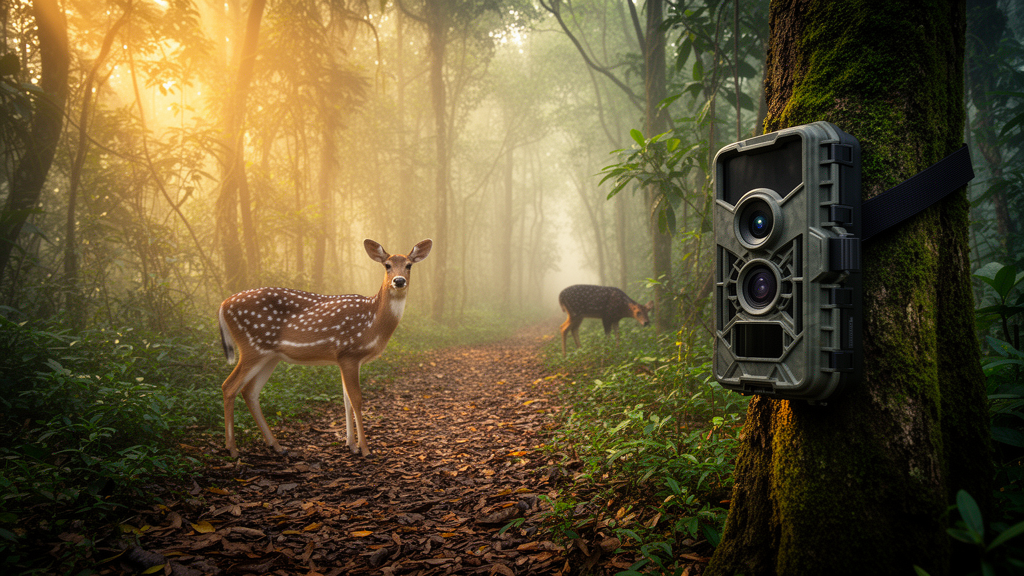
In the rolling forests of southern Argentine Mesopotamia, two deer species share the same woods, the same watercourses and, increasingly, the same hours of the day. A two-year camera-trap study in the Protected Natural Area “La Esmeralda”, in Entre Ríos Province, has now quantified just how differently the two cervids use this landscape. The exotic axis deer (Axis axis), introduced to Argentina from the Indian subcontinent in the early twentieth century, consistently outnumbered and outperformed the native brown brocket deer (Subulo gouazoubira) in both abundance and behavioral flexibility, according to the study published in Discover Life.
Researchers deployed four camera traps at fixed stations between July 2022 and January 2024, two in semixerophytic native forest and two in riparian forest along stream margins. The stations, separated by roughly 800 to 1,200 meters, operated without interruption for a total monitoring period of 554 days, accumulating 1,868 camera-days of sampling effort. The cameras recorded three consecutive photographs followed by a ten-second video at each trigger event, mounted some 30 to 40 centimeters above the ground with no bait or attractants. Images were retrieved every 20 days and classified by species based on body size, coat coloration, body proportions and antler morphology.
The relative abundance indices told a striking story. Axis deer reached their highest values at the riparian forest station CT2, with an index of 91.89 derived from 442 events, followed by 69.47 with 289 events at station CT4 in native forest. The native brocket deer showed a stronger association with riparian habitats, reaching indices of 35.02 and 41.16 at the two riparian stations, but its records dropped sharply in native forest, to just 16.11 at CT4 and 5.99 at CT3. In other words, the invasive species maintained high occurrence frequencies in both habitat types, while the native species concentrated its presence in riparian corridors and became scarce where axis deer were most abundant.
Activity patterns added a second layer of contrast. When the researchers classified records into fixed temporal intervals, both species qualified as cathemeral, meaning neither concentrated 70 percent or more of its records in a single period, and both remained active across daytime, nighttime and crepuscular hours. But continuous analyses using Kernel Density Estimation and the Non-negative Trigonometric Sum distribution revealed functional differences that the coarse classification missed. The brown brocket deer showed a predominantly crepuscular pattern, with well-defined activity peaks near dawn and, more markedly, at dusk, particularly within native forests. The axis deer, by contrast, displayed a broader and more flexible pattern, combining nocturnal, crepuscular and even diurnal activity, especially in riparian forests where records were distributed relatively homogeneously across the 24-hour cycle.
Seasonal analyses sharpened the picture further. The brocket deer kept its crepuscular signature year-round but shifted the timing of its peaks: dusk activity dominated in autumn and spring within native forests, while in summer both species shifted activity toward the early morning hours between 03:00 and 05:00 and reduced midday movement, probably in response to elevated temperatures. In winter, the brocket deer broadened its temporal distribution and increased diurnal activity, a pattern consistent with ungulates in temperate environments using warmer daytime hours to optimize energetic balance. The axis deer showed even more dramatic seasonal swings, intensifying nocturnal behavior in native forests during winter and fragmenting its activity into multiple peaks during spring and summer.
Temporal overlap between the two species was high in both environments, but with telling differences. In riparian forests the overlap coefficient reached 0.826, indicating strong coincidence in activity patterns, with both cervids peaking around dusk and during the first nighttime hours. In native forests the coefficient was 0.785, still high but lower and more variable across seasons: overlap fell to a low of 0.48 in winter, when the brocket deer concentrated around dusk while the axis deer remained largely nocturnal, and rose to 0.85 in summer. In riparian forests, overlap stayed consistently high through winter (0.82), spring (0.89) and summer (0.79), dropping to a moderate 0.54 only in autumn. The researchers interpret the seasonal dips in native forest as a possible form of partial temporal segregation that could reduce competition for resources or direct encounters.
Population density estimates from the Random Encounter and Staying Time (REST) model, which combines encounter rates with the time individuals spend within the camera detection zone, reinforced the asymmetry between the species. In riparian forests, axis deer densities exceeded those of the brocket deer for most of the year, peaking at approximately 5.7 individuals per hectare in May, with additional peaks near 3.0 in August and 2.5 in November. The brocket deer maintained lower and more stable estimates there, highest in January at roughly 2.2 individuals per hectare and dropping below 1.0 during the winter months of June and July. In native forests the gap narrowed: axis deer peaked near 2.8 individuals per hectare in November, but during July and August the brocket deer reached approximately 2.0 to 2.2 individuals per hectare, temporarily exceeding the exotic species in that habitat.
The study’s authors caution that these figures are local densities tied to the sampled camera stations, not estimates of total population size across the protected area. With only two stations per habitat and unequal sampling effort among stations, extrapolation to the whole landscape was deliberately avoided. The REST model also rests on assumptions, including a closed population during the study period, stations not concentrated on predictable movement corridors, no behavioral response of animals to the cameras, and complete detection of individuals entering the detection zone. Future work with more stations distributed across the landscape and longer monitoring periods would be needed for regionally representative estimates.
The broader context gives the findings their conservation weight. Native forest ecosystems in Entre Ríos have undergone extensive transformation in recent decades through deforestation, although forest cover still represents 26.4 percent of the province, more than two million hectares, and natural grasslands account for another 34.1 percent. The axis deer is recognized as a highly invasive species capable of reaching elevated densities and impacting native vegetation communities, and some prior studies have suggested it may be displacing the brown brocket deer through habitat competition. Yet the two species also coexist as syntopic species, and hunters, park rangers and landowners have reported mixed groups containing both, a coexistence the camera-trap record supports.
Interactions with domestic livestock add another complicating factor. Photographic records suggested that axis deer frequently used areas also occupied by cattle, while brocket deer appeared more often in sectors with lower livestock presence, but the authors emphasize these observations were not based on a formal co-occurrence analysis and should be treated as qualitative evidence. The pattern is nonetheless consistent with earlier work documenting negative correlations between livestock presence and brocket deer activity. Taken together, the study portrays a native cervid dependent on environments with greater vegetation complexity and lower disturbance, sharing them with an exotic competitor whose ecological and temporal plasticity may confer a decisive advantage. The authors suggest that conserving heterogeneous landscapes containing both native forest and riparian forest patches will be critical for maintaining viable brocket deer populations within these productive matrices, and that long-term camera-trap monitoring will be key to tracking how coexistence, competition and displacement unfold as the Espinal landscape continues to change.
Subject of Research: Population dynamics, activity patterns and density of native and invasive cervids in southern Argentine Mesopotamia
Article Title: Population dynamics and habitat use of cervids in southern Argentine Mesopotamia
Article References: Sabattini, J. A., Muzzachiodi, N., Merino, M. L., & Sabattini, I. A. (2026). Population dynamics and habitat use of cervids in southern Argentine Mesopotamia. Discover Life, 56(1), Article 48. https://doi.org/10.1007/s11084-026-09769-x
Image Credits: AI Generated
DOI: 10.1007/s11084-026-09769-x
Keywords: axis deer, brown brocket deer, camera traps, Argentine Espinal, invasive species, activity patterns, temporal overlap, population density, REST model, Entre Ríos, habitat use, cathemeral
Cite Scienmag News
Margaret Porter. (October 28, 2026). Camera traps reveal invasive axis deer outpacing native brocket deer in Argentine forests. Scienmag. https://scienmag.com/camera-traps-reveal-invasive-axis-deer-outpacing-native-brocket-deer-in-argentine-forests/
Margaret Porter. "Camera traps reveal invasive axis deer outpacing native brocket deer in Argentine forests." Scienmag, 28 October 2026, https://scienmag.com/camera-traps-reveal-invasive-axis-deer-outpacing-native-brocket-deer-in-argentine-forests/. Accessed 4 November 2026.
Margaret Porter. "Camera traps reveal invasive axis deer outpacing native brocket deer in Argentine forests." Scienmag. October 28, 2026. https://scienmag.com/camera-traps-reveal-invasive-axis-deer-outpacing-native-brocket-deer-in-argentine-forests/