

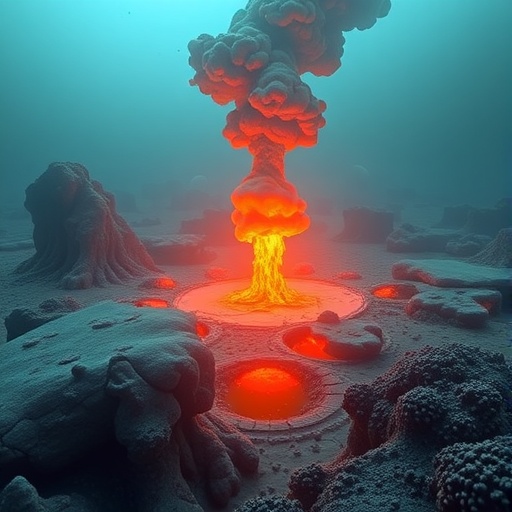
In a groundbreaking study set to reshape our understanding of the Earth’s early atmosphere and oceanic conditions, Zhang et al. have unveiled a compelling connection between explosive volcanic activity in the Early Cambrian period and significant shifts in oceanic chemistry. This research, published in Commun Earth Environ, posits that super-eruptions occurring in the north-western margin of the ancient supercontinent Gondwana may have been pivotal in instigating dramatic changes that led to what the researchers term the ‘Strangelove ocean’. The findings hold extraordinary implications for our understanding of the early Earth’s geological and environmental history.
The Early Cambrian period, dating from approximately 541 to 485 million years ago, is an era notable for its unprecedented evolutionary changes, often referred to as the Cambrian Explosion. During this period, a remarkable diversification of life forms occurred. However, the geological and climatic contexts surrounding these developments have remained subjects of extensive debate and research. Until now, the link between volcanic activities and oceanic transformations had not been thoroughly explored from this vantage point.
Zhang and his colleagues meticulously detailed a series of explosive volcanic eruptions that are believed to have occurred in conjunction with geological activity on the north-western margin of Gondwana. These super-eruptions, characterized by the massive release of gases and pyroclastic materials, would have had far-reaching consequences for the surrounding environment. This research highlights how these events could have triggered extensive climatic changes—altering weather patterns and, ultimately, the composition of the oceans.
Central to the findings is the concept that the immense quantities of volcanic gases, particularly sulfur dioxide and carbon dioxide, released during these eruptions could have led to severe acidification of the oceans. Such acidification, alongside the increase in temperature driven by greenhouse gas emissions, would have created harsh conditions for existing marine life. The researchers propose that these volcanic activities coincided with changes in ocean circulation patterns, further complicating the environmental landscape of the Cambrian seas.
The researchers utilized a combination of geochemical data and paleontological evidence to reconstruct the environmental conditions of the time. By analyzing sediment cores and mineral deposits throughout various geological sites, the team was able to infer changes in ocean chemistry that aligned with periods of explosive activity. This multi-faceted approach provided a clearer picture of how interconnected volcanic activity and oceanic chemistry were during the Cambrian period.
One notably exciting implication of this study is its potential to reframe narratives about the stability and sustainability of early marine ecosystems. Current understanding often posits that while life thrived during the Cambrian Explosion, it faced few significant challenges. The new evidence introduced by Zhang and colleagues suggests that early life forms were, in fact, experiencing the tumultuous effects of super-eruptions and significant oceanic upheavals, shaping their evolutionary trajectories in profound ways.
Furthermore, this research offers critical insights into the mechanisms of ecological resilience. The ability of ancient organisms to withstand or adapt to drastic environmental changes may contribute valuable lessons to contemporary biological conservation efforts. With modern ecosystems facing challenges from human-induced climate change, understanding historical analogs, such as those presented in this study, could guide efforts to preserve biodiversity in our oceans.
Moreover, the ‘Strangelove ocean’ concept introduced in this research reflects a shift in scientific discourse from one of stability to one of dynamic change. The name, evoking a sense of both intrigue and caution, stems from historical references to environmental anomalies linked to human activity. By comparing ancient marine conditions to modern ones, this research utters a dire warning, emphasizing the cyclical nature of ecological upheavals across geological time scales.
The study does not just address the impacts of volcanic eruptions; it also opens the door for future research avenues. Scientists are now encouraged to explore how the interactions between geological phenomena and biological processes may have influenced the evolution of life during other geological epochs. Investigating the planetary responses to these catastrophic events could illuminate patterns that resonate with current changes observed in our own world, where human activities exert considerable influence over natural systems.
The implications of this research extend beyond geology and paleontology into the realms of climate science and ecology. As our understanding of the Earth’s history deepens, it becomes increasingly essential for scientists to synthesize knowledge across disciplines. The unifying theme of environmental change—whether initiated by natural or anthropogenic forces—remains a cornerstone for addressing the challenges of our time.
In conclusion, Zhang et al.’s exploration into the explosive episodes of the Early Cambrian and their relationship with oceanic transformations provides an essential narrative connecting volcanic activity to the larger patterns of environmental and biological evolution. This study encourages a more integrated approach to understanding Earth’s history and its lessons for present and future ecological resilience. As scientists continue to delve into the complexities of our planet’s climatic history, the revelations from this research serve as a crucial reminder of the interconnectedness of geological processes and life itself.
This study is not merely a reconstructive look at the past; it is a clarion call for a more holistic perspective on geological and biological correlations that shape life on Earth. The legacy of these findings will likely influence both academic discourse and public understanding of Earth’s climatic and biological history for years to come.
With our planet facing unprecedented environmental challenges, learning from our past—and understanding how ancient ecosystems reacted to extreme events—may be one of our most vital tools in navigating an uncertain future.
Subject of Research: Early Cambrian explosive super-eruptions and their impact on oceanic conditions and marine life.
Article Title: Early Cambrian explosive super-eruptions in the north-western margin of Gondwana may have triggered the ‘Strangelove ocean’.
Article References:
Zhang, D., Zhou, M., Zhou, Z. et al. Early Cambrian explosive super-eruptions in the north-western margin of Gondwana may have triggered the ‘Strangelove ocean’.
Commun Earth Environ (2026). https://doi.org/10.1038/s43247-026-03243-2
Image Credits: AI Generated
DOI: 10.1038/s43247-026-03243-2
Keywords: Early Cambrian, super-eruptions, ocean chemistry, volcanic activity, ecological resilience, Strangelove ocean.


