

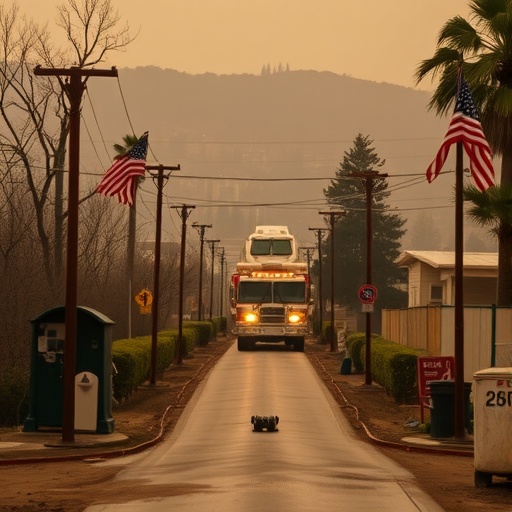
California has wrestled with wildfire smoke for decades, traditionally viewing it as a seasonal inconvenience rather than a chronic public health crisis. However, the growing severity and frequency of wildfires have dramatically altered this perception. Recent research spearheaded by UC San Diego’s Scripps Institution of Oceanography reveals a troubling trend: the intervals between consecutive multi-day wildfire smoke events are contracting. These shrinking recovery periods between smoke waves are reducing the time communities have to recover before new smoke exposure sets in, amplifying the cumulative health risks faced by populations across the state.
This groundbreaking study, published in the journal GeoHealth on March 11, developed a comprehensive data-driven analysis spanning the years 2006 to 2020. The researchers employed sophisticated machine learning techniques to isolate fine particulate matter specifically produced by wildfire smoke, distinguishing it from pollution arising through urban traffic and industrial activities. By defining “smoke waves” as two or more consecutive days where wildfire particulate matter exceeded a threshold concentration, they could quantify not only the frequency and duration of smoke events but also the critical recovery periods between them.
The findings showed a stark increase in the prevalence of smoke waves throughout California, with the frequency rising by about 85% between the periods 2006–2010 and 2016–2020. Even more alarming was the significant contraction—over 60%—in the length of time between these events. This indicates that wildfires are not only becoming more common but that their resulting air pollution episodes are increasingly relentless. Regions such as Southern California and the Central Valley have experienced the most drastic reductions in recovery time, creating nearly continuous exposure periods for residents.
These patterns have profound implications given the mounting evidence linking wildfire smoke exposure to a host of health disorders. Past studies have associated exposure to particulate matter from wildfire smoke with exacerbated respiratory conditions, heightened cardiovascular risks, and an increased rate of premature mortality. A 2025 epidemiological investigation estimated that short-term wildfire smoke exposure accounts for approximately 40,000 deaths annually in the United States alone. Notably, the fine particulate matter originating from wildfires tends to be more biologically harmful per unit than equivalent concentrations from vehicular or industrial sources, owing to the complex chemical composition of biomass combustion.
Until now, most research efforts have focused on isolated wildfire smoke events, treating each episode independently and ignoring the broader temporal context. This latest study addresses this critical gap by analyzing the impact of consecutive smoke waves occurring in close succession. Data from wildland firefighters, who endure repeated exposure over wildfire seasons, suggest that cumulative smoke inhalation can exacerbate airway inflammation and reduce lung function more severely than singular exposures. Whether such cumulative detrimental effects are mirrored in the general populace, however, remains to be conclusively determined.
The worsening smoke conditions are intricately tied to California’s escalating wildfire activity, a direct consequence of climate change’s influence on regional weather patterns, vegetation dryness, and fire behavior. The resulting smoke pollution has not only reversed decades of progress in improving air quality but is now recognized as California’s leading source of fine particulate matter contamination. The socio-environmental toll is vast, disproportionately impacting communities already vulnerable due to socioeconomic factors, limited healthcare access, and insufficient resources to mitigate exposure through air filtration or temporary relocation.
Spatial analysis within the study revealed important regional disparities. Northern California, historically bearing the brunt of wildfire smoke, maintained persistent smoke wave frequency but did not exhibit significant declines in recovery duration. Conversely, Southern California and the Central Valley experienced heightened smoke wave frequency coupled with sharply diminished recovery periods. These regions also host larger populations with socioeconomic and demographic vulnerabilities, such as higher proportions of racial and ethnic minorities, lower-income households, and single female-headed families, compounding the challenges faced by these communities.
By adopting a nuanced approach that integrates geospatial data with demographic and socioeconomic variables, the research exposes how environmental injustice manifests in wildfire smoke exposure. The compounding stressors—ranging from substandard housing conditions to outdoor occupational hazards—exacerbate the health burdens in these areas. The shortening of smoke-free periods undermines residents’ ability to recuperate, potentially magnifying respiratory and cardiovascular harm and heightening risks during prolonged wildfire seasons.
Public health policy frameworks to date predominantly consider smoke exposure on an event-by-event basis, signaling alerts when pollution surpasses established thresholds without accounting for the temporal proximity of preceding smoke waves. This research challenges that paradigm, asserting the necessity of incorporating the duration between exposures into risk assessments. Such recalibration would better inform air quality advisories and protective measures, recognizing that shorter recovery intervals may compound physiological damage and strain healthcare systems.
The authors advocate for future investigations that rigorously quantify the health, social, and economic impacts of diminished recovery times between wildfire smoke episodes. Enhanced understanding of temporal exposure dynamics could catalyze transformative shifts in public health management and climate adaptation strategies, fostering resilience amid an era marked by intensifying wildfire regimes.
The trajectory toward increasingly frequent and prolonged wildfire smoke exposure underscores the urgency of proactive interventions. These must extend beyond individual behavior change to systemic solutions addressing climate mitigation, infrastructural adaptation, and equity-driven resource allocation. By illuminating the spatial and temporal complexities of wildfire smoke exposure, the study lays a foundation for targeted public health responses that prioritize communities most at risk.
As researchers continue to unravel the multifaceted consequences of consecutive smoke events, the broader relevance of this work extends globally. Regions experiencing similar wildfire intensification—such as parts of Canada and Australia—could benefit from applying analogous analytical frameworks to guide policy and protect public health. In the face of a rapidly changing climate, integrating environmental science with social equity considerations becomes paramount in crafting effective responses to this escalating threat.
This study is the product of collaboration between environmental epidemiologists and scientists at UC San Diego’s Scripps Institution of Oceanography and UCLA. The team’s interdisciplinary effort, supported by the University of California and the California Office of Environmental Health Hazard Assessment, represents a critical advancement in understanding wildfire smoke’s evolving risk landscape, highlighting the pressing need to rethink exposure models and public health preparedness in a world where wildfire smoke is not a mere seasonal nuisance but a chronic environmental hazard.
Subject of Research: Effects of wildfire smoke exposure frequency and recovery period on public health and environmental justice in California
Article Title: Shorter recovery periods between smoke waves: a spatio-temporal analysis in California (2006-2020)
News Publication Date: March 11, 2024
Web References:
- https://doi.org/10.1146/annurev-med-052422-020909
- https://www.nature.com/articles/s41586-025-09611-w
- https://link.springer.com/article/10.1007/s40572-022-00355-7
Keywords: Wildfires, Climate change effects, Air pollution, Environmental health, Wildfire smoke, Particulate matter, Public health policy, Environmental justice


