


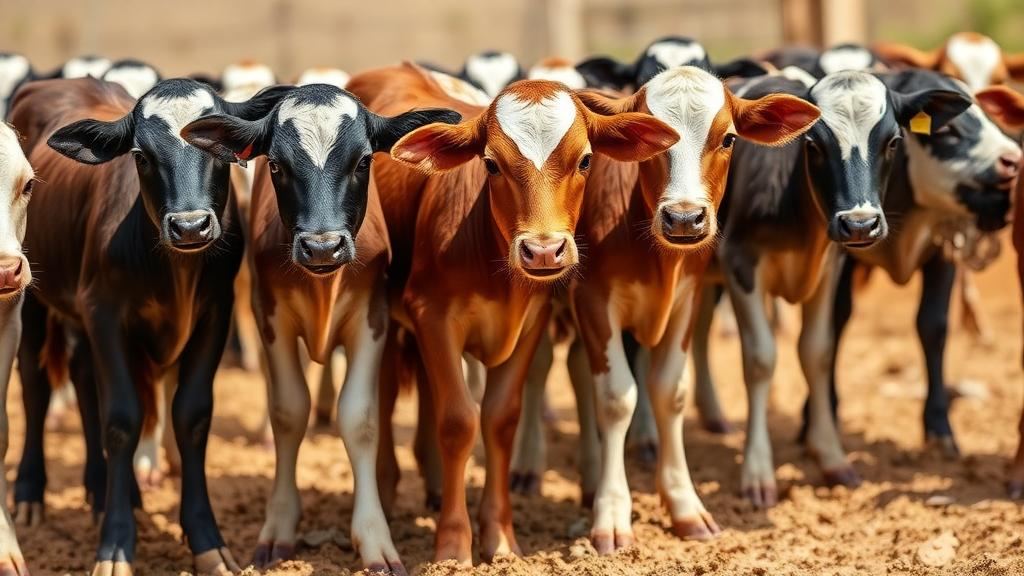
A cross-sectional investigation conducted in and around Haramaya town in eastern Ethiopia has found that nearly a quarter of dairy calves carry coccidian parasites, single-celled protozoa that colonise and destroy the lining of the intestine. The study, published in Veterinary Medicine and Science, examined 284 calves younger than twelve months and detected Eimeria oocysts in 64 of them, an overall prevalence of 22.5 percent with a 95 percent confidence interval of 18.1 to 27.8 percent. Beyond simply documenting the parasite, the researchers identified a cluster of risk factors that point directly to the everyday conditions in which Ethiopian calves are raised, with farm hygiene emerging as the strongest and most modifiable determinant of infection.
Ethiopia’s stakes in this question are enormous. The country holds Africa’s largest livestock population, with a national herd of roughly 70.3 million cattle, 42.9 million sheep, 52.5 million goats and 8.1 million camels according to the Central Statistics Agency’s 2021 sample survey. Livestock supply animal protein, draft power for cultivation, transport, export earnings, organic fertiliser and household fuel, and they act as a financial buffer during crop failures. The sector contributes up to 40 percent of agricultural gross domestic product, nearly 20 percent of total GDP and about 20 percent of foreign exchange earnings. Any disease that quietly erodes calf growth therefore carries consequences that ripple through the national economy.
Coccidiosis is precisely such a disease. It is caused by Eimeria species, intracellular protozoa that invade and destroy the epithelial cells of the intestinal tract. Clinical cases present with diarrhoea, weight loss, fever, anorexia, emaciation and sometimes haemorrhagic dysentery and death. More insidiously, the majority of infections remain subclinical, yet they still reduce feed intake, impair feed conversion efficiency and slow weight gain. Subclinical cases account for more than 95 percent of total production losses attributed to the disease, and annual global losses have been estimated to exceed US$400 million. Affected calves may suffer growth retardation of up to two months, a delay that reshapes the lifetime productivity of a dairy animal.
More than a dozen Eimeria species have been described in cattle and buffalo, with Eimeria bovis, Eimeria zuernii and Eimeria auburnensis most frequently reported. E. bovis and E. zuernii are the most pathogenic, capable of severe disruption of intestinal absorption and substantial morbidity and mortality. The parasites display marked host specificity, restricting transmission largely to cattle. Calves acquire infection by ingesting sporulated oocysts shed in faeces, a process accelerated by communal housing, overcrowding and contaminated udders. The oocysts are environmentally formidable, surviving prolonged freezing at temperatures as low as minus 18 degrees Celsius and requiring only warmth and moisture to sporulate into their infective form over days to weeks.
The new study focused on Haramaya District, located roughly 500 kilometres east of Addis Ababa and 18 kilometres west of Harar, at altitudes between 1,600 and 2,100 metres. The area receives bimodal rainfall of approximately 492 to 866 millimetres annually, with temperatures ranging from 5.2 to 24 degrees Celsius, and mixed crop-livestock farming dominates. Haramaya town was purposively selected as the major urban dairy centre, while five surrounding kebeles, the local administrative units, were chosen by simple random sampling to represent peri-urban production systems. A preliminary census of all farms keeping calves under twelve months produced the sampling frame, from which individual calves were drawn by lottery, giving every eligible animal an equal chance of inclusion and minimising selection bias.
Fieldwork ran from November 2024 to May 2025, with sampling conducted during the dry season. Fresh faecal samples were collected directly from each calf, sealed in labelled leak-proof containers and transported in insulated cool boxes at roughly 4 to 8 degrees Celsius. In the laboratory, three grams of each sample were homogenised with 40 millilitres of sugar flotation solution of specific gravity 1.27, centrifuged at 1,500 revolutions per minute for five minutes, and the resulting surface film was examined microscopically at 40 times magnification for the characteristic oocysts. The sample size of 284 was calculated from an expected prevalence of 24.4 percent drawn from earlier work in the area, using standard epidemiological formulas for a 95 percent confidence interval.
The results showed that host characteristics and farm conditions mattered more than genetics or geography. Prevalence rose with age: calves aged six to under twelve months carried an infection rate of 27.3 percent, significantly higher than the 17.2 percent seen in calves younger than six months, a pattern the authors attribute to cumulative exposure to contaminated feed, water, bedding and animals over time. Calves in poor body condition showed a prevalence of 29.7 percent against 18.6 percent in those in good condition, though the cross-sectional design prevents any conclusion about whether malnutrition predisposed the animals to infection or the parasite drove them into decline. Farm hygiene produced the starkest contrast: 31.3 percent of calves on farms rated as poorly hygienic were positive, compared with 14.6 percent on well-kept farms.
Several expected risk factors, by contrast, proved statistically irrelevant. Sex was not associated with infection, suggesting male and female calves faced similar exposure. Breed made no significant difference, with crossbred Holstein Friesian crosses at 26.5 percent and local breeds at 21.3 percent, a finding consistent with the view that environmental and management conditions outweigh genetic susceptibility. Neither the management system, whether intensive housing or extensive free grazing, nor the individual kebele of origin was significantly linked to infection, implying that the crucial variable is not how a farm is organised but how cleanly it is run. Accumulated faeces, wet bedding, poor drainage and unhygienic feed and water troughs evidently matter more than the label attached to the production system.
The 22.5 percent prevalence sits squarely within the range reported across Ethiopia, matching figures from Dire Dawa, Wolaita Sodo, South Wollo, Bahir Dar and even Egypt, while remaining lower than rates of 62.5 percent in Asella and 68.1 percent in Addis Ababa and Debre Zeit. Earlier regional work has catalogued the local parasite fauna in detail, identifying six Eimeria species around Haramaya, with E. bovis and E. zuernii most common and mixed infections frequent. The present study, however, stopped at oocyst detection and did not identify species, so the reported figure should be read as the proportion of calves carrying detectable coccidia rather than as species-specific infection. The authors flag this as a key limitation and call for sporulation-based morphological identification and molecular characterisation, together with quantitative oocyst counts, in future work.
For farmers and veterinarians in East Hararghe, the practical message is unusually clear. Since hygiene status was the strongest modifiable predictor of infection, interventions targeting calf pen cleanliness, regular manure removal, dry and clean bedding, adequate drainage and well-maintained feeding and watering facilities could substantially cut exposure to Eimeria oocysts. Combined with routine health monitoring, attention to calf nutrition to protect body condition, and awareness that older calves accumulate exposure over months, such measures offer a low-cost path to reducing the hidden burden of subclinical coccidiosis. The authors recommend longitudinal follow-up studies with broader geographic coverage to clarify infection dynamics and quantify production losses, steps that would help convert these epidemiological findings into concrete gains for Ethiopia’s dairy-dependent rural households.
Subject of Research: Prevalence and risk factors of coccidiosis in calves in eastern Ethiopia
Article Title: Prevalence of Coccidiosis and Its Associated Risk Factors Among Calves in and Around Haramaya Town, Eastern Hararge, Oromia, Ethiopia
Article References: Jiru, B. T., & Emiru, A. Y. (2026). Prevalence of Coccidiosis and Its Associated Risk Factors Among Calves in and Around Haramaya Town, Eastern Hararge, Oromia, Ethiopia. Veterinary Medicine and Science, 12(5), Article e71245. https://doi.org/10.1002/vms3.71245
Image Credits: AI Generated
DOI: 10.1002/vms3.71245
Keywords: coccidiosis, Eimeria, calves, Ethiopia, livestock, parasitology, farm hygiene, veterinary epidemiology, dairy cattle, cross-sectional study, oocysts, body condition
Cite Scienmag News
William Thompson. (September 30, 2026). Calf Parasite Study Reveals Hygiene as Key Driver of Coccidiosis in Ethiopian Dairy Herds. Scienmag. https://scienmag.com/calf-parasite-study-reveals-hygiene-as-key-driver-of-coccidiosis-in-ethiopian-dairy-herds/
William Thompson. "Calf Parasite Study Reveals Hygiene as Key Driver of Coccidiosis in Ethiopian Dairy Herds." Scienmag, 30 September 2026, https://scienmag.com/calf-parasite-study-reveals-hygiene-as-key-driver-of-coccidiosis-in-ethiopian-dairy-herds/. Accessed 4 October 2026.
William Thompson. "Calf Parasite Study Reveals Hygiene as Key Driver of Coccidiosis in Ethiopian Dairy Herds." Scienmag. September 30, 2026. https://scienmag.com/calf-parasite-study-reveals-hygiene-as-key-driver-of-coccidiosis-in-ethiopian-dairy-herds/


