

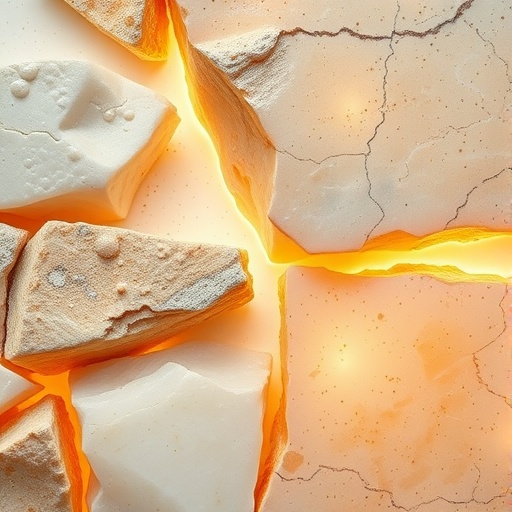
In a groundbreaking study set to reshape our understanding of mineral durability and earth’s geological processes, researchers have uncovered the spontaneous healing abilities of cracks in calcite—a primary mineral found in sedimentary rocks and marine organisms. The findings, published in Nature Communications in 2026, reveal an intricate interplay between dynamic strain evolution and surface chemistry that allows calcite to repair itself without external intervention. This discovery not only challenges traditional views of mineral degradation but also opens new avenues for materials science, geophysics, and environmental engineering.
Calcite, a form of calcium carbonate, is ubiquitous in the Earth’s crust, playing a vital role in both natural geological formations and anthropogenic materials such as concrete. While previous studies have focused on the mechanical strength and fracture behavior of calcite under static conditions, this recent work delves deeper into the time-dependent processes occurring at the crack interfaces. The researchers observed that under certain environmental and mechanical conditions, calcite exhibits spontaneous crack healing—a process that effectively restores its structural integrity.
Central to this phenomenon is the concept of dynamic strain evolution, whereby the stresses and deformations around a crack tip fluctuate over time, rather than remaining fixed. This dynamic behavior drives the redistribution of strain energy, facilitating localized atomic rearrangements at the crack surfaces. The study shows that such strain oscillations can activate surface chemical reactions that lead to mineral reprecipitation and bonding across the crack, effectively sealing it. This mechanochemical synergy highlights the complex coupling between mechanical forces and chemical processes in mineral systems.
Using state-of-the-art microscopy techniques combined with in situ mechanical testing, the research team tracked the temporal progression of crack closure in calcite samples subjected to cyclic loading conditions. Unlike conventional fracture mechanics models that predict crack propagation under repetitive stress, the data revealed intermittent periods of crack shrinkage and surface smoothing. These observations support the hypothesis that dynamic strain induces chemical changes conducive to healing, rather than promoting further damage.
Further chemical analyses pinpointed changes in the surface chemistry at the crack interface during the healing phases. The presence of water molecules and dissolved calcium and carbonate ions was critical, suggesting that fluid-mediated transport and mineral reprecipitation are vital drivers of the process. This underscores the importance of environmental factors such as humidity and solution chemistry in modulating the healing efficiency. In practical terms, calcite’s healing behavior is not only a mechanical response but also a result of its reactive interface interacting dynamically with its surroundings.
One of the most remarkable implications of this study is its potential impact on the durability of carbonate-based construction materials and the long-term stability of carbonate reservoirs in subsurface geology. Understanding the natural healing mechanisms of calcite cracks can lead to the development of self-healing concretes and cements, which could dramatically reduce maintenance costs and enhance infrastructure resilience. Moreover, this knowledge can improve predictions of rock behavior during seismic activity or fluid injection operations in carbon sequestration.
The polymer-like self-mending behavior observed in these mineral systems also invites a comparison with biological materials known for their remarkable ability to repair damage. The study bridges gaps between geology, materials science, and biomimetics, suggesting that the principles of dynamic strain-induced healing could inspire novel synthetic materials capable of autonomous repair. This approach contrasts with traditional material designs relying solely on toughness or static strength to resist fracture.
From a fundamental perspective, the research challenges the conventional wisdom that mineral fractures inevitably propagate once initiated, highlighting instead a rich spectrum of interactions that can partially or completely reverse crack growth. It invites a reconsideration of geological timescales, where microfractures in mineral grains may persist and heal repeatedly, affecting rock porosity, permeability, and mechanical properties. These micro-scale healing events might cumulatively influence macroscopic geological phenomena like fault stability and carbonate diagenesis.
Incorporating computational modeling alongside experimental techniques, the team was able to simulate the atomistic mechanisms underpinning crack healing. The models corroborated that oscillatory strain fields modulate the local energy landscape, lowering the activation barrier for surface diffusion and ionic migration. This mechanistic insight ties together the observed phenomena with fundamental principles of thermodynamics and kinetics, providing a predictive framework for future research on mineral self-repair.
The role of surface chemistry in this process extends beyond mere mineral dissolution and precipitation. Surface charge distributions, defect structures, and adsorbed species all modulate the mineral’s capacity to undergo healing. The study’s authors emphasize that the dynamic surfaces of mineral cracks are reactive interfaces, continually exchanging atoms and charges with adjacent fluids, thus constantly reshaping their microstructure in response to mechanical stimuli.
Beyond pure calcite, the mechanisms highlighted in this study may apply to a wider class of minerals where dynamic strain and chemically active surfaces coexist. Such universality offers exciting prospects for the design of hybrid materials combining inorganic and organic phases, or for enhancing the restoration of natural systems impacted by human activities. Understanding mineral self-healing thus aligns with broader environmental and sustainability goals.
The experimental design itself leveraged advanced techniques such as atomic force microscopy for real-time surface topography mapping, synchrotron-based spectroscopy to ascertain chemical shifts, and nanoindenter devices for precise mechanical loading. These tools permitted an unprecedented resolution in observing crack tip dynamics, enabling the team to disentangle the intertwined physical and chemical mechanisms.
Looking forward, this discovery promotes a paradigm shift not only in mineral physics but in applied geology and materials engineering. The ability of a commonly abundant mineral such as calcite to self-heal cracks may inspire industrial methods that harness natural processes to enhance durability and reduce resource consumption. Moreover, the insights into strain and chemistry coupling may inform seismic risk assessments and the development of fault zone remediation strategies.
As the authors note, further research is needed to quantify the rates and limits of spontaneous crack healing under varying temperature, pressure, and fluid composition conditions that mimic Earth’s subsurface environments. Expanding these studies to polycrystalline aggregates and complex geological settings will refine our understanding of the scale-dependent implications of such healing phenomena.
In conclusion, the revelation of spontaneous crack healing in calcite mediated by dynamic strain evolution and surface chemistry is a milestone in mineral science. It illuminates the sophisticated interplay of mechanical forces and chemical reactivity that govern mineral behavior and opens exciting scientific and technological frontiers. This knowledge promises to influence disciplines ranging from civil engineering and environmental sustainability to geodynamics and materials design, rewriting what we thought possible for mineral resilience in nature and industry.
Subject of Research:
Spontaneous crack healing mechanisms in calcite through dynamic strain evolution and surface chemistry interplay.
Article Title:
Spontaneous crack healing in calcite reveals the influence of dynamic strain evolution and surface chemistry.
Article References:
Devoe, M., P. Lisabeth, H., Nakagawa, S. et al. Spontaneous crack healing in calcite reveals the influence of dynamic strain evolution and surface chemistry. Nat Commun (2026). https://doi.org/10.1038/s41467-026-71110-x
Image Credits:
AI Generated


