When the COVID-19 pandemic disrupted industrial supply chains in the spring of 2020, one of the less obvious casualties was the carbon dioxide supply that municipal water treatment plants rely on to adjust the pH of finished drinking water. The City of Ames, Iowa, was warned by its CO2 supplier on March 30, 2020 that it could guarantee only 50 percent of the plant’s normal carbon dioxide usage, and at an 83 percent surcharge over the contracted price. By April 17 the supplier could commit to full contracted volumes, but only enough to match the plant’s usage from the previous three months, which had been low-demand months.
Faced with that uncertainty, engineers and operators at the Ames Water Treatment Plant revived a treatment strategy that most of the industry had abandoned decades ago: split treatment. In a full-scale trial conducted in May 2020, the plant bypassed a small fraction of its raw groundwater around the lime softening process and recombined that unsoftened stream with the lime-softened water in the recarbonation basin. The results, published in Discover Water, showed that a 10 percent bypass reduced carbon dioxide demand by 67 percent, from 318 pounds per million gallons treated to 104 pounds per million gallons, compared with the plant’s April 2020 baseline.
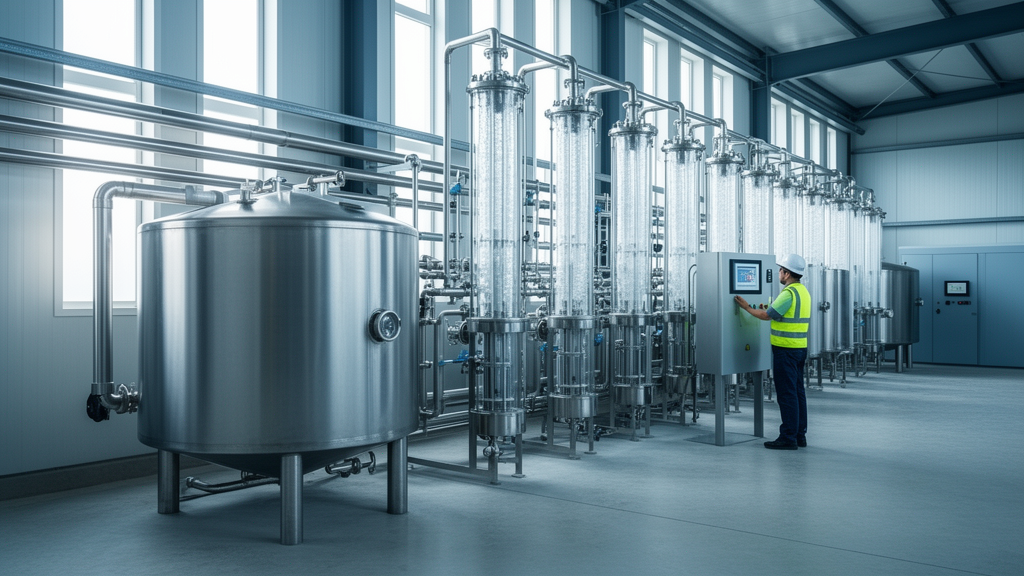
The Ames plant is a conventional lime softening facility that has operated since 2017, drawing groundwater from an alluvial aquifer through 22 municipal wells and designed to produce up to 15 million gallons of treated water per day. In normal operation, lime slurry is added to the water in solid contact units to precipitate carbonate hardness as lime sludge, a process that drives the pH of the softened water up to roughly 11.00 to 11.20. Carbon dioxide is then injected in the recarbonation basin to bring the finished water down to a target pH of 9.45. Because the plant’s water demand at the time required only two of its three solid contact units, the third unit was available to carry bypassed raw water with no lime addition, making the trial possible without any construction.
During the trial, operators varied either the split percentage or the target hydroxide alkalinity range in the softened units, never both at once, so that the effect of each individual change could be distinguished. Flow to the bypass unit was controlled by opening and closing the unit’s influent valve to hold either 5 percent or 10 percent of total plant flow. At the end of the trial, the order of the changes was reversed to return the plant to normal operation in a slow, controlled manner, which also generated additional data under baseline conditions. Throughout the trial, laboratory testing frequency was increased as a precaution, covering clearwell and recarbonation basin pH, total chlorine residual, total iron, and the pH, total alkalinity, calcium hardness and total hardness of the bypassed raw water, using HACH colorimetric procedures on a DR3900 spectrophotometer, a HACH TU5200 turbidimeter and a Thermo Scientific Orion Dual Star pH meter.
The trial had been framed around seven objectives: reduce carbon dioxide usage, keep treated water within the plant’s operating permit, identify maintenance issues, quantify cost savings, train staff on the technique, determine start-up and shut-down intervals, and investigate the theory and history of split treatment in lime softening utilities. On the cost side, the 10 percent split at a hydroxide alkalinity target of 20 to 30 milligrams per liter as calcium carbonate cut lime usage by 17 percent, from 2.49 to 2.06 pounds per thousand gallons treated. Annualized from the 22 days the 10 percent split was in operation, the savings amounted to roughly 17,000 dollars in carbon dioxide, 77,000 dollars in lime and 65,000 dollars in lime sludge removal and hauling, a combined total of approximately 159,000 dollars per year. Chemical savings alone, without sludge disposal, came to about 95,000 dollars annually.
The theoretical underpinning of the trial came from split treatment chemical equilibrium equations published by Zipf and Luthy, which the authors used to predict the water quality that a given bypass fraction would produce. Using a raw water carbon dioxide concentration of 52 milligrams per liter as calcium carbonate, a treated water hardness target of 156 milligrams per liter as calcium carbonate, a product water pH of 9.45, a raw water total alkalinity of 290 milligrams per liter as calcium carbonate and a hydroxide alkalinity target of 36 milligrams per liter in the solid contact units, the calculations pointed to an optimum bypass of 14.6 percent, at which pH adjustment could be achieved with no supplemental carbon dioxide at all. The theoretical magnesium hardness in the finished water at 14.6, 10 and 5 percent bypass was estimated at 19.0, 13.0 and 7.0 milligrams per liter as calcium carbonate respectively, with corresponding calcium hardness values of 137, 143 and 149 milligrams per liter.
The measured results tracked those predictions closely for alkalinity. For the 10 percent split, the theoretical total alkalinity of 66.6 milligrams per liter as calcium carbonate compared with a trial value of 61 plus or minus 3 milligrams per liter; for the 5 percent split, the estimate of 51.3 compared with a trial average of 55 plus or minus 4. Treated water hardness, however, ran higher than the theoretical values, which the authors attribute to the equilibrium equations not accounting for residual magnesium and calcium hardness left in the solid contact units, since lime softening at Ames does not remove all hardness ions. A linear regression of carbon dioxide demand against split percentage from the trial data yielded the equation y equals negative 18.4x plus 302, implying that a split of about 16.4 percent would eliminate recarbonation entirely, reasonably close to the theoretical 14.6 percent.
Two operational concerns that often limit split treatment, corrosion and disinfection, were examined directly. In a separate two-month trial, mild steel coupons suspended in the recarbonation basin showed slightly less scaling and corrosion during a 5 percent split than before the split, based on weight gain and loss measurements. However, moving the addition point of sodium hexametaphosphate, a scale and corrosion inhibitor, from before filtration to before recarbonation produced significantly more scaling and corrosion, suggesting the impact of split treatment itself is minimal as long as the inhibitor is added where it currently is, ahead of the multimedia filters. Chlorine demand, which plant staff feared might rise because bypassed raw water carries organics and insoluble iron that softening would normally remove, showed little to no change, and the Langelier Index, a measure of the water’s corrosive or scale-forming tendency, stayed above the plant’s expectation of 1.20 throughout the study, against a product water target of 1.30 to 1.50.
Not everything behaved as predicted. Total hardness in the finished water was expected to increase slightly, since the bypassed fraction skips the process that precipitates calcium and magnesium, the two primary hardness cations in groundwater. Instead, hardness during the trial was unexpectedly the lowest of any split target range, a result the authors attribute to differences in which combinations of the plant’s 22 wells were being used during the baseline period and the trial, since quarterly well sampling shows raw water quality varies considerably by well. The authors also note a limitation for other utilities: because part of the flow receives no softening, facilities treating surface water or groundwater under the influence of surface water could see a reduction in log pathogen removal for the diverted flow, and taste, odor and turbidity problems in raw water can make bypass infeasible for some plants.
Split treatment is not new to Ames. Records show the technique was tested there in 1932 with 11 and 22 percent bypass, used again in 1944 and 1947, when no recarbonation was needed for four months, and then operated continuously from the mid-1960s until 1985 at a 25 percent split that eliminated recarbonation and significantly reduced lime and soda ash requirements. That run ended when severe scale buildup in a clarifier inlet pipe, caused by reduced flow and mineral deposition in the split treatment piping, created maintenance problems. Neither the old nor the new Ames plant was designed for split treatment mode. The technique was common in the 1950s and 1960s, typically operated with splits up to 30 percent in excess lime softening plants, but published material on it is sparse after the 1960s and few plants use it routinely today.
The trial’s success has prompted the city to consider piping modifications that would allow split treatment as a regular part of the treatment scheme, routing raw water around the solid contact unit basins entirely through a new pipe connecting the unit influent piping to the effluent piping just before the recarbonation tank, with an automated modulating valve and flow meter. Any such change would require verification of the trial results, evaluation of long-term maintenance, approval from the Iowa Department of Natural Resources and operator input. Since the trial ended in September 2020, contracted prices have risen to 225 dollars per ton for lime, up 74 percent from 166 dollars, and 88 dollars per ton for carbon dioxide, up 8 percent from 72 dollars, strengthening the economic case. The authors note that while the specific savings reflected an unusual moment during the pandemic, the underlying reductions in chemical and sludge disposal costs would apply at any time, and that reduced dependence on purchased chemicals increases plant resiliency while lowering the carbon footprint of water treatment.
Subject of Research: Split treatment to reduce carbon dioxide demand at a municipal lime softening water treatment plant
Article Title: Split treatment evaluation, optimization, and operation of the Ames water treatment plant
Article References: Jacob, M., Martindale, N., Hammes, L., & Ellis, T. G. (2026). Split treatment evaluation, optimization, and operation of the Ames water treatment plant. Discover Water, 6(1), Article 129. https://doi.org/10.1007/s43832-026-00467-3
Image Credits: AI Generated
DOI: 10.1007/s43832-026-00467-3
Keywords: water treatment, lime softening, split treatment, carbon dioxide, pH adjustment, drinking water, COVID-19 supply chain, cost savings, Ames Iowa, recarbonation, lime sludge, water quality
Cite Scienmag News
Violet Maxwell. (October 28, 2026). Bypassing Lime Softening Cut a Water Plant’s CO2 Use by 67 Percent. Scienmag. https://scienmag.com/bypassing-lime-softening-cut-a-water-plants-co2-use-by-67-percent/
Violet Maxwell. "Bypassing Lime Softening Cut a Water Plant’s CO2 Use by 67 Percent." Scienmag, 28 October 2026, https://scienmag.com/bypassing-lime-softening-cut-a-water-plants-co2-use-by-67-percent/. Accessed 28 October 2026.
Violet Maxwell. "Bypassing Lime Softening Cut a Water Plant’s CO2 Use by 67 Percent." Scienmag. October 28, 2026. https://scienmag.com/bypassing-lime-softening-cut-a-water-plants-co2-use-by-67-percent/