

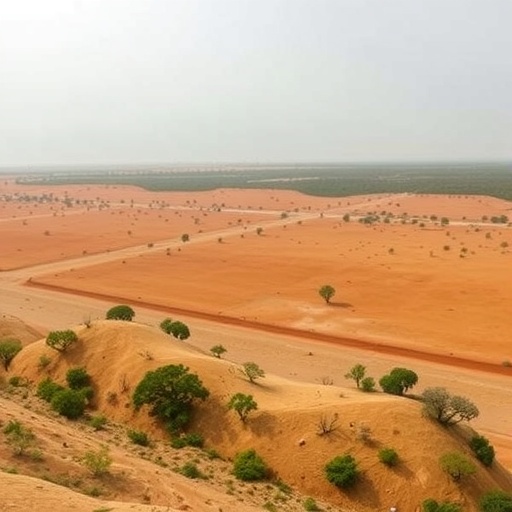
As our planet warms, scientists are uncovering disturbing patterns in how climate extremes will increasingly jeopardize human societies—especially in vulnerable parts of the world. A groundbreaking new study, soon to be published in Geophysical Research Letters, reveals that compound hot-dry events—periods when extreme heat and drought converge—are projected to occur over five times more frequently by the end of this century compared to the mid-to-late 20th century. This alarming rise could place nearly 28% of the global population, concentrated overwhelmingly in low-income and tropical regions, under substantial threat. These are communities that have historically contributed minimally to greenhouse gas emissions yet stand to suffer the gravest consequences.
The intersection of intense heat and persistent drought does not merely sum their impacts—it catalyzes a dangerous amplification of risks that affect ecosystems, economies, and public health. Di Cai, the study’s lead author and climate scientist at the Ocean University of China, explains that these compound extremes exacerbate water scarcity, destabilize food systems through volatile pricing, and pose severe challenges to outdoor workers exposed to harsh environmental conditions. Wildfire occurrences, agricultural productivity losses, and heat-induced mortality rates are all exacerbated beyond what singular events would produce.
Analyzing historical data from 2001 to 2020, the research team utilized a fine-grained geographical grid approach to isolate land areas affected by these hot-dry extremes. Their analysis found that such compound events currently occur roughly four times per year on average—in stark contrast to twice annually during the preindustrial era spanning 1850 to 1900. Advanced climate modeling projections, incorporating 152 simulations from eight sophisticated models and integrating population growth trajectories, paint a stark picture for the future. The “hot-dry” classification in the study is defined by daily temperatures reaching the highest decile while experiencing at least moderate drought conditions, benchmarked against a baseline period from 1961 to 1990.
This research involved processing terabytes of climate and demographic data, highlighting the computational and scientific challenges of forecasting in an increasingly chaotic climate system. Monica Ionita, a senior researcher and co-author from the Alfred Wegener Institute, emphasizes the unpredictability that rising climate variabilities impose on forecast accuracy, noting that understanding rapidly evolving extremes is crucial yet complex. The findings indicate that if current socioeconomic and emission pathways persist, by the 2090s, nearly one-third of humanity—some 2.6 billion people—could face daily risks of hot-dry extremes more than five times those experienced in the late 20th century. The trajectory for the near term, the 2030s, predicts a lower but still significant exposure figure of approximately 6.6%.
Such a concentration of climate risk among a significant segment of the global population signals profound implications not only environmentally but socially and economically. Ionita expresses deep concern, noting that this escalation will reshape the lived experience of future generations, contrasting sharply against the relatively stable climatic conditions today’s adults have known. She reflects on the pace of change as unexpectedly rapid, suggesting the urgency for society to rethink its climate strategies before the impacts become irreversible.
A critical aspect of the study underscores the inequitable nature of these escalating risks. The burden of hot-dry extremes is disproportionately borne by nations near the equator and within tropical latitudes—areas including island states such as Mauritius and Vanuatu—despite their minimal contributions to the greenhouse gases driving climate change globally. The researchers quantify this disparity by demonstrating that the lifetime carbon emissions of an average American citizen effectively translate into exposing another individual in a vulnerable country to heightened hot-dry risks by century’s end. This asymmetry injects a poignant ethical dimension into the climate crisis dialogue.
These vulnerable populations face compounded challenges due to limited infrastructural resilience and healthcare capacity. Di Cai highlights that simple adaptive technologies, such as air conditioning, remain financially out of reach for many communities, and access to reliable water supplies is tenuous at best. The risks extend beyond environmental statistics into the realm of everyday survival. For these regions, climate change is not an abstraction but a pressing reality that undermines basic necessities and human dignity.
Significantly, the study reveals that ambitious global mitigation efforts can substantially alleviate these risks. If all countries meet their current commitments under the Paris Agreement combined with additional long-term pledges, the proportion of the global population exposed to extreme hot-dry conditions could decrease by nearly one-third, dropping to about 18% or 1.7 billion people by 2100. This mitigation pathway emphasizes the pivotal role policy decisions and global cooperation will play in shaping the climate future we leave to coming generations.
The research further notes a striking contrast between natural climate variability and anthropogenic influence. Simulations restricted to natural forcings showed no significant trends in extreme hot-dry events, reinforcing the causal link between human-induced greenhouse gas emissions and worsening compound climate extremes. This finding underscores the responsibility embedded in current emission trajectories and the moral imperative to reduce global warming to safeguard vulnerable populations.
Beyond purely scientific observations, these conclusions hold deep societal resonance. With climate extremes jeopardizing food security, livelihoods, and health systems on connecting continents, the message is clear: avoiding the most catastrophic outcomes requires immediate and sustained action. The study serves as a clarion call for increased support to low-income nations facing outsized climate risks, not only through emission reductions but enhanced adaptive capacity and equitable resource distribution.
By integrating multidisciplinary expertise and extensive climate simulations, this research offers an unprecedented glimpse into the intersection of environmental hazards and social vulnerability. It lays bare the profound injustices embedded in the climate crisis, highlighting how those least responsible for carbon emissions are often the most endangered by their compounding effects. As the clock ticks toward the mid and late 21st century, this sobering evidence demands that science, policy, and society come together to forge a viable path forward.
In summary, the study on compound hot-dry extremes breaks critical new ground by illustrating how increasing climate variability will heighten risks sharply for a significant share of the global population, particularly in under-resourced tropical countries. Its technical rigor combined with an urgent ethical narrative makes it a landmark contribution to climate science and a potent catalyst for climate action worldwide. The choices humanity makes today will directly reverberate through the lives and landscapes of billions in the decades to come.
Subject of Research: Compound Hot-Dry Extremes and Their Increasing Frequency Due to Anthropogenic Climate Change, with a Focus on Disproportionate Impacts in Low-Income, Tropical Nations
Article Title: Compound Hot-Dry Extremes Amplify Disproportionate Climate Risks for Low-Income Nations
News Publication Date: April 7, 2026
Web References: DOI link – http://dx.doi.org/10.1029/2025GL118822
Keywords: Climate extremes, compound events, heatwaves, drought, climate change impacts, low-income nations, tropical climate, global warming, greenhouse gas emissions, climate justice, climate modeling, mitigation strategies


