


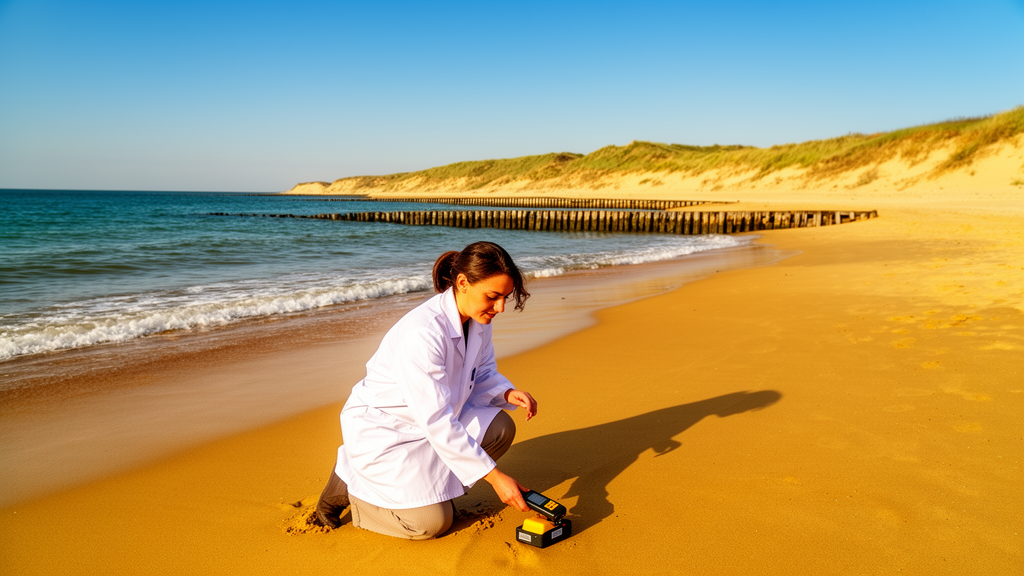
The sands that millions of holidaymakers walk across every summer along the Bulgarian Black Sea coast have now been put under the scientific microscope, and the verdict is reassuring: the natural radioactivity locked in these beach sediments sits comfortably below worldwide averages, and the levels of a lingering man-made isotope are remarkably low.
A research team collected sand from 33 locations stretching along the entire 354-kilometre Bulgarian coastline, from the village of Durankulak near the Romanian border down to Rezovo at the Turkish frontier. Roughly 200 kilometres of this shore consists of sandy beaches, formed over millennia by the weathering and erosion of igneous and metamorphic rocks in the surrounding terrain. Because such sediments naturally carry traces of radioactive elements from the Earth’s crust, measuring them offers a direct window into the radiological environment that residents and tourists experience every day.
Each sample was cleaned and dried in a laboratory oven at temperatures up to 60 degrees Celsius, then sealed into cylindrical containers for gamma-spectrometric analysis. The measurements relied on a semiconductor detector with a 60-cubic-centimetre crystal, operating at 1 kilovolt with a relative efficiency of 4.5 percent for the caesium-137 gamma line. To keep ambient background radiation from contaminating the results, the detector was wrapped in layered shielding of lead, aluminium, cadmium and polyethylene, and the resulting spectra were processed with dedicated software that calculated each isotope’s specific activity from its characteristic gamma peaks.
The analysis identified the classic natural radioactive fingerprint of beach sands: isotopes from the uranium-radium and thorium decay series, detected through gamma lines of daughter products such as lead-214, bismuth-214, actinium-228 and thallium-208, plus the primordial isotope potassium-40, identified by its 1460.80-kiloelectronvolt gamma line. On average, the sands contained 11.62 becquerels per kilogram of uranium-238, 6.82 becquerels per kilogram of thorium-232 and 396.55 becquerels per kilogram of potassium-40. Every one of these figures falls below the global averages of 35, 30 and 370 becquerels per kilogram respectively, as compiled by the United Nations Scientific Committee on the Effects of Atomic Radiation.
The spread between individual beaches tells its own story. Uranium-238 activities ranged from 5.80 becquerels per kilogram at Rezovo Beach to 28.30 at Irakli Beach, while thorium-232 mostly stayed between 3 and 12 becquerels per kilogram, with Irakli again standing out at 19.06. Potassium-40, the most abundant of the three natural isotopes, varied from roughly 209 to 705 becquerels per kilogram, peaking at Rapongi Beach in Varna and dipping lowest near the village of Tyulenovo. Frequency analysis showed that 84 percent of uranium measurements clustered between 7 and 16 becquerels per kilogram, 87 percent of thorium values sat between 5 and 10, and 70.5 percent of potassium readings fell between 240 and 550.
One artificial isotope also made an appearance. Caesium-137, a fission product of atmospheric nuclear weapons tests and reactor accidents, was detected in 11 of the 33 samples at concentrations between 1.4 and 3.4 becquerels per kilogram, with the highest value at Kavarna Beach. That average of 3.16 becquerels per kilogram is modest by any measure, and consistent with recent regional surveys, which have recorded caesium-137 in Black Sea sands at anywhere from 0.8 to 12.3 becquerels per kilogram. Its presence is a faint echo of mid-twentieth-century fallout in a basin that has long been considered one of the more radioactively studied marine environments in the world.
Using the GPS coordinates of every sampling point, the team generated geostatistical distribution maps that reveal how radioactivity varies along the coast. Uranium-238 proved fairly uniform, with its maximum at Irakli. Thorium-232 showed its lowest values in the northern Black Sea, with a single pronounced hot spot at Irakli Beach. Potassium-40 peaked near Tyulenovo and the Rai campsite at Kamchiya, while caesium-137 reached its highest concentrations around Kranevo village and the central beach of Golden Sands, with levels gradually rising toward the southern stretch of the coast.
Beyond raw isotope counts, the researchers calculated a battery of internationally recognised radiation hazard indices, including radium equivalent activity, gamma index, external and internal hazard indexes, outdoor absorbed dose rate, annual effective dose, excess lifetime cancer risk and absorbed dose rate in air. The averages were unremarkable in the best sense: an absorbed dose rate in air of 26.32 nanogray per hour against a world average of 84, an annual effective dose of 0.16 millisieverts per year against a global benchmark of 0.48, and a radium equivalent activity of 51.90 becquerels per kilogram, far under the 370 limit. External and internal hazard indexes came in at 0.14 and 0.17, both well below the safety threshold of one, and the estimated excess lifetime cancer risk of 0.11 per thousand sat below the reference value of 0.29. The maps of these indices flagged mild hot spots at Tyulenovo, the Rai campsite and Primorsko’s southern beach, with the lowest readings at Rezovo.
The statistical treatment went further than simple averages. Pearson correlation analysis across twelve radiological variables showed that 83 percent of the coefficients fell into the high or very high correlation ranges, confirming that the calculated hazard indices move in lockstep with the underlying isotope concentrations. Notably, thorium-232 correlated only weakly with the radiological parameters, leading the authors to conclude that thorium and its decay products exert the least influence on the natural radioactivity of these beaches. A hierarchical cluster analysis reinforced this picture, grouping ten radiological factors together while potassium-40 stood apart in its own cluster, and linking uranium-238 and thorium-232 most closely to the overall radiological parameter levels.
For beachgoers, the practical takeaway is simple: the sands of the Bulgarian Black Sea coast deliver a radiation dose well within internationally published limits set by UNSCEAR, the NEA-OECD and the International Commission on Radiological Protection. For scientists, the study provides a detailed baseline, complete with distribution maps and statistical relationships, against which any future changes in the coastal radiological environment can be judged, whether they stem from erosion, coastal development or the slow decay of legacy fallout still working its way through the Black Sea ecosystem.
Subject of Research: Radioactivity levels and radiation hazard indices in beach sands along the Bulgarian Black Sea coast
Article Title: Investigation of the radioactivity of sands collected from Bulgarian Black Sea coast
Article References: Arhangelova, N., & Salim, S. (2026). Investigation of the radioactivity of sands collected from Bulgarian Black Sea coast. BioRisk, 24, 103-117. https://doi.org/10.3897/biorisk.24.178091
Image Credits: AI Generated
DOI: 10.3897/biorisk.24.178091
Keywords: radioactivity, Black Sea, Bulgaria, beach sand, gamma spectrometry, radionuclides, caesium-137, potassium-40, uranium-238, thorium-232, radiation hazard indices, radiological assessment
Cite Scienmag News
Violet Maxwell. (October 16, 2026). Bulgarian Black Sea Sands Show Radioactivity Below Global Averages. Scienmag. https://scienmag.com/bulgarian-black-sea-sands-show-radioactivity-below-global-averages/
Violet Maxwell. "Bulgarian Black Sea Sands Show Radioactivity Below Global Averages." Scienmag, 16 October 2026, https://scienmag.com/bulgarian-black-sea-sands-show-radioactivity-below-global-averages/. Accessed 16 October 2026.
Violet Maxwell. "Bulgarian Black Sea Sands Show Radioactivity Below Global Averages." Scienmag. October 16, 2026. https://scienmag.com/bulgarian-black-sea-sands-show-radioactivity-below-global-averages/


