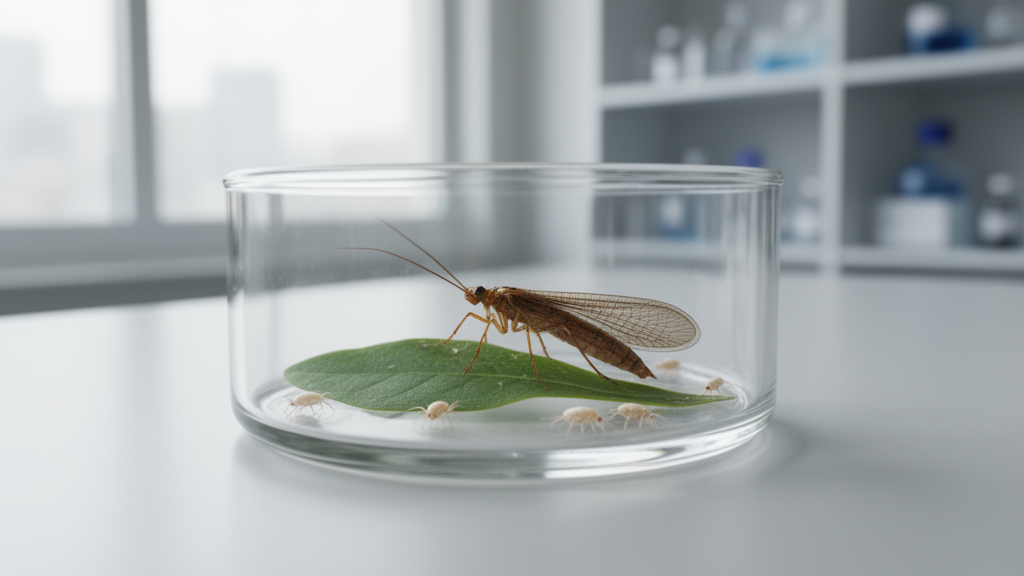
A laboratory study from Cairo University has found that the brown lacewing Sympherobius barberi, a small predatory insect being considered for biological pest control, survives dramatically better when its larvae are fed a storage mite rather than aphids. The total larval survival rate jumped from 31 percent on the Duranta aphid, Aphis durantae, to 89 percent on the acarid mite Tyrophagus putrescentiae, a difference the researchers describe as highly significant. The finding matters because the first larval stage of this predator is notoriously fragile in captivity, and mass-rearing programs for beneficial insects often stall at exactly that bottleneck.
The study, published in the Egyptian Journal of Biological Pest Control, is presented by Monir M. El Husseini, Samy M. Sayed, Ata Ata and Marwa M. A. Farag as the first investigation of the biology of S. barberi in Egypt. The authors collected adult lacewings with a simple light trap in April 2026, placed at night in gardens at the Faculty of Agriculture, Cairo University in Giza Governorate, where Duranta erecta plants were heavily infested with aphids. Attracted adults were caught in glass tubes and transferred to small chimney-glass rearing cages supplied with aphid-infested young Duranta leaves, an arrangement that allowed the researchers to see inside and count the eggs laid each day.
Sympherobius barberi belongs to the family Hemerobiidae, the brown lacewings, a group of roughly 27 genera and 560 known species whose adults and larvae are active predators of soft-bodied plant pests, including tetranychid mites, aphids, whiteflies and mealybugs. Geographically the species is reported across America, Europe, northern Asia and Oceania, and it is considered endemic to the continental United States, Canada and Mexico. In Mexico it has been identified as the second most abundant natural enemy of the cochineal insect Dactylopius opuntiae in prickly pear cactus growing regions, although work in Texas decades earlier had treated it as an infrequent predator of the same pest. In one applied example, the species was used against the Asian citrus psyllid Diaphorina citri, producing a reported 35 to 81 percent reduction in pest population.
For the experiment, the team ran four replicates of 25 individually reared larvae for each prey species, keeping everything under controlled laboratory conditions of 25 plus or minus 2 degrees Celsius, a 14:10 light-dark cycle and 65 plus or minus 7 percent relative humidity. Newly hatched larvae were placed one per rearing dish and fed either aphid-infested Duranta leaves or the mite T. putrescentiae, which the laboratory mass-produces on wheat bran in jars using a semi-artificial diet. The mite colonies were shaken gently twice a week for aeration, covered with fine gauze, and can be stored on wheat bran for five weeks at 5 degrees Celsius, a practical detail that matters for anyone trying to keep a continuous supply of prey available.
The developmental timings that emerged were broadly similar between the two diets. Egg incubation lasted between three and four days regardless of what the mothers had been fed, averaging 3.12 days for eggs that produced females and 2.20 days for those producing males. The first larval instar lasted around 3.4 days in both sexes on either prey, and the second instar roughly 2.2 to 2.5 days, with no significant differences. The third instar was the exception: female larvae took significantly longer on aphids, 6.4 days versus 5.48 days on mites. Female pupae lasted about 5.4 days and male pupae about 4.7 days, unaffected by larval diet. Overall, only the total immature period of females differed significantly, lasting 21 days on aphids versus 19.56 days on mites.
Survival told a very different story. Egg hatchability was 100 percent for eggs from females on both diets, and every larva that reached the pupal stage emerged successfully as an adult. But the larval stage itself was where the two prey diverged sharply. Only 45 percent of first-instar larvae survived on aphids, compared with 96 percent on the mite, a difference the authors report as highly significant. The second instar also survived significantly better on mites, at 94.83 percent versus 75.68 percent. By the third instar the gap had closed, with survival of 90.95 percent on aphids and 97.78 percent on mites, no longer statistically significant. The cumulative effect was the headline result: total larval survival of 31 percent on aphids against 89 percent on mites.
Adult performance was largely indifferent to larval diet. Male longevity averaged 6.36 days on the aphid diet and 6.20 days on the mite diet, while females lived longer, averaging 12.67 and 12.8 days respectively, with no significant difference in either sex. The pre-oviposition period was about 4.2 days on aphids and 4.32 days on mites, and the oviposition period ran 8.33 versus 8.48 days. Females reared on aphids laid between 30 and 44 eggs, averaging 36.6 eggs per female, while those on mites laid between 33 and 44 eggs, averaging 38.2, a small and statistically insignificant advantage for the mite diet. All females died after laying their last eggs, showing no post-oviposition period.
The demographic parameters, which combine survival and reproduction into population growth measures, were also nearly identical between diets. Reared on aphids, the intrinsic rate of increase was 0.1255, the net reproductive rate 36.61, the finite rate of increase 1.134, the mean generation time 28.68 days and the doubling time 5.523 days. On the mite diet the corresponding values were 0.1277, 35.16, 1.136, 27.88 days and 5.428 days. The authors report no significant differences between the two diets for these parameters, meaning the predator’s projected population growth is essentially the same whichever prey the larvae eat.
How do these numbers compare with earlier work on the same species? A previous study found that S. barberi larvae survived to pupation at an average of 70 percent when fed D. citri nymphs, but reached 100 percent on frozen eggs of the flour moth Ephestia kuehniella. Another investigation, using the cochineal insect as prey, recorded only 24.7 percent of first-instar larvae reaching the pupal stage, with the lowest survival in the first instar, where just 38.5 percent progressed to the second instar, a pattern the authors note matches their own aphid results. Those earlier studies also reported longer preimaginal development, around 27 to 32 days, compared with roughly 19 to 22 days in the present work, although the authors caution that insect development is strongly affected by laboratory temperature, humidity and photoperiod.
The authors conclude that the storage mite T. putrescentiae is a viable alternative prey for mass-rearing this brown lacewing, at least for the first and second larval instars, precisely the stages where mortality is worst on aphid diets. The mite is already used as an alternative prey for rearing predatory mites such as Amblyseius swirskii and Neoseiulus bicaudus, and for anthocorid bugs, where one study achieved 87 percent survival for Orius insidiosus and another raised Orius majusculus survival to 90.3 percent on mites versus 79.3 percent on thrips. Because S. barberi is considered polyphagous, the authors suggest further studies with different prey to compare its demographic parameters with related species. The comparison should be read with care, since the predator species it is measured against were reared on different prey, and all results here come from a single laboratory colony under one set of controlled conditions rather than field trials.
Subject of Research: Laboratory rearing biology and demographic parameters of the brown lacewing Sympherobius barberi on two prey species
Article Title: Biological and demographic parameters of the microneuropteran brown lacewing, Sympherobius barberi Banks (Neuroptera: Hemerobiidae) reared on two different preys
Article References: El Husseini, M. M., Sayed, S. M., Ata, A., & Farag, M. M. A. (2026). Biological and demographic parameters of the microneuropteran brown lacewing, Sympherobius barberi Banks (Neuroptera: Hemerobiidae) reared on two different preys. Egyptian Journal of Biological Pest Control, 36(1), Article 32. https://doi.org/10.1186/s41938-026-00913-3
Image Credits: AI Generated
DOI: 10.1186/s41938-026-00913-3
Keywords: brown lacewing, Sympherobius barberi, Hemerobiidae, biological control, mass rearing, Tyrophagus putrescentiae, Aphis durantae, larval survival, demographic parameters, intrinsic rate of increase, Egypt, predatory insects
Cite Scienmag News
Gavin Prescott. (October 28, 2026). Brown Lacewing Rears Better on Storage Mite Than Aphid, Study Finds. Scienmag. https://scienmag.com/brown-lacewing-rears-better-on-storage-mite-than-aphid-study-finds/
Gavin Prescott. "Brown Lacewing Rears Better on Storage Mite Than Aphid, Study Finds." Scienmag, 28 October 2026, https://scienmag.com/brown-lacewing-rears-better-on-storage-mite-than-aphid-study-finds/. Accessed 30 October 2026.
Gavin Prescott. "Brown Lacewing Rears Better on Storage Mite Than Aphid, Study Finds." Scienmag. October 28, 2026. https://scienmag.com/brown-lacewing-rears-better-on-storage-mite-than-aphid-study-finds/