

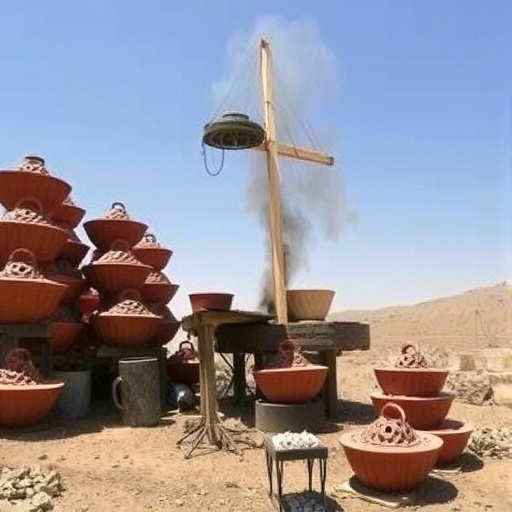
In a groundbreaking study published in the journal “Archaeological and Anthropological Sciences,” researchers have unveiled new insights into Middle Bronze Age copper smelting practices in the Wadi Arabah region. This research serves as a pivotal addition to our understanding of ancient metallurgy, a field that has often been shrouded in mystery due to limited archaeological evidence. The study, authored by Liss and colleagues, delves into the techniques and technologies that ancient civilizations utilized to extract and process copper, a vital metal for their time.
The researchers embarked on this investigation with the goal of filling a significant gap in the historical record concerning copper production during the Middle Bronze Age. Although scholarly work has previously touched upon copper usage, there has been a notable lack of comprehensive data regarding the actual smelting processes employed by these early metallurgists. Wadi Arabah, a crucial historical trade route, was a strategic location where evidence of ancient smelting sites has been sporadically discovered, prompting further examination.
Through rigorous fieldwork and advanced analytical methods, the study identifies the environmental and geological factors that played a key role in the selection of smelting sites across the Wadi Arabah. By analyzing the mineral composition of the local ores, the authors provide evidence suggesting that ancient metallurgists had a sophisticated understanding of their natural surroundings. This knowledge enabled them to selectively mine for copper-rich ores, demonstrating an early form of resource management.
Particularly astounding is the revelation that the smelting techniques utilized were complex and involved multiple stages. The researchers describe how copper was not merely extracted in its raw form but underwent a series of carefully controlled processes that refined the metal to achieve the desired purity. This level of sophistication indicates a rich tradition of metallurgical knowledge that has profound implications for understanding technological advancement in ancient cultures.
A notable aspect of the study is the insights it provides into the social dynamics surrounding copper production. The authors speculate on the community organization required for such an enterprise, suggesting that smelting was not an isolated activity. Instead, it likely involved collaborative efforts among specialized craftsmen, laborers, and probably even trade networks that distributed the final products. This intertwining of social and economic factors within the context of metallurgy reflects broader patterns of human interaction during the Middle Bronze Age.
Furthermore, the findings shed light on the trade connections that may have existed between communities in the Wadi Arabah and other regions. By examining material culture and isotope analyses of copper artifacts, the study posits that there were exchanges of both goods and knowledge that transcended geographical boundaries. Such interactions could have facilitated the diffusion of metallurgical techniques and fostered cultural integration among neighboring civilizations.
In terms of technical methodologies, the researchers employed a range of modern scientific analyses including scanning electron microscopy and X-ray fluorescence spectroscopy. These advanced techniques allowed them to study the microstructural characteristics of the copper artifacts and to ascertain the specific alloy compositions used by the ancient metallurgists. The precision of these analyses serves to authenticate the historical significance of their findings.
The significance of these research outcomes transcends mere academic interest; it has the potential to reshape current narratives about technological developments in the ancient Near East. With the study’s revelations about the complexity of copper smelting processes, there is an urgent call for re-examining the chronology of technological advancements commonly associated with later historical periods. Such a reassessment could have profound implications on our understanding of progress in human societies.
Moreover, the study emphasizes the importance of interdisciplinary approaches in archaeology and anthropology. By integrating geological, chemical, and social science perspectives, the researchers have crafted a multifaceted view of ancient practices. This holistic approach not only enriches the investigation of past societies but also sets a new precedent for future research endeavors.
Ultimately, this research underscores the notion that metallurgy was not merely a means of producing tools and artifacts but was deeply enmeshed in the fabric of daily life, economies, and even ideologies of the time. The findings point towards a complex interplay between technology and culture that is foundational in the study of ancient civilizations.
As our understanding of the Middle Bronze Age continues to evolve, studies like this one provide vital threads in the intricate tapestry of human history. By illuminating the details of copper smelting in Wadi Arabah, the authors contribute to a larger narrative of human ingenuity and resilience. Such insights foster appreciation for the technological achievements of our ancestors and their lasting influence on contemporary practices.
In conclusion, the research conducted by Liss and colleagues opens new avenues for exploration within the realms of archaeology, anthropology, and metallurgy. Their work not only unearths the past but propels further inquiry into the societal structures, technological advancements, and cultural interactions that defined an era so crucial to human development.
Subject of Research: Middle Bronze Age copper smelting in the Wadi Arabah.
Article Title: Middle Bronze Age copper smelting in the Wadi Arabah: filling the gap.
Article References:
Liss, B., Yahalom-Mack, N., Avner, U. et al. Middle Bronze Age copper smelting in the Wadi Arabah: filling the gap.
Archaeol Anthropol Sci 17, 212 (2025). https://doi.org/10.1007/s12520-025-02294-4
Image Credits: AI Generated
DOI: https://doi.org/10.1007/s12520-025-02294-4
Keywords: Middle Bronze Age, copper smelting, Wadi Arabah, ancient metallurgy, archaeological science.


