

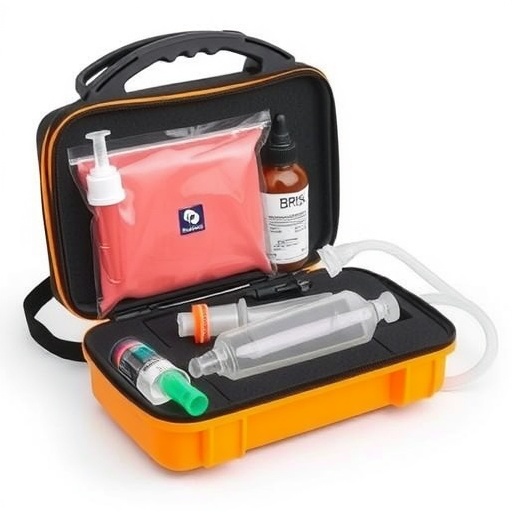
In the rapidly evolving field of medical technology, the ability to respond effectively to emergencies can prove to be a matter of life or death. In recent developments highlighted in the Annals of Biomedical Engineering, researchers have focused their attention on a crucial aspect of emergency medical response: suction devices. A team led by experts Peri, Londono, and Hasan has explored the innovative design of a groundbreaking tool known as the Battlefield Ready Innovative Suction Kit (BRISK), specifically tailored for urgent situations. Their efforts not only address immediate medical concerns but also pave the way for a revolution in emergency medical technology.
The BRISK kit is a culmination of rigorous research aimed at enhancing medical emergency responses in chaotic environments, such as battlefields or disaster zones. Traditional suction devices have often been bulky, cumbersome, and challenging to operate under pressure. The researchers recognized these limitations and sought to devise a more practical solution. The BRISK kit is designed with portability and ease of use in mind, ensuring that medical personnel can react swiftly and effectively when time is of the essence.
One of the most notable features of the BRISK kit is its lightweight construction. Weighing significantly less than conventional suction devices, the kit has been engineered for portability without sacrificing functionality. The intricate design allows for efficient suction capabilities, making it suitable for a wide range of medical emergencies, including airway obstructions, trauma care, and wound management. By addressing the weight factor, the team is ensuring that healthcare providers can carry the equipment with minimal hindrance when every second counts.
In terms of technical specifications, the BRISK kit employs state-of-the-art components that enhance suction performance while ensuring user safety. The suction pressure is adjustable, allowing medical professionals to tailor their approach depending on the patient’s needs. This level of customization is critical in emergency situations where injuries may vary significantly in severity and nature. Moreover, the kit includes features that simplify cleaning and maintenance, ensuring that the equipment remains hygienic and ready for use at a moment’s notice.
The developers also prioritized user-friendliness when designing the BRISK kit. Incorporating intuitive controls and clear visual indicators, the device minimizes the learning curve for medical personnel who may need to operate it under stress. Extensive user testing has led to a design that integrates seamlessly into emergency protocols, ensuring that practitioners can focus on the patient rather than the equipment.
The versatility of the BRISK kit is another aspect that sets it apart. It can be effectively utilized in various scenarios—be it in the civilian medical field during a natural disaster or on the battlefield during military engagements. This adaptability broadens its potential impact, making it a valuable asset for hospitals, military medical units, and emergency response teams globally. The research team believes that the BRISK kit could significantly improve patient outcomes across numerous contexts.
The implications of this technological advancement extend beyond immediate active medical response. By equipping frontline medical personnel with better tools, there is a direct influence on the overall effectiveness of emergency response infrastructures. The BRISK kit not only serves as a practical response tool but also contributes to the efficiency of healthcare systems, particularly in areas where resources may be strained.
The ongoing research into suction technology reflects a significant shift towards prioritizing innovation in medical operations. The advent of tools like the BRISK kit emphasizes the importance of research-driven approaches to designing medical technologies specifically for challenging environments. As the team continues to refine the kit based on user feedback and further testing, they are committed to ensuring that the device remains at the cutting edge of medical emergency technology.
Looking to the future, the research team is also investigating the integration of smart technology within the BRISK kit. Potential applications could include app connectivity for remote monitoring or data-sharing with hospital systems, enhancing the coordination of care between front-line workers and hospital staff. As medical technology progresses, integrating data analytics into emergency devices will likely become the norm rather than the exception.
In summary, the BRISK kit represents a pivotal advancement in emergency medical response technology. By combining portability, performance, and user-friendly design, the research team has created a tool that stands to redefine how medical emergencies are managed in high-pressure environments. The development of the BRISK kit is indicative of what the future of medical technology holds—a future where immediacy and efficiency lead to better patient outcomes and, ultimately, save lives.
As researchers continue their work on enhancing and perfecting the BRISK kit, the commitment to field-ready solutions is paramount. The ongoing dialogue within the medical community about the importance of innovation ensures that the insights garnered from the BRISK project will contribute to the next generation of medical devices. This relentless quest for improvement highlights an essential truth in healthcare: when it comes to saving lives, there is no room for complacency.
In conclusion, the work done by Peri, Londono, Hasan, and their team embodies the spirit of innovation that characterizes the biomedical field. The BRISK kit is not just a prototype; it represents a vision for a future where technology plays an instrumental role in emergency medical care, making it both safer and more efficient.
Subject of Research: Emergency medical suction devices
Article Title: Correction to: Field-Ready Suction Solutions for Emergencies: The Battlefield Ready Innovative Suction Kit (BRISK)
Article References:
Peri, S.R., Londono, M.J., Hasan, R. et al. Correction to: Field-Ready Suction Solutions for Emergencies: The Battlefield Ready Innovative Suction Kit (BRISK).
Ann Biomed Eng (2026). https://doi.org/10.1007/s10439-026-03972-7
Image Credits: AI Generated
DOI: 10.1007/s10439-026-03972-7
Keywords: Medical technology, emergency response, suction device, BRISK kit, biomedical engineering, innovative solutions.


