


More than 70 high school students and science teachers gathered at Young Middle School in Arlington this summer to learn about quantum information science (QIS). The annual workshop and camp are part of a national pilot program called Quantum for All led by Karen Jo Matsler, assistant professor in practice and master teacher in the UTeach program at The University of Texas at Arlington.

Credit: Courtesy UT Arlington
More than 70 high school students and science teachers gathered at Young Middle School in Arlington this summer to learn about quantum information science (QIS). The annual workshop and camp are part of a national pilot program called Quantum for All led by Karen Jo Matsler, assistant professor in practice and master teacher in the UTeach program at The University of Texas at Arlington.
“Just the word ‘quantum’ scares people, which is why many teachers and school administrators avoid it, thinking the concepts are too complicated,” Dr. Matsler said. “My goal is to give teachers the confidence and the tools to teach it.”
Although QIS is used for everything from cellphones to computers to MRI machines, most students do not receive any education on its principles until late into their college careers. This delay causes many to miss out on well-paying QIS jobs. By some estimates, the QIS technology market will be worth $44 billion by 2028, yet there are major talent shortages, with the number of open jobs outnumbering the number of qualified applications by about 3 to 1.
Matsler’s Quantum for All program aims to fill this learning gap by providing training and curriculum tools for high school science teachers, with assistance from a nearly $1 million grant from the National Science Foundation.
The summer workshop featured a week of learning for 35 teachers hailing from around the country. A few of those in attendance were UTA alumni, including Lauren Adams (’24 B.A., Biology), Victor Cervantes (’18 B.S., Physics) and Jaime Govea (’18 B.S., Physics). Over a week, they learned how to implement QIS topics into their respective classrooms.
“This is my third year attending the program—I started as an attendee and now I’m a leader,” said Cervantes, who teaches in the Forney Independent School District.
The teachers immediately put that training into practice the following week during the Quantum for All camp, where they taught QIS to 41 high school students from the Dallas-Fort Worth area.
“This fall will be my first year to teach on my own, so I really like having the opportunity to practice teaching these concepts during the camp with a smaller group of students and less pressure to move on to other physics topics,” said Adams, a teacher in the Fort Worth Independent School District.
“Unlike other summer institutes, the ‘Quantum for All’ camp allowed us to apply our training to a group of students for a week of stellar instruction,” said Govea, a teacher in Mesquite Independent School District.
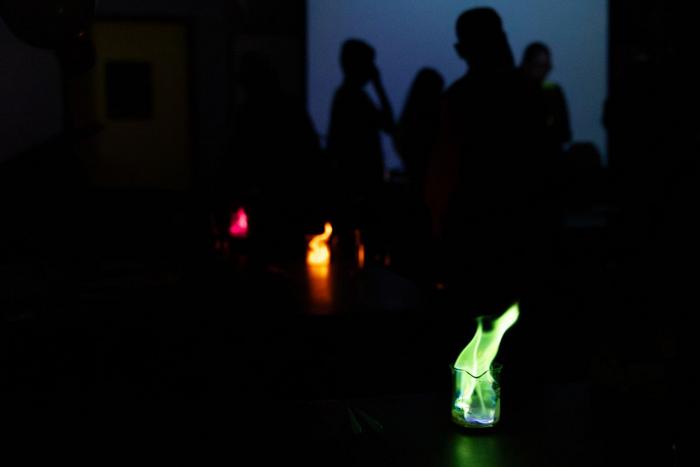
One of the camp’s hands-on lab activities included using solenoids, magnets, the electricity of about three 9-Volt batteries, and toy cars to simulate how the large hadron collider, the world’s largest and most powerful particle accelerator, can accelerate particles so they are traveling 99.99% the speed of light. The students also analyzed six different metal chloride flame tests to determine the unique emission spectra. They were then able to identify the various metal ions based on what they saw using diffraction glasses.
Matsler’s passion to bring quantum physics to the high school classroom has also led the state of Texas to start including quantum concepts in the Texas Essential Knowledge and Skills (TEKS), the curriculum standards set by the Texas Education Agency for public schools. She has also helped with the development of a national framework of QIS key concepts for grades K-12, which she hopes will be integrated into national STEM standards and curricula.
“This fall will be the first year Texas students will have specific quantum concepts included in TEKS,” said Matsler. “So far, Texas is one of only a handful of states that have quantum principles as part of the required curriculum, but our goal is to bring the concepts to all high school science classrooms.”
Cite Scienmag News
Katie Riggs. (July 10, 2024). Bringing quantum tools to high school classrooms. Scienmag. https://scienmag.com/bringing-quantum-tools-to-high-school-classrooms/
Katie Riggs. "Bringing quantum tools to high school classrooms." Scienmag, 10 July 2024, https://scienmag.com/bringing-quantum-tools-to-high-school-classrooms/. Accessed 5 September 2026.
Katie Riggs. "Bringing quantum tools to high school classrooms." Scienmag. July 10, 2024. https://scienmag.com/bringing-quantum-tools-to-high-school-classrooms/

