


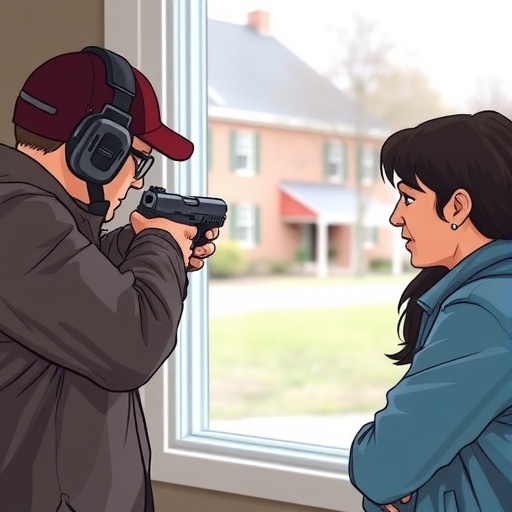
A brief, respectful conversation about firearm safety can substantially increase gun owners’ willingness to temporarily store their weapons outside the home during a personal or household crisis, according to a Rutgers-led study. The finding is significant because firearms are highly lethal and can turn a short-lived suicidal crisis into a fatal event within minutes. Researchers say that making a firearm less immediately accessible—without requiring a permanent change in ownership—may create enough time for distress to pass, help to arrive or a person in crisis to reconsider an impulsive decision. The study examined Project Safe Guard, a short intervention designed to encourage safer firearm storage, and found that its effects were especially pronounced among people who initially rejected the idea of storing a gun elsewhere.
The research was conducted by investigators at the New Jersey Gun Violence Research Center at Rutgers and analyzed data from 232 members of the Mississippi National Guard who reported having firearms in their homes. Participants were drawn from an original randomized controlled trial of Project Safe Guard, allowing researchers to compare the intervention with a control conversation focused on other aspects of health and home safety. This design is important because it distinguishes changes associated with the firearm-safety discussion from changes that might occur simply because participants were contacted, interviewed or encouraged to think about household safety. The researchers assessed participants’ attitudes before and after the conversation, then followed up with them three and six months later.
Project Safe Guard lasted approximately 15 minutes and focused on secure firearm storage and the circumstances in which access to a gun might become dangerous. Participants were asked whether they would be willing to have someone they trusted temporarily store their firearm if they, or another member of their household, became highly distressed. The question addressed a crisis-specific safety measure rather than permanent disarmament or the surrender of firearms. That distinction matters because resistance to temporary out-of-home storage may stem from concerns about self-reliance, personal security, inconvenience, privacy or the belief that a crisis will never affect one’s own household. A short, voluntary conversation can address those concerns while preserving the participant’s sense of autonomy.
The results showed that participants who received Project Safe Guard became significantly more willing to consider storing their firearms away from home if they themselves experienced severe emotional distress. The researchers also observed an increase in willingness when the hypothetical crisis involved another household member, although that effect was smaller. The strongest change appeared among participants who initially said they were not at all willing to use out-of-home storage. Immediately after the intervention, 56.5 percent of these participants reported at least some willingness to consider temporarily storing their firearm outside the home. In the comparison group, only 20.8 percent expressed such willingness, meaning the proportion was more than twice as high among those who received the firearm-safety conversation.
The investigators describe this shift as a change in an important psychological barrier: whether people can imagine using a safety strategy before an emergency occurs. During a suicidal crisis, decision-making can become narrowed and highly dependent on whatever means are immediately available. Firearm access is therefore considered a “lethal means” issue in suicide prevention. Lethal means safety interventions do not assume that distress can always be prevented or that suicidal thoughts can be eliminated instantly. Instead, they seek to increase the physical distance and time between a person in crisis and a potentially fatal method. Technical studies of suicide prevention have repeatedly suggested that adding delay or reducing access can save lives because many suicidal crises are transient, while a firearm can make an impulsive act irreversible.
The effect did not disappear completely during follow-up, but it weakened over time. Among participants who had initially rejected out-of-home storage, 68.4 percent of those assigned to Project Safe Guard reported some willingness to consider the practice three months later, compared with 36.4 percent of participants in the comparison group. By six months, however, the difference between the groups was smaller and no longer statistically significant. This pattern suggests that a single conversation may change attitudes quickly but may not permanently alter behavior or preferences. The fading effect also points to the potential value of repeated counseling, reminders or easy-to-use storage options that make a safety decision practical when a crisis actually develops.
The study measured willingness, not real-world firearm storage. That limitation is central to interpreting the findings. A person may say that temporary storage is acceptable but still fail to arrange it because of legal uncertainty, a lack of trusted people nearby, concerns about transportation, fear of losing access for protection or uncertainty about how a firearm can be stored lawfully. Regulations governing transfers, storage and access vary across the United States, and some gun owners may not know whether a friend, relative, retailer, range or law-enforcement agency can legally hold a firearm for a limited period. The researchers argue that improving the availability and familiarity of temporary storage services will be necessary if increased willingness is to translate into actual safety behavior.
The Mississippi National Guard sample also limits how broadly the findings can be generalized. Service members may differ from other firearm owners in their experiences with weapons, military culture, perceptions of risk and attitudes toward self-reliance. The researchers further noted that not every Project Safe Guard session specifically discussed out-of-home storage, a design feature that may have reduced the intervention’s apparent effect. Even so, the response among initially unwilling participants suggests that direct persuasion is not the only mechanism involved. A respectful discussion may help people recognize that storing a firearm away from home during a crisis is not a judgment about ownership, character or competence, but a temporary risk-management decision.
Michael Anestis, executive director of the New Jersey Gun Violence Research Center and lead author of the study, said many firearm owners are understandably hesitant to consider placing their weapons elsewhere, even when they acknowledge that a crisis can change the safety of having a gun readily available. The researchers describe Project Safe Guard as part of a broader approach in which clinicians, public-health professionals and trusted community figures discuss firearm storage without coercion or stigma. Earlier research found that the intervention could increase secure storage practices within the home. The new findings extend that work by indicating that a brief conversation may also broaden consideration of out-of-home storage, particularly during periods when someone’s risk of suicide is elevated.
The authors say the next challenge is determining whether these changes in attitude lead to measurable reductions in firearm access during crises and, ultimately, fewer suicides. Future research could test repeated counseling, crisis-response plans created in advance, partnerships with firearm retailers and ranges, and state-specific systems for temporary storage. It could also examine how family members, health-care providers and military leaders can raise the subject in ways that are acceptable to firearm owners. For now, the Rutgers study offers evidence that a conversation lasting only about 15 minutes can shift views on a highly sensitive safety measure. The result does not prove that Project Safe Guard prevents suicide by itself, but it suggests that opening the door to temporary firearm storage may be a realistic and potentially powerful step in moments when time and distance can determine whether a crisis becomes fatal.
Article Publication Date: 28-Aug-2026
Web References: New Jersey Gun Violence Research Center at Rutgers; https://onlinelibrary.wiley.com/doi/full/10.1111/sltb.70131; https://pubmed.ncbi.nlm.nih.gov/28294383/; https://jamanetwork.com/journals/jamanetworkopen/fullarticle/2836421; https://ajph.aphapublications.org/doi/10.2105/AJPH.2020.306019
References: Suicide and Life-Threatening Behavior; DOI: 10.1111/sltb.70131
Keywords
Firearm safety, suicide prevention, lethal means safety, out-of-home firearm storage, Project Safe Guard, gun violence, crisis intervention, mental health, National Guard, behavioral science
Cite Scienmag News
Denise Maddox. (August 15, 2026). Brief firearm safety conversations may encourage storing guns outside the home. Scienmag. https://scienmag.com/brief-firearm-safety-conversations-may-encourage-storing-guns-outside-the-home/
Denise Maddox. "Brief firearm safety conversations may encourage storing guns outside the home." Scienmag, 15 August 2026, https://scienmag.com/brief-firearm-safety-conversations-may-encourage-storing-guns-outside-the-home/. Accessed 3 September 2026.
Denise Maddox. "Brief firearm safety conversations may encourage storing guns outside the home." Scienmag. August 15, 2026. https://scienmag.com/brief-firearm-safety-conversations-may-encourage-storing-guns-outside-the-home/


