

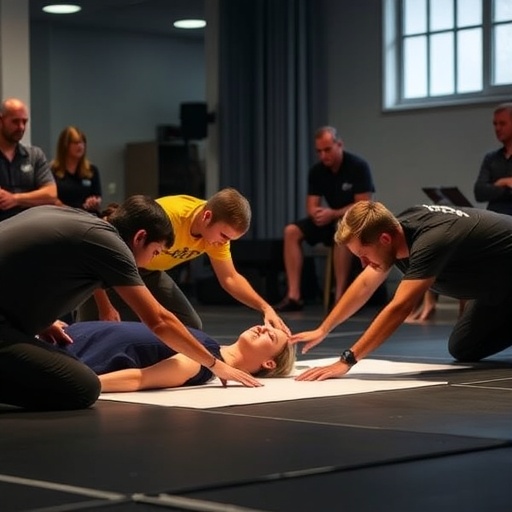
In a groundbreaking study published in 2025, researchers led by Wang et al. dove deep into the theory-practice discrepancy observed in cardiopulmonary resuscitation (CPR) performance among emergency healthcare providers in China. The findings of this multi-centre evaluation have ignited discussions in the medical community and beyond, highlighting a crucial gap between established CPR training protocols and the actual application of these skills in emergency situations.
CPR is a lifesaving procedure performed when the heart stops beating. It is a skill that requires not only theoretical knowledge but also practical proficiency and the ability to perform under pressure. Despite extensive training, many healthcare providers encounter real-world scenarios that present complexities absent from their training environments. This study sheds light on those disparities by meticulously evaluating the performance of practitioners across various hospitals in China.
To assess the CPR performance effectively, the researchers designed a robust methodology encompassing both quantitative and qualitative metrics. Data were collected from a diverse group of emergency healthcare providers, reflecting a wide range of experience levels and training backgrounds. Utilizing both video recordings and direct observation, the researchers could capture how providers executed CPR techniques in real-time situations, revealing critical insights that go beyond mere self-reported competency.
One of the most concerning findings of the study was the variability in CPR technique execution among different providers. Even when healthcare workers had similar training backgrounds, their performance varied significantly due to factors including stress levels, environmental conditions, and the presence of bystanders. Many healthcare providers cited anxiety and a lack of confidence as major barriers to effective CPR performance, emphasizing the psychological stresses that can accompany emergency medical situations.
Additionally, the study illustrated the importance of ongoing training and simulation exercises in bridging the gap between theoretical knowledge and practical application. While initial training is crucial, regular refresher courses and realistic simulation scenarios are necessary to maintain skills and adapt to the pressures of real-life situations. The researchers advocate for the integration of more comprehensive training programs that address these psychological aspects, along with practical skills, to enhance overall performance in life-threatening situations.
Another area addressed by the study was the need for a standardized assessment method to objectively evaluate CPR performance across different institutions. By establishing clear benchmarks and performance indicators, hospitals can create specialized training modules that focus on their healthcare providers’ weaknesses. This custom-focused approach not only improves outcomes but also fosters a culture of continuous learning and improvement within medical professions.
The potential implications of the study extend beyond China, as the findings resonate with healthcare systems worldwide. The research suggests that many countries may face similar challenges regarding CPR training and performance discrepancies among healthcare providers. It opens up a vital conversation about the global standards of medical training and the need for international collaborations to strengthen emergency care practices.
As part of the study, Wang et al. also emphasized the importance of technological integration in CPR training. Virtual reality simulations and artificial intelligence tools can offer practitioners a platform to hone their skills in a risk-free environment. Such innovative approaches allow for the modeling of high-pressure scenarios and promote an immersive learning experience, encouraging greater retention of skills and confidence in their application during actual emergencies.
The study’s conclusions urge practitioners and medical educators alike to critically evaluate existing training protocols and consider revisions based on empirical data. Moreover, it calls upon healthcare policymakers to prioritize the enhancement of emergency response training as a fundamental component of healthcare delivery. By fostering a more robust and realistic training framework, it may be possible to significantly improve survival rates following cardiac arrests.
In conclusion, the striking contrast between the theory and practice of CPR observed in this study serves as a clarion call for reform in emergency medical training programs. It highlights an urgent need for healthcare systems worldwide to adapt and evolve their training methodologies to better prepare providers for the realities they will face in the field. By addressing these gaps, we can improve the overall efficacy of CPR and other emergency interventions, ultimately saving more lives in critical situations.
As the medical community digests these findings, it is imperative that collaboration and dialogue continue. Researchers, educators, and practitioners must come together to refine emergency training protocols and embrace innovative solutions that prioritize both theoretical knowledge and practical skill application. Only then can we hope to close the training gap and ensure that emergency healthcare providers are equipped for success in their most critical moments.
The study by Wang et al. is a vital contribution to the conversation around emergency healthcare training, and it paves the way for future research aimed at improving lifesaving techniques in medical practice.
Subject of Research: Theory–practice discrepancy in CPR performance.
Article Title: Theory–practice discrepancy in cardiopulmonary resuscitation performance: a multi-centre evaluation of emergency healthcare providers in China.
Article References:
Wang, H., Liang, Jj., Zhang, Zl. et al. Theory–practice discrepancy in cardiopulmonary resuscitation performance: a multi-centre evaluation of emergency healthcare providers in China.
BMC Med Educ (2025). https://doi.org/10.1186/s12909-025-08433-8
Image Credits: AI Generated
DOI:
Keywords: CPR, emergency healthcare, training discrepancies, medical education, psychological factors in resuscitation, simulation training, healthcare improvement.


