

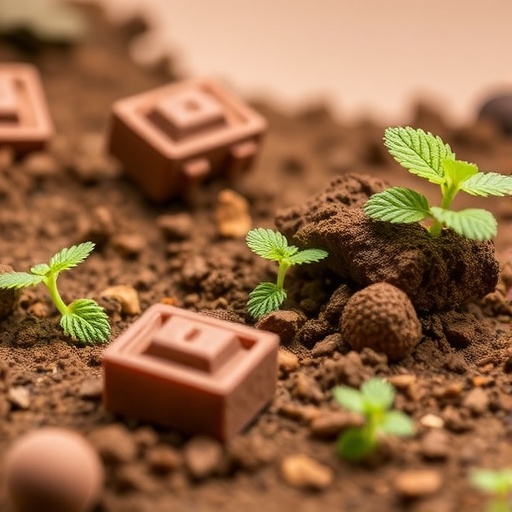
Bacteria, the most ubiquitous life forms on Earth, have always intrigued scientists, particularly regarding their adaptability to extreme environments. Researchers from the Indian Institute of Science (IISc) have recently delved into how these microorganisms, specifically the species Sporosarcina pasteurii, react when exposed to perchlorate, a toxic chemical prevalent in Martian soil. This study not only sheds light on bacterial resilience but also raises significant implications for future extraterrestrial colonization efforts.
Perchlorate is a chlorine-based chemical compound that has been detected in the Martian soil during various exploratory missions. Originally considered to be a significant obstacle for Earth-based microorganisms, scientists have discovered that perchlorate does not merely hinder bacterial survival but also influences biocementation processes. Aloke Kumar, the lead researcher and an associate professor at IISc, emphasizes the importance of understanding how Earth-origin organisms respond to Martian conditions. This interrogation transcends beyond mere microbial growth; it dives deep into the potential of utilizing these bacteria for constructing habitats on extraterrestrial surfaces.
The research team initially explored the biocementation capabilities of Sporosarcina pasteurii, which forms bricks from Martian regolith. Utilizing a combination of urea, calcium, and a natural adhesive known as guar gum, this bacterium produces calcium carbonate. This biochemical reaction results in solid aggregates, gluing soil particles together and offering a promising solution for building structures in alien environments. In this recent endeavor, the researchers leveraged a robust strain of the bacterium that they discovered in Bengaluru’s soils.
By simulating Martian conditions in the laboratory, the researchers introduced various concentrations of perchlorate into the prepared soil mixture. The outcome was unexpected; although the presence of perchlorate induced stress in the bacterial cells, resulting in slower growth and morphology changes—such as becoming more circular and forming multicellular structures—these stressed cells exhibited enhanced biocementation capabilities. Electron microscopy unveiled an increase in precipitates resembling calcium chloride, forming microscale bridges between the bacterial cells and surrounding soil particles.
Kumar’s findings challenge pre-existing notions surrounding perchlorates as merely detrimental. Instead, the findings revealed that, when combined with additional ingredients like guar gum and nickel chloride, perchlorate can significantly improve the structural integrity of the resultant ‘bricks.’ This synergistic effect elucidates a complex interaction where the environmental stressors mobilize adaptive mechanisms within the bacteria, potentially enhancing their utility in biocementation.
Swati Dubey, the first author of the study, argues that the duality of perchlorate—its role as a stressor and an enhancer—requires further examination. The extracellular matrix (ECM) produced by the bacteria may play a critical role in nutrient transportation, thereby facilitating improved infrastructure formation. Future research will aim to analyze these microbridges’ contribution more deeply, especially under atmospheric conditions simulating Mars’s elevated CO2 levels.
By pioneering biocementation processes tailored for Martian applications, the IISc team is paving the way for sustainable extraterrestrial construction methods. Cement production is notorious for its carbon emissions; hence, harnessing biology for construction purposes could offer a more ecological approach not only in space endeavors but also on Earth. The long-term vision is for in situ resource utilization—minimizing the need to transport materials from Earth, which could significantly reduce costs and logistical challenges associated with interplanetary missions.
Building habitats on Mars poses various challenges, including stability in the face of the planet’s uneven terrain. The IISc research may lead to developing robust roads, launch pads, and other necessary structures, thereby improving the feasibility of long-term human presence. As co-author Shubhanshu Shukla observes, effective construction techniques could mitigate common mishaps experienced during lander missions.
The implications of this research resonate far beyond mere curiosity about bacterial behavior. They offer tangible solutions for future Mars missions, where establishing habitable environments could revolutionize humanity’s relationship with the cosmos. If these microorganisms can adapt and thrive in such harsh conditions, they open doors to the possibility of sustainable life beyond Earth.
The ongoing investigations aim not just for success in fabricating building materials for Martian habitats but also to lay the groundwork for future scientific explorations. The ultimate goal is to explore how we can adaptively use Earth-origin sources to survive and thrive on Mars, allowing for the possibility of human habitation.
This multifaceted study represents a significant leap into uncharted territories, where biology meets engineering, and science fiction steadily advances toward reality. As researchers continue to stimulate inquiry into the adaptability of Earth life forms, understanding the potential uses of such organisms on alien planets keeps the dream of interplanetary colonization alive.
Thus, as we tread closer to a future where humanity may inhabit Mars, the research into Sporosarcina pasteurii and perchlorate interactions exemplifies the possibilities for a new age of exploration. It exemplifies how curiosity-driven science can unveil innovative pathways that could ultimately help us forge a future among the stars.
Subject of Research: Effects of perchlorate on biocementation capable bacteria and Martian bricks
Article Title: Effect of perchlorate on biocementation capable bacteria and Martian bricks
News Publication Date: 29-Jan-2026
Web References: http://dx.doi.org/10.1371/journal.pone.0340252
References: PLOS One
Image Credits: Credit: Aloke Lab, IISc
Keywords: Sporosarcina pasteurii, perchlorate, biocementation, Mars, extraterrestrial habitation, IISc, Aloke Kumar, sustainable construction, calcium carbonate, microbiology, astrobiology, Mars colonization.


