

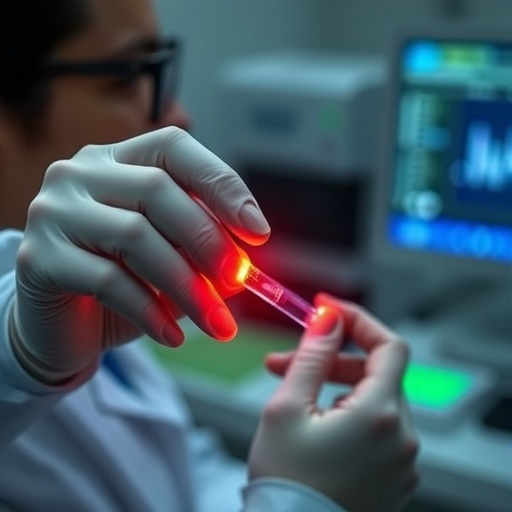
A groundbreaking advancement in disease diagnostics has emerged from a research team at La Trobe University, pioneering a single-use biosensor test strip with the potential to revolutionize how illnesses such as cancer are detected. This innovative technology leverages enzymatic signal amplification to identify microRNAs—small, non-coding molecules that serve as crucial biomarkers, providing some of the earliest indicators of disease presence. Their ultra-sensitive detection surpasses current methodologies, promising unprecedented accuracy and accessibility in point-of-need diagnostics.
The research, extensively detailed in the journal Small, presents a cutting-edge electrochemical biosensor that functions similarly to conventional glucose monitoring strips but with far greater sensitivity. While glucose test strips detect sugar molecules in the millimolar concentration range, the La Trobe team’s biosensor distinguishes microRNAs present in blood plasma at attomolar levels—concentrations up to a trillion times lower. This monumental leap in detection sensitivity addresses one of the central challenges in molecular diagnostics: identifying trace biomolecules long before they manifest as symptomatic disease.
At the heart of the technology lies a duplex-specific DNase (DSN) enzyme that dramatically amplifies the electrochemical signal generated upon microRNA binding. This enzymatic amplification enhances the measurable electrical response, allowing direct correlation between signal attenuation and microRNA concentration in the tested sample. The biosensor’s mechanism utilizes a DNA probe immobilized on an electrode surface that hybridizes selectively with target microRNAs. Once hybridized, the DSN enzyme selectively cleaves the probe in DNA-RNA duplexes, triggering an amplified decrease in the electrical signal.
Unlike traditional methods such as Polymerase Chain Reaction (PCR), which require complex, laboratory-based workflows and extensive sample preparation, this biosensor enables rapid, on-site testing. The ability to detect microRNAs directly in blood plasma with high specificity and sensitivity could expedite early diagnosis and continuous monitoring of diseases including various cancers, cardiovascular conditions, and neurodegenerative disorders. This approach offers a minimally invasive alternative to typical biopsies or imaging techniques fraught with cost and accessibility limitations.
One of the lead researchers, PhD candidate Vatsala Pithaih, explained the critical role played by the enzyme: it effectively magnifies the minute changes in electrical current caused by microRNA binding. This amplification makes it possible to identify microRNA concentrations that would otherwise be imperceptible against biological noise. The innovation translates into a noise-resilient biosensor capable of detecting attomolar concentrations, accelerating diagnostic timelines from weeks to mere minutes.
Senior researcher Dr. Saimon Moraes Silva underscored the challenge inherent in detecting microRNAs, which are often present in blood, plasma, or saliva at exceedingly low copy numbers. Beyond the technical hurdles, microRNA profiles are subtly dynamic, fluctuating with disease progression, thus necessitating precise, quantitative measurements for clinical relevance. The La Trobe biosensor’s specificity to microRNA subtypes presents a precision medicine tool that could personalize treatment regimens based on individual molecular signatures.
This transformative biosensor promises integration into compact, portable diagnostic devices with user-friendly interfaces, aimed at non-specialist operators in resource-limited settings. Distinguished Professor Brian Abbey highlighted the potential for democratizing molecular diagnostics through this innovation, envisioning widespread deployment in clinics, remote communities, and even at the patient’s bedside. The cost-effectiveness and ease of use contrast sharply with the current paradigm relying on centralized, expensive laboratory infrastructure.
The research was executed through a multidisciplinary collaboration within the La Trobe Institute for Molecular Science (LIMS) and the ARC Research Hub for Molecular Biosensors at Point-of-Use (MOBIUS). Team members come from diverse backgrounds, combining expertise in electrochemistry, molecular biology, enzyme kinetics, and biomedical engineering to forge this comprehensive biosensing platform. The project also benefitted from funding by the Australian Research Council, emphasizing national support for innovation with far-reaching health impacts.
Technically, the sensor employs a sensitive electrochemical readout system that measures changes in current brought on by the enzymatic degradation of DNA probes tethered to the electrode. This degradation alters the electrode’s surface properties, modulating electron transfer rates in a way that is precisely quantifiable. The resulting electrical signal decrement directly correlates with microRNA abundance, enabling both qualitative and quantitative analysis. The employment of DSN signal amplification is a cornerstone of achieving attomolar sensitivity, setting a new benchmark in nucleic acid biosensing.
Beyond cancer diagnostics, this biosensor’s framework can be extended to detect a wide array of nucleic acid biomarkers relevant to infectious diseases, genetic disorders, and environmental monitoring. The modularity of the DNA probe design means the platform can be rapidly adapted to new targets simply by changing probe sequences, showcasing the versatility of this technology. As it moves towards commercialization, the biosensor technology holds great promise in revolutionizing personalized healthcare through early detection and continuous monitoring paradigms.
In summary, this remarkable biosensor ushers in a new era for molecular diagnostics, capitalizing on enzymatic signal amplification to detect ultra-low concentration microRNAs. Its simplicity, sensitivity, and adaptability align with the imperatives of modern medicine – enabling earlier intervention, improving patient outcomes, and broadening access to vital diagnostic tools. With continued refinement and validation, La Trobe University’s innovation stands poised to make significant strides in global health diagnostics, transforming laboratory breakthroughs into everyday clinical realities.
Subject of Research: Cells
Article Title: Duplex-Specific DNase Signal Amplification Allows Attomolar Electrochemical Detection of MicroRNAs
News Publication Date: 2-Nov-2025
Web References:
https://onlinelibrary.wiley.com/doi/10.1002/smll.202507997
References:
10.1002/smll.202507997
Keywords:
Bioelectronics


