

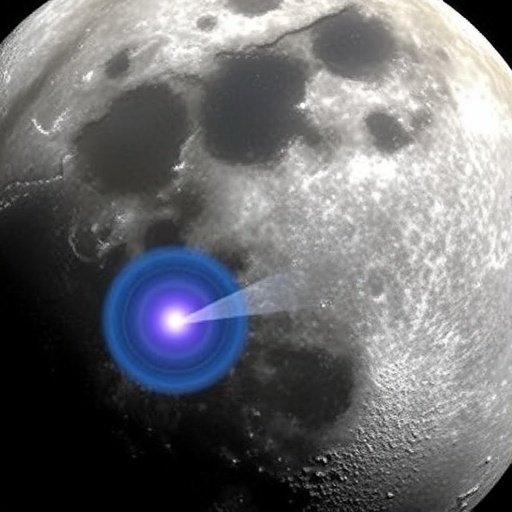
For decades, the magnetic history of the Moon has been shrouded in scientific controversy, with conflicting evidence about the strength and persistence of its ancient magnetic field. New research emerging from the Department of Earth Sciences at the University of Oxford, however, now sheds critical light on this debate, revealing a nuanced portrait of lunar magnetism that reconciles seemingly contradictory findings. Published in the journal Nature Geoscience, the study proposes that the Moon’s magnetic field was not uniformly strong or weak but instead exhibited brief, intense episodes of magnetism amidst prolonged intervals of relative quiescence.
The Moon’s magnetic field plays a pivotal role in understanding its geological and thermal history, especially in the context of its early formation around 3.5 to 4 billion years ago. Historically, scientists have struggled to resolve whether the Moon harbored a strong, Earth-like dynamo-driven magnetic field or whether its magnetic activity was minimal due to its comparatively small metallic core. The newly published work demonstrates that both perspectives capture elements of truth—the strength of the lunar field was highly intermittent.
The research team meticulously analyzed samples of lunar rocks collected during the Apollo missions, focusing in particular on Mare basalts, a type of volcanic rock prevalent in the Moon’s large, dark plains. Using advanced geochemical and paleomagnetic techniques, the scientists unearthed a critical correlation: mare basalt samples with high titanium content also recorded exceptionally strong magnetic fields, sometimes even surpassing the strength of Earth’s magnetic field. Conversely, samples with lower titanium concentrations only exhibited signs of weak magnetism.
This finding is revolutionary because it identifies titanium as a key geochemical marker linked to transient, powerful magnetic events on the Moon. The team hypothesizes that intermittent melting of titanium-rich materials at the lunar core-mantle boundary generated localized dynamos strong enough to produce these intense magnetic fields, albeit for brief durations. These episodes are estimated to have lasted no longer than 5,000 years and possibly as short as a few decades, a stark contrast to earlier assumptions that strong lunar magnetism persisted for hundreds of millions of years.
The study offers a compelling explanation for the long-standing puzzle arising from the bias in the Apollo rock samples. Because all six Apollo missions touched down in relatively flat, titanium-rich mare basalts, early interpretations mistakenly generalized the strong magnetic signals from these rare, short-lived events as evidence of sustained magnetism over half a billion years. Consequently, the Moon’s magnetic history had been overstated due to an unrepresentative sampling of its diverse geological regions.
Mathematical models developed as part of this research validate this sampling bias. By simulating the lunar surface’s full geological variability, they show it would be incredibly unlikely to detect these ephemeral strong magnetic intervals unless sampling was concentrated in the specific mare basalt terrains. This insight analogously illustrates how limited sampling on a planetary scale can significantly skew interpretations of magnetic histories.
The implications of this refined lunar magnetic record extend beyond academic curiosity. It reshapes our understanding of the Moon’s thermal evolution and internal dynamics, supporting a dynamo mechanism consistent with its small core size and intermittent core-mantle interactions. Moreover, it opens new avenues for future investigations, particularly with NASA’s upcoming Artemis missions, which could target more diverse sampling sites to further unravel the Moon’s early magnetic field structure.
Lead author Associate Professor Claire Nichols from Oxford’s Department of Earth Sciences emphasized that the research reframes the lunar magnetism debate by demonstrating the Moon experienced fleeting episodes of intense magnetic activity triggered by mantle processes involving titanium-rich volcanism. These events were exceptional rather than the norm, revealing the Moon’s magnetic narrative as more complex than previously imagined.
Co-author Associate Professor Jon Wade illustrated the importance of sampling diversity in planetary sciences by drawing a terrestrial analogy. Had aliens landed on Earth only six times in flat, titanium-rich regions, their understanding of Earth’s magnetic field might have been similarly biased. His remarks underscore the need for broad, geographically varied sampling in extraterrestrial geology to avoid misleading conclusions.
Dr. Simon Stephenson, another co-author, highlighted that with the ability to predict magnetic signatures tied to specific chemical compositions, upcoming lunar exploration missions represent a compelling opportunity to validate these findings. Systematic collection and analysis of lunar samples from varied geological settings promise to advance our comprehension of lunar magnetodynamics significantly.
The study’s integration of cutting-edge geochemical analysis, dynamo modeling, and a critical review of the Apollo sampling strategy marks a significant leap forward in lunar science. It not only reconciles historical contradictions but also establishes a framework for interpreting magnetic phenomena on other planetary bodies, particularly those with small or complex cores.
By recognizing the episodic nature of the Moon’s magnetic field and linking it to high-titanium volcanism, this research transforms a previously contested subject into a refined scientific narrative, enriching our broader understanding of planetary magnetism and early solar system evolution.
Subject of Research: The lunar magnetic field, its strength, variability, and its link to high-titanium volcanism.
Article Title: An intermittent dynamo linked to high-titanium volcanism on the Moon
News Publication Date: 26 February 2026
Web References: https://www.earth.ox.ac.uk/people/claire-nichols
https://www.earth.ox.ac.uk/people/jon-wade
https://earth.web.ox.ac.uk/people/simon-stephenson
https://www.ox.ac.uk/research/recognition/economic-impact
References: Published in Nature Geoscience on 26 February 2026
Image Credits: Charlie Rex
Keywords: Moon magnetic field, lunar dynamo, titanium volcanism, Mare basalts, lunar core, Apollo missions, magnetic history, planetary magnetism, lunar geology, dynamo theory, lunar samples, Artemis missions


