


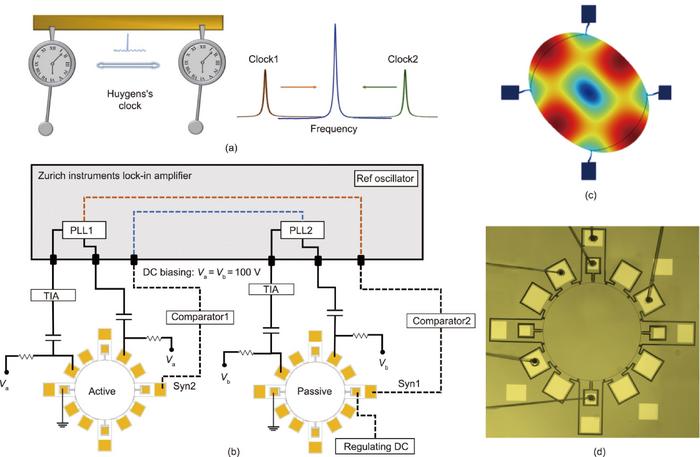
In a significant development for the miniaturization of electronic devices, a new study published in Engineering has reported the creation of a Microelectromechanical Systems (MEMS) clock that offers improved precision and stability. The clock, which utilizes the synchronization principle discovered by the Christiaan Huygens, consists of two synchronized MEMS oscillators and a frequency compensation system.

Credit: Xueyong Wei et al.
In a significant development for the miniaturization of electronic devices, a new study published in Engineering has reported the creation of a Microelectromechanical Systems (MEMS) clock that offers improved precision and stability. The clock, which utilizes the synchronization principle discovered by the Christiaan Huygens, consists of two synchronized MEMS oscillators and a frequency compensation system.
The research details how the MEMS Huygens clock enhances short-time stability, with the Allan deviation – a measure of the clock’s accuracy over time – improving by a factor of 3.73 from 19.3 ppb to 5.17 ppb at 1 second. The clock’s long-term stability is also significantly boosted, with the Allan deviation improving by 1.6343 × 10⁵ times to 30.9 ppt at 6000 seconds.
To achieve these results, the researchers developed a frequency compensation system that counteracts the MEMS oscillator’s temperature-frequency characteristics, thereby maintaining the clock’s accuracy by controlling the resonator current. This innovation led to a highly efficient method of compensating for frequency shifts in both oscillators simultaneously, consuming just 2.85 mW∙°C−1.
The study’s comprehensive solution scheme paves the way for high-precision MEMS oscillators and expands the application scope of synchronization in MEMS technology. With the continuous shrinking of electronic components, this breakthrough offers promising prospects for industries relying on precise timekeeping, such as telecommunications, navigation, and data processing.
As the demand for more accurate and reliable timing sources grows, the MEMS Huygens clock presented in this study stands to make a substantial impact on the future of microelectromechanical systems and their integration into everyday technologies.
The paper “MEMS Huygens Clock Based on Synchronized Micromechanical Resonators,” authored by Xueyong Wei, Mingke Xu, … Zhuangde Jiang. Full text of the open access paper: https://doi.org/10.1016/j.eng.2023.12.013. For more information about the Engineering, follow us on Twitter (https://twitter.com/EngineeringJrnl) & like us on Facebook (https://www.facebook.com/EngineeringJrnl).
Journal
Engineering
Article Title
MEMS Huygens Clock Based on Synchronized Micromechanical Resonators
Article Publication Date
24-Mar-2024
Cite Scienmag News
Denise Maddox. (June 12, 2024). Breakthrough MEMS Huygens clock improves timekeeping precision and stability. Scienmag. https://scienmag.com/breakthrough-mems-huygens-clock-improves-timekeeping-precision-and-stability/
Denise Maddox. "Breakthrough MEMS Huygens clock improves timekeeping precision and stability." Scienmag, 12 June 2024, https://scienmag.com/breakthrough-mems-huygens-clock-improves-timekeeping-precision-and-stability/. Accessed 4 September 2026.
Denise Maddox. "Breakthrough MEMS Huygens clock improves timekeeping precision and stability." Scienmag. June 12, 2024. https://scienmag.com/breakthrough-mems-huygens-clock-improves-timekeeping-precision-and-stability/

