


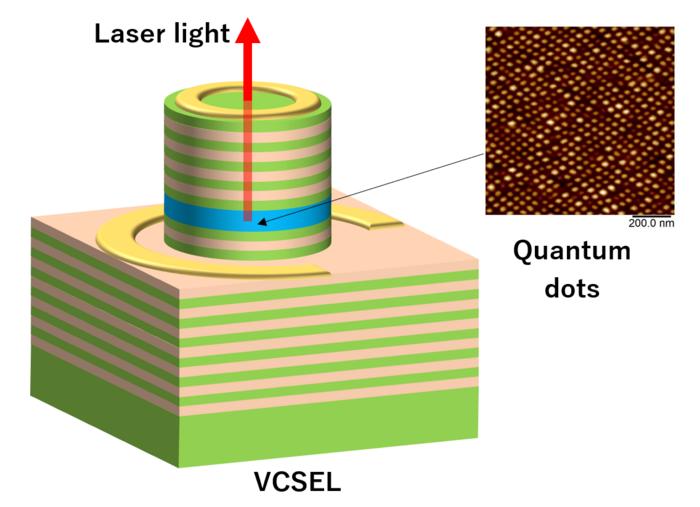
In a groundbreaking collaborative effort between the National Institute of Information and Communications Technology (NICT) and Sony Semiconductor Solutions Corporation, researchers have unveiled the world’s first practical surface-emitting laser utilizing quantum dots as the optical gain medium. This remarkable advancement is poised to transform optical fiber communication systems, heralding a new era of efficiency and capability in data transmission. The development marks a significant leap forward in light source technology, promising a future of miniaturization, reduced power consumption, and enhanced cost efficiency.
At the heart of this innovation lies the use of quantum dots—nanoscale semiconductor structures that serve as the basis for the laser’s light-emitting capabilities. Unlike traditional lasers, this new surface-emitting variant operates at a critical wavelength of 1,550 nanometers, aligning perfectly with the specifications required for modern optical fiber communication. The significance of this wavelength cannot be understated, as it is the industry standard for long-distance data transmission, particularly in telecommunications.
Historically, vertical-cavity surface-emitting lasers (VCSELs) have been central to advancements in optical communication, primarily because of their efficiency and capacity to be manufactured in arrays. However, conventional VCSELs generally operate at shorter wavelengths, such as 850 or 940 nanometers. Pioneering efforts in the field have now successfully pushed technological boundaries, enabling the development of lasers that function effectively at the longer wavelengths necessary for prevalent fiber optic applications.
The intricate journey to realize this surface-emitting laser involved overcoming significant technical challenges associated with traditional VCSELs. These challenges include maintaining high output and efficiency, especially at the longer 1,550 nanometers, a feat that requires careful consideration of the materials and design structures used. NICT and Sony’s collaborative work has led to innovations that address these issues head-on, demonstrating the practical potential of quantum dots in achieving high-performance laser technology.
A key aspect of the breakthrough is NICT’s prowess in high-precision crystal growth techniques. The research team employed a meticulous molecular beam epitaxy method, a process crucial for crafting the highly reflective semiconductor multilayer films needed for the laser. The scalability and quality of these films are vital, as they significantly enhance the light intensity and overall performance of the VCSEL. This precision in crystal growth resulted in a distributed Bragg reflector (DBR) that achieves reflectivity exceeding 99%, a critical milestone for the development of an effective laser.
Moreover, addressing internal crystal strain, which can degrade performance, was essential for optimizing the density of quantum dots within the laser structure. By implementing advanced strain-compensation techniques, researchers were able to mitigate the adverse effects that arise around quantum dot formations, thereby enhancing the light-emitting efficiency of the laser. This step not only underscored the technical innovation involved but also illustrated the potential for scaling up production through improved manufacturing processes.
Sony’s significant contribution to the project stemmed from its expertise in device design and advanced processing technology. The collaboration honed in on creating a novel structure known as a tunnel junction to facilitate effective current injection. In traditional VCSEL architecture, obstacles can impede light extraction even when quantum dots are emitting light. Sony’s innovative approach allowed for a design that streamlined current flow while enhancing the extraction of light, proving crucial to the laser’s efficiency as well as its practical deployment.
The realization of a low threshold current of merely 13 mA in the laser design marks a significant achievement, illustrating the laser’s capability to operate efficiently and responsively. The elimination of polarization fluctuations further contributes to stabilized output, a critical factor for any technology aiming for widespread application in high-speed communication systems. The collaboration has successfully combined groundbreaking materials science and device engineering in a manner that has generated excitement within the optics and telecommunications fields.
As the industry looks towards the future of communication technologies, this development is especially timely considering the growing demands for faster, more reliable data transmission gradients. With the widespread rollout of 5G and the anticipated evolution to next-generation networks, the need for highly efficient optical systems is paramount. The integration of quantum dot VCSEL technology is expected to play a pivotal role in meeting these emerging demands, providing the foundation for more robust and versatile optical communication systems.
Looking ahead, researchers at NICT and Sony are committed to further advancing quantum-dot-based VCSEL technology. Their ongoing efforts aim to enhance capacity whilst continuing to drive down power consumption and production costs. As the demand for high-bandwidth applications on the horizon intensifies, continuous innovation will be essential to ensure that optical fiber communication continues to evolve to meet society’s needs.
The research findings have garnered recognition in the scientific community, recently published in the esteemed journal "Optics Express." This prestigious platform has highlighted the groundbreaking nature of the research, whereby NICT and Sony set a new benchmark for what is achievable with semiconductor lasers and optical technologies. The combination of detailed experimental methodologies and concerted collaborative efforts reflects the innovative spirit that defines the current landscape of materials science and engineering.
In conclusion, the journey towards developing this advanced surface-emitting laser with quantum dots as the central operative component represents a marriage of scientific rigor, engineering excellence, and visionary thinking. As the implications of this breakthrough unfold across various sectors—ranging from telecommunications to consumer electronics— the researchers at NICT and Sony look forward to the broader societal impact of their work. Their commitment to fostering advancements in optical technology provides an optimistic outlook toward future communications infrastructure, seamlessly integrating speed, efficiency, and sustainability.
Keywords
Quantum dots, Vertical-cavity surface-emitting lasers, Optical fiber communications, Semiconductor processing, High-precision crystal growth, Tunnel junctions, Data transmission technology.
Cite Scienmag News
Denise Maddox. (June 6, 2025). Breakthrough in Optical Fiber Communications: Introducing the First Practical Surface-Emitting Laser, Paving the Way for Miniaturization, Energy Efficiency, and Cost Reduction. Scienmag. https://scienmag.com/breakthrough-in-optical-fiber-communications-introducing-the-first-practical-surface-emitting-laser-paving-the-way-for-miniaturization-energy-efficiency-and-cost-reduction/
Denise Maddox. "Breakthrough in Optical Fiber Communications: Introducing the First Practical Surface-Emitting Laser, Paving the Way for Miniaturization, Energy Efficiency, and Cost Reduction." Scienmag, 6 June 2025, https://scienmag.com/breakthrough-in-optical-fiber-communications-introducing-the-first-practical-surface-emitting-laser-paving-the-way-for-miniaturization-energy-efficiency-and-cost-reduction/. Accessed 5 September 2026.
Denise Maddox. "Breakthrough in Optical Fiber Communications: Introducing the First Practical Surface-Emitting Laser, Paving the Way for Miniaturization, Energy Efficiency, and Cost Reduction." Scienmag. June 6, 2025. https://scienmag.com/breakthrough-in-optical-fiber-communications-introducing-the-first-practical-surface-emitting-laser-paving-the-way-for-miniaturization-energy-efficiency-and-cost-reduction/


