


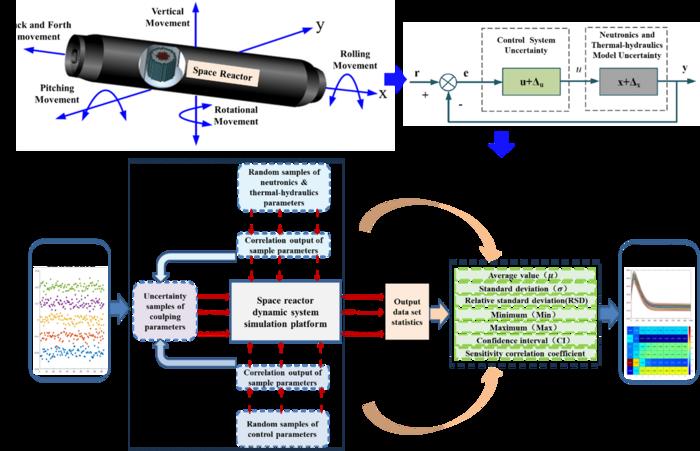
Researchers from institutions such as the University of South China, Tsinghua University, and the Technical University of Munich have unveiled significant advancements in the field of space nuclear reactors. Their latest study introduces an innovative whole-system uncertainty model coupled with a sophisticated intelligent power control system. This new approach promises quicker response times, increased accuracy, and enhanced adaptability under various uncertain conditions. The focus of this research is to enhance the operational efficiency of nuclear energy systems, especially in the unpredictable environments that accompany space exploration.
The development of model uncertainty in nuclear reactors often stems from both theoretical simulational approximations and the empirical correlation fittings identified during experimental processes. This is particularly crucial in the context of space reactors, which face multi-degree-of-freedom movements. Environments in space can lead to fluctuating conditions, causing the reactor to endure shifts, tilts, and oscillations. Such factors inevitably introduce parameter unpredictability within the reactor’s neutronics and thermal-hydraulics models. Moreover, the sensors and actuators integral to the reactor’s control system are also susceptible to uncertainties resulting from environmental disturbances. Addressing and quantifying these systemic uncertainties is essential for ensuring the safe and reliable operation of space nuclear reactors.
Dr. Run Luo, the lead author of the study, emphasized the importance of their findings, stating that this innovative model can be implemented within the complex uncertainties characteristic of space environments. The research elucidates the coupling mechanism of neutronic parameters alongside thermal hydraulic parameters and control system parameters of space nuclear reactors, specifically in motion conditions. This breakthrough is expected to not only improve the space reactor’s responsiveness but also enhance its load-following accuracy.
Traditional control systems, especially the Proportional-Integral-Derivative (PID) controllers, are often ill-equipped to handle the complexities posed by the innate uncertainties of nuclear reactors. These conventional systems struggle to achieve optimal control performance due to their rigid structures. In light of this challenge, the researchers integrated multi-objective intelligent optimization methods in the design of their control system for uncertainty-laden environments. Such methodologies are pivotal for elevating the adaptive control capabilities of space reactors.
The crux of the research lies in overcoming the inefficiencies associated with traditional manual tuning processes for obtaining optimal control parameters within uncertain parameters environments. Through the implementation of the Non-dominated Sorting Genetic Algorithm II (NSGA-II), a powerful intelligent method, the study showcases a substantial improvement in the optimization of controller design. This technique offers a more efficient and precise alternative to the trials and tribulations involved in manual experiential acquisition.
The results of the research are compelling; control errors significantly diminished after optimization across several metrics, including Integral of Absolute Error (IATE), Mean Squared Error (MSE), and Maximum Peak Deviation (MPD). Furthermore, the optimized intelligent controllers displayed reduced overshoot and oscillation, along with a faster transition time to new steady states even when faced with uncertainties. These enhancements are crucial in ensuring that nuclear reactors can operate reliably amidst volatile conditions.
In fostering a more stable and accurate control environment for nuclear reactors, the implications of this research could far-reaching. The findings serve to build the foundation for future advancements in the control mechanisms of advanced nuclear energy systems. Such advancements promise to augment the reactors’ resistance to disruptions and bolster their adaptive capabilities in the face of complex and unpredictable conditions encountered in space exploration.
The excitement surrounding this research is palpable, as it not only addresses immediate challenges but also offers new avenues for exploration and innovation in nuclear reactor technology. As the dynamics of space travel continue to evolve, the demand for smarter and more responsive nuclear energy solutions will undoubtedly grow. The implications for future research in intelligent control systems are vast, and the nuclear industry stands to benefit substantially from these groundbreaking findings.
As researchers continue to refine their models and control systems, this study sets the stage for further inquiries into the intricate mechanisms of reactor dynamics. The pursuit of knowledge in this arena will likely lead to safer, more efficient nuclear systems that can thrive in the increasingly complex fields of space exploration and beyond. This trajectory of growth not only signifies a technological leap but also a crucial step toward sustainable energy solutions on a cosmic scale.
In summary, the advancements in intelligent optimization for space nuclear reactors signify a pivotal moment in nuclear research and engineering. The collaboration of leading academic institutions signals a collective commitment to addressing one of the most pressing challenges in energy production: the uncertainty inherent in operating within dynamic and unpredictable environments. With innovative models and smarter control strategies, the future of nuclear reactors in space appears remarkably promising.
Keywords
Cite Scienmag News
Grant Pearson. (May 29, 2025). Breakthrough in Nuclear Reactor Control: Next-Gen Intelligent System Enhances Adaptive Capabilities. Scienmag. https://scienmag.com/breakthrough-in-nuclear-reactor-control-next-gen-intelligent-system-enhances-adaptive-capabilities/
Grant Pearson. "Breakthrough in Nuclear Reactor Control: Next-Gen Intelligent System Enhances Adaptive Capabilities." Scienmag, 29 May 2025, https://scienmag.com/breakthrough-in-nuclear-reactor-control-next-gen-intelligent-system-enhances-adaptive-capabilities/. Accessed 6 September 2026.
Grant Pearson. "Breakthrough in Nuclear Reactor Control: Next-Gen Intelligent System Enhances Adaptive Capabilities." Scienmag. May 29, 2025. https://scienmag.com/breakthrough-in-nuclear-reactor-control-next-gen-intelligent-system-enhances-adaptive-capabilities/


