

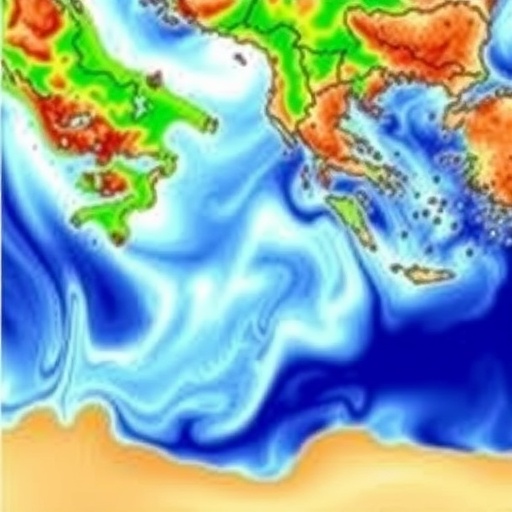
A groundbreaking study has unveiled a novel approach to forecasting winter rainfall in the Eastern Mediterranean by examining the heat uptake dynamics of the Aegean Sea during August. This innovative research, recently published in Weather and Climate Dynamics, introduces the Aegean Sea Heat Uptake Anomaly (AQA) index, a localized oceanic signal that accurately predicts precipitation patterns months ahead. The study, led by Prof. Ori Adam and Ofer Cohen at Hebrew University’s Institute of Earth Sciences, marks a significant advancement in regional climate modeling, surpassing traditional global indices in forecasting skill.
The Eastern Mediterranean basin has emerged as one of the planet’s most climate-vulnerable regions, exhibiting strong trends of rising temperatures and decreasing rainfall due to accelerated global warming. Its semi-arid environment faces mounting water scarcity pressures, making reliable seasonal precipitation forecasts an essential tool for sustainable resource management and drought preparedness. In this context, the research team focused on exploring sub-basin scale ocean-atmosphere interactions to uncover precursors to winter rainfall variability, hitherto underrecognized in seasonal prediction frameworks.
By meticulously analyzing sea surface temperature (SST) data and associated heat exchange fluxes from 1979 to 2023, the team detected three dominant patterns of variability governing the Mediterranean region. Two core modes emerged, characterized by east-west dipole temperature structures. These heat distribution anomalies in the Mediterranean surface waters hold a previously unexplored connection to atmospheric circulation changes impacting wintertime rainfall over the Levantine coast.
Central to their findings was the introduction of the AQA index, which quantifies deviations in the net heat flux from the Aegean Sea to the atmosphere specifically during August. Negative anomalies indicate enhanced ocean-to-atmosphere heat release, while positive values denote heat uptake by the sea surface. Critically, the research revealed a strong inverse correlation, quantified as R = -0.6, between August’s AQA values and subsequent precipitation accumulations in December through February over Israel and surrounding areas.
The robustness of the AQA-rainfall linkage was rigorously validated using two independent datasets: ERA5, a global reanalysis product providing interpolated atmospheric and oceanic observational data, and extensive ground-based rainfall measurements maintained by the Israel Meteorological Service (IMS). This dual confirmation across observational platforms reinforces the index’s reliability as a predictive tool for seasonal forecasting applications.
Delving into atmospheric dynamics, the study elucidated the physical mechanisms underpinning the AQA’s predictive power. During years when the Aegean Sea enters a negative heat uptake state in late summer, the atmosphere responds with a lagged intensification of the regional subtropical jet stream. This process induces a baroclinic environment characterized by unstable temperature gradients and enhanced vertical wind shear, conditions highly conducive to the formation and persistence of “Cyprus Lows,” a dominant mid-latitude cyclonic system bringing sustained winter rains to the Levant.
This chain reaction—from enhanced late summer oceanic heat release to atmospheric instability—fundamentally alters storm system frequency and lifespan over the Eastern Mediterranean. The study found statistically significant increases in both the duration and recurrence of Cyprus Low events during winters following strong negative AQA episodes. This persistence translates directly into elevated cumulative precipitation, providing a mechanistic explanation for the AQA’s correlation with wetter winters.
Importantly, the localized AQA index demonstrated superior predictive skill compared to established global climate variability modes, notably the North Atlantic Oscillation (NAO) and the El Niño-Southern Oscillation (ENSO). While NAO and ENSO exert broad hemispheric influences on atmospheric circulation, their connection to Eastern Mediterranean precipitation is comparatively weaker and less consistent. The AQA offers a refined regional lens, capturing mesoscale oceanic-atmospheric coupling that escapes coarse global indices.
The implications of these findings extend beyond improved rainfall forecasts. By integrating the AQA index into seasonal climate models, water resource managers and governmental agencies can anticipate water availability and drought conditions with greater lead time, enabling proactive policy responses. This is especially pertinent in the Levant, where groundwater depletion and reduced reservoir inflows threaten ecological stability and human livelihoods.
The study also underscores the pivotal role of the Mediterranean Sea not merely as a passive ocean basin but as an active climatic regulator. Its summer heat exchange processes imprint upon winter atmospheric circulation, challenging long-held assumptions about the temporal disconnection between seasonal climate drivers. This ocean-atmosphere feedback mechanism exemplifies how regional seas mediate climate variability on multiple timescales.
Researchers emphasize the novelty and significance of linking late summer oceanic heat fluxes to meteorological outcomes months later. Such teleconnections elucidate complex Earth system interactions and support the broader scientific endeavor to demystify weather system predictability amidst climate change-induced uncertainties. The AQA index thus represents a compelling case study in leveraging high-resolution oceanographic data for operational climate services.
This research opens promising avenues for future inquiry, including the potential to expand the AQA methodology to other localized maritime regions exhibiting analogous heat flux variability. Further studies may refine the index’s spatial and temporal resolutions, optimize its incorporation into coupled climate models, and explore synergistic effects with land surface processes. Ultimately, such advancements lend hope for more resilient societies adapting to shifting climatic realities.
In summary, the discovery of the AQA index constitutes a transformative stride in Mediterranean climatology. By decoding the ocean’s thermal rhythms and their atmospheric repercussions, scientists have unveiled a potent predictive tool for winter rainfall in the Levant. This breakthrough not only elevates scientific understanding but also holds tangible promise for enhancing water security in one of the world’s most climate-sensitive regions.
Subject of Research: Not applicable
Article Title: Mediterranean Sea heat uptake variability as a precursor to winter precipitation in the Levant
News Publication Date: 2 February 2026
Web References: http://dx.doi.org/10.5194/wcd-7-263-2026
References: Weather and Climate Dynamics, Volume 7, pages 263–280, 2026.
Keywords: Climate change, Precipitation, Weather


