


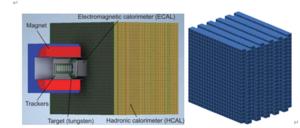
In the forefront of the pursuit to unveil the mysteries of the dark sector of the universe, the DarkSHINE experiment represents a pioneering effort in the detection of dark photons—hypothetical gauge bosons that may bridge the observable universe with elusive dark matter. Integral to this initiative is the state-of-the-art electromagnetic calorimeter (ECAL), a detector system engineered to capture and precisely measure the energy deposited by incoming particles. Recent advancements in the DarkSHINE detector, particularly the ECAL’s intricate configuration and performance, illuminate significant strides toward enhancing sensitivity in dark photon searches.
The DarkSHINE detector system, schematically represented in recent illustrative materials, is a multifaceted array designed to optimize interaction tracking and energy measurement. The ECAL, situated strategically within the system, serves as a critical component that absorbs particles, primarily electrons, measuring their energy deposition patterns. Its configuration, meticulously optimized over various iterations, features segmented detector modules that allow for refined spatial and energy resolution capabilities—attributes essential for differentiating between signal events indicative of dark photons and background noise from standard particle interactions.
At the core of the detector’s function lies the ECAL’s energy deposition characteristics when subjected to an 8 GeV electron beam. Detailed comparative analyses reveal distinct patterns corresponding to dark photon-induced events versus those generated from inclusive background interactions. This differentiation is paramount, as it directly impacts the experiment’s ability to isolate potential dark photon signals from the complex particle environment. The subtle yet measurable variations in energy distribution within the ECAL signify the robustness of its design and data acquisition systems.
Further deepening the ECAL’s efficacy is the signal efficiency parameter as a function of dark photon mass. Experimental data and simulation trends display how various ECAL configurations respond across a spectrum of hypothetical dark photon masses. These results underscore the crucial balance between detector acceptance, energy threshold tuning, and resolution-dependent efficiencies, painting a comprehensive picture of how system parameters interlace with fundamental physics targets. The ability to maintain high signal efficiency while suppressing background contamination is a remarkable achievement demonstrating the detector’s sophistication.
Complementing efficiency studies, the ECAL’s energy resolution and containment have been systematically assessed. Incident electrons covering an energy range from 1 to 8 GeV were subjected to the detector in controlled beam tests, analyzing both the precision of energy measurement and the completeness of energy capture within the calorimeter’s physical boundaries. Achieving exceptional energy resolution is non-trivial and necessitates exact calibration, high-quality scintillating materials, and advanced readout electronics. The outcomes indicate a high degree of energy containment and resolution consistency, critical for the unambiguous interpretation of experimental data.
An instrumental aspect of ongoing research has been the hands-on involvement of emerging scientific talent, exemplified by the contributions of PhD student Zhiyu Zhao. Conducting beam tests at the DESY TB-22 facility in Germany, Zhao operated a small-scale ECAL detector module under rigorous experimental conditions. These tests provided essential empirical data validating simulation models and guided iterative enhancements in design and operational protocols. The collaboration between experienced researchers and early-career scientists embodies a dynamic synergy fueling innovation in detector technology.
The DarkSHINE detector team itself comprises a diverse group of physicists, engineers, and technologists, united by the shared pursuit of expanding the frontiers of dark matter research. A group photograph captures this multifaceted team, symbolizing the collective effort and interdisciplinary collaboration at the heart of this endeavor. Such cohesion is indispensable given the intricate challenges posed by rare event searches and the necessity for precision instrumentation.
The overarching goal of the DarkSHINE experiment centers on detecting rare interactions mediated by dark photons, which, unlike their Standard Model counterparts, may interact only faintly with conventional matter. This requires not only highly sensitive detection but also sophisticated discriminative capabilities to parse background events. The ECAL’s design inherently addresses these challenges, being responsive to energy signatures while facilitating spatial localization vital for event reconstruction.
From a technical perspective, the ECAL exploits scintillating materials combined with photodetector arrays that convert incident particle energy into measurable light signals. Signal readout electronics translate these optical signals into digital data for analysis, with calibration constants accounting for subtle variances in detector response. These detailed engineering considerations ensure that the ECAL maintains stability and accuracy over prolonged operational periods, a prerequisite for credible dark photon searches.
Moreover, the integration of simulation frameworks with empirical data has empowered the team to refine detector models iteratively. By benchmarking beam test results against Monte Carlo simulations, researchers achieve enhanced predictive capabilities, optimizing detector geometry and material composition. This interplay between experiment and theory epitomizes the modern approach to particle detector development.
The ECAL’s capability to differentiate energy deposits from signal versus background hinges upon nuanced aspects such as shower shape analyses and timing resolution. Particles initiating electromagnetic cascades within the calorimeter leave characteristic footprints, facilitating discrimination algorithms to enhance signal purity. This is especially critical given the ambient noise and cosmic ray backgrounds that pervade experimental environments.
Looking forward, results obtained from current ECAL modules and test beams lay a foundation for scaling the detector system. Future iterations aim to increase granularity, improve timing accuracy, and adopt advanced materials with superior scintillation efficiency. These enhancements promise to elevate DarkSHINE’s sensitivity, thereby amplifying its potential to detect or constrain dark photon parameters across unexplored mass ranges.
In a broader context, the DarkSHINE experiment exemplifies the synergy between precision instrumentation, theoretical innovation, and international collaboration, driving the search for physics beyond the Standard Model. As experimental techniques advance and data accrues, the prospect of uncovering dark photons inches closer to reality, potentially revolutionizing our understanding of the universe’s hidden sectors. The ECAL’s pivotal role within this scientific journey underscores the indispensability of cutting-edge detector technology in modern high-energy physics.
Keywords
DarkSHINE, electromagnetic calorimeter, ECAL, dark photon, detector system, energy resolution, particle physics, beam tests, DESY TB-22, dark matter, signal efficiency, particle detection technology
Cite Scienmag News
Bethany Barker. (May 30, 2025). Breakthrough in Dark Matter Detection: Novel LYSO Crystal Calorimeter Boosts Dark Photon Search Sensitivity. Scienmag. https://scienmag.com/breakthrough-in-dark-matter-detection-novel-lyso-crystal-calorimeter-boosts-dark-photon-search-sensitivity/
Bethany Barker. "Breakthrough in Dark Matter Detection: Novel LYSO Crystal Calorimeter Boosts Dark Photon Search Sensitivity." Scienmag, 30 May 2025, https://scienmag.com/breakthrough-in-dark-matter-detection-novel-lyso-crystal-calorimeter-boosts-dark-photon-search-sensitivity/. Accessed 3 September 2026.
Bethany Barker. "Breakthrough in Dark Matter Detection: Novel LYSO Crystal Calorimeter Boosts Dark Photon Search Sensitivity." Scienmag. May 30, 2025. https://scienmag.com/breakthrough-in-dark-matter-detection-novel-lyso-crystal-calorimeter-boosts-dark-photon-search-sensitivity/


