


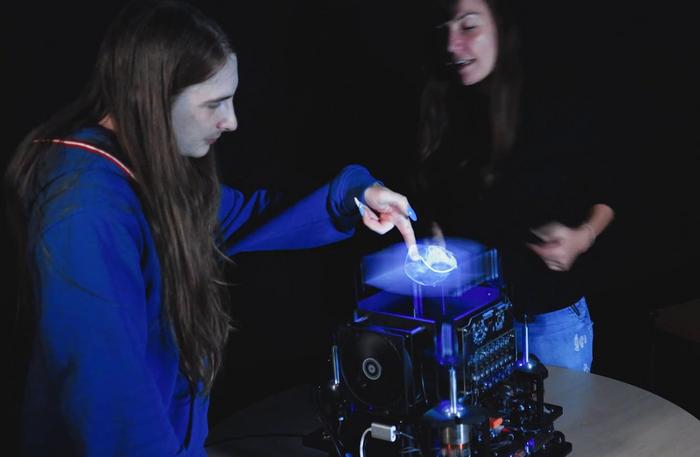
In a groundbreaking development within the realm of user interface technology, a remarkable advancement in the display of three-dimensional graphics has emerged, making waves in both scientific and technological communities. A dedicated research team from the Public University of Navarra (UPNA) includes notable figures such as Doctor Elodie Bouzbib and Asier Marzo, who together with colleagues have accomplished the impressive feat of presenting three-dimensional images that float in mid-air and can be manipulated by hand. This innovation marks a significant milestone in the pursuit of true holographic displays, showcasing a receiver’s capacity for tactile interaction.
The term "hologram" often conjures images of futuristic displays found in science fiction films. However, what is typically portrayed in these visual narratives are, in fact, volumetric displays rather than true holograms. The distinction, as articulated by Bouzbib, rests in the functionality and interaction capabilities of these technologies. She elaborates that volumetric displays provide graphics that appear in space and can be viewed from multiple angles without the need for virtual reality glasses, thereby elevating the standard for interactive display technologies.
A pivotal aspect of this research focuses on the concept of the "come-and-interact" paradigm, which allows users to engage with the display by simply approaching it, reminiscent of the intuitive interactions we have with modern touch devices. For many years, traditional volumetric displays have been limited by their inability to accommodate direct manipulation of 3D graphics, which this new technology adeptly addresses. Researchers have achieved a breakthrough by allowing users to come into direct contact with the holographic images, enabling a natural interaction between hands and digital representations.
The significance of direct interaction is echoed by lead researcher Asier Marzo, who emphasizes the importance of engaging with virtual objects in a manner that mirrors our everyday interactions with technology. This includes tasks like dragging, lifting, and rotating objects as we would on a smartphone or tablet. Thus, the research team has successfully created an interface that transcends the limitations of previous volumetric displays, leading to a more immersive and organic experience that aligns with human behavioral patterns.
Previous attempts to develop commercially viable volumetric displays have failed to incorporate the hands-on interaction that this research brings to the forefront. Notable companies such as Voxon Photonics and Brightvox Inc. have ventured into the realm of volumetric displays; yet, the absence of an interactive interface has halted the potential user experience from reaching its full capacity. The researchers from UPNA have recognized that, as humans, we thrive on direct manipulation of objects, making this innovation particularly revolutionary in terms of how we will interact with three-dimensional visualizations.
The research, which is part of a larger project named InteVol, has been exemplary in its execution and practical applications. Funded by the European Research Council (ERC), InteVol aims to push the boundaries of technology to create an exceptional user experience. The team’s innovative efforts will be presented at the upcoming CHI 2025 conference in Yokohama, Japan, a significant gathering where more than 4,000 researchers and industry leaders will converge to discuss advancements in interactive technologies.
This new volumetric display operates on a unique principle, employing a rapid oscillation of an elastic diffuser that enables the projection of images at an impressive rate of 2,880 frames per second. The result is an illusion of volume that effectively harnesses the persistence of vision phenomenon. However, the introduction of an elastic diffuser presents unique challenges. Unlike traditional rigid diffusers, the elastic material allows for human interaction without the risk of injury, but it requires careful calibration to ensure that the images remain accurate despite the potential for deformation during use.
What truly sets this technology apart is its potential application across various fields, from education to entertainment. Imagine students gathered around a dynamic holographic engine, able to fully explore its components without the constraints of physical models or virtual reality headsets. The implications for collaborative learning are profound, as multiple people can interact with the display simultaneously, promoting teamwork and communication. Museums, too, stand to benefit substantially; visitors could experience exhibits in a novel and interactive manner, stepping beyond passive observation to engaging actively with the displays.
The practical applications extend into professions that rely on intricate design and visualization, such as engineering and architecture. Professionals could leverage true-3D graphics to present and discuss models or plans in real-time, further enhancing collaboration and ideation during project development. By allowing individual users to engage with these graphics naturally, the technology lessens the barriers typically associated with learning and exploring complex subjects.
As such, the integration of directly manipulable volumetric displays opens a door to a future where interactive technology is seamless and intuitive. Healthcare professionals could utilize this technology for anatomical visualization, providing insightful perspectives on medical education and training. Industrial applications could range from manufacturing to product design, improving workflows and efficiencies through enhanced visual communication.
In summary, the journey toward developing volumetric displays with elastic diffusers that allow for natural interaction signifies a pivotal moment in interactive technology. As research continues to evolve, the potential for widespread application appears limitless, leaving an indelible mark on both science and society. The enthusiasm surrounding this innovation promises to shape not only how we connect with data but also influences the way we perceive and interact with the world around us.
Keywords
Applied sciences, engineering, computer science, user interfaces
Cite Scienmag News
Denise Maddox. (April 9, 2025). Breakthrough: Holograms You Can Touch and Manipulate. Scienmag. https://scienmag.com/breakthrough-holograms-you-can-touch-and-manipulate/
Denise Maddox. "Breakthrough: Holograms You Can Touch and Manipulate." Scienmag, 9 April 2025, https://scienmag.com/breakthrough-holograms-you-can-touch-and-manipulate/. Accessed 4 September 2026.
Denise Maddox. "Breakthrough: Holograms You Can Touch and Manipulate." Scienmag. April 9, 2025. https://scienmag.com/breakthrough-holograms-you-can-touch-and-manipulate/


