


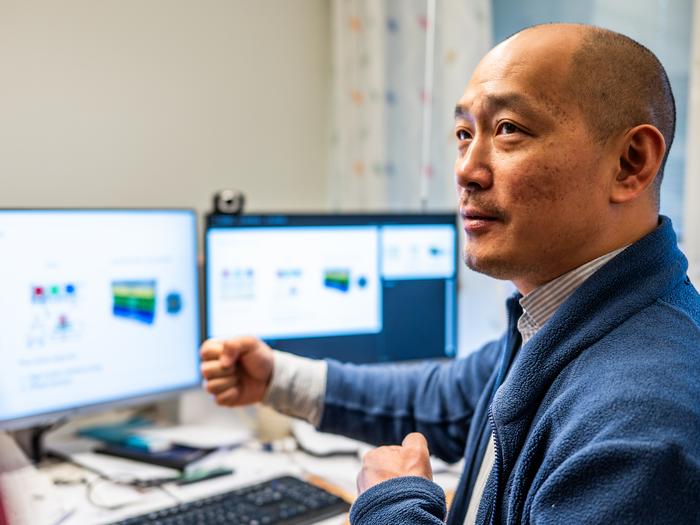
Researchers at Linköping University, Sweden, have developed a digital display screen where the LEDs themselves react to touch, light, fingerprints and the user’s pulse, among other things. Their results, published in Nature Electronics, could be the start of a whole new generation of displays for phones, computers and tablets.

Credit: Olov Planthaber
Researchers at Linköping University, Sweden, have developed a digital display screen where the LEDs themselves react to touch, light, fingerprints and the user’s pulse, among other things. Their results, published in Nature Electronics, could be the start of a whole new generation of displays for phones, computers and tablets.
“We’ve now shown that our design principle works. Our results show that there is great potential for a new generation of digital displays where new advanced features can be created. From now on, it’s about improving the technology into a commercially viable product,” says Feng Gao, professor in optoelectronics at Linköping University (LiU).
Digital displays have become a cornerstone of almost all personal electronics. However, the most modern LCD and OLED screens on the market can only display information. To become a multi-function display that detects touch, fingerprints or changing lighting conditions, a variety of sensors are required that are layered on top of or around the display.
Researchers at Linköping University have now developed a completely new type of display where all sensor functions are also found in the display’s LEDs without the need of any additional sensors.
The LEDs are made of a crystalline material called perovskite. Its excellent ability of light absorption and emission is the key that enables the newly developed screen.
In addition to the screen reacting to touch, light, fingerprints and the user’s pulse, the device can also be charged through the screen thanks to the perovskites’ ability to also act as solar cells.
“Here’s an example – your smartwatch screen is off most of the time. During the off-time of the screen, instead of displaying information, it can harvest light to charge your watch, significantly extending how long you can go between charges,” says Chunxiong Bao, associate professor at Nanjing University, previously a postdoc researcher at LiU and the lead author of the paper.
For a screen to display all colours, there needs to be LEDs in three colours – red, green and blue – that glow with different intensity and thus produce thousands of different colours. The researchers at Linköping University have developed screens with perovskite LEDs in all three colours, paving the way for a screen that can display all colours within the visible light spectrum.
But there are still many challenges to be solved before the screen is in everyone’s pocket. Zhongcheng Yuan, researcher at the University of Oxford, previously postdoc at LiU and the other lead author of the paper, believes that many of the problems will be solved within ten years:
“For instance, the service life of perovskite LEDs needs to be improved. At present, the screen only works for a few hours before the material becomes unstable, and the LEDs go out,” he says.
Journal
Nature Electronics
Article Title
A multifunctional display based on photo-responsive perovskite light-emitting diodes
Article Publication Date
10-Apr-2024
Cite Scienmag News
Bethany Barker. (April 10, 2024). Breakthrough for next-generation digital displays. Scienmag. https://scienmag.com/breakthrough-for-next-generation-digital-displays/
Bethany Barker. "Breakthrough for next-generation digital displays." Scienmag, 10 April 2024, https://scienmag.com/breakthrough-for-next-generation-digital-displays/. Accessed 4 September 2026.
Bethany Barker. "Breakthrough for next-generation digital displays." Scienmag. April 10, 2024. https://scienmag.com/breakthrough-for-next-generation-digital-displays/

