

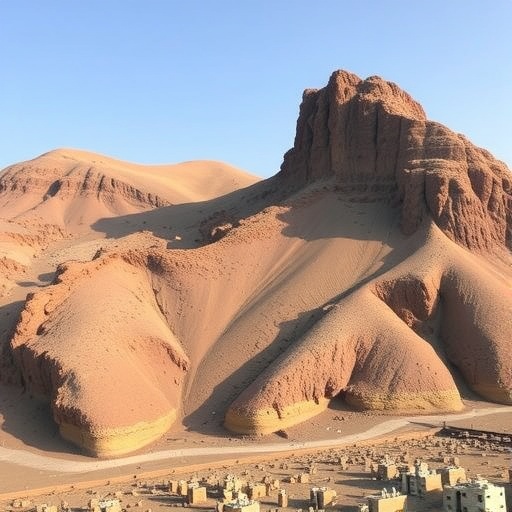
In the rugged terrains of eastern Oman, a geologic marvel is unfolding, illuminating processes fundamental not only to Earth’s tectonic evolution but also offering promising pathways for tackling climate change through natural carbon sequestration. Recent research published in the Geological Society of America Bulletin uncovers the tectonic genesis of naturally carbonated ultramafic rocks within the Samail Ophiolite, one of the world’s largest and most accessible slices of oceanic mantle exposed on the continents. This work sheds new light on how fluids interact with mantle rocks to produce listwaenite—a carbonate-rich ultramafic rock—significantly advancing our understanding of mineral carbonation and fluid flow in complex tectonic settings.
The Samail Ophiolite presents a unique natural laboratory where mantle peridotites are extensively altered by carbonated fluids, forming listwaenites characterized by their distinctive orange-brown hue. These rocks hold paramount importance as geological analogs for long-term carbon storage, representing natural instances where atmospheric CO₂ has been locked away in stable mineral phases for millions of years. The study, conducted at an unprecedented scale with detailed geological mapping down to 1:10,000, focused on the Fanja region within the eastern Oman Mountains to unravel the structural controls governing this large-scale carbonation.
Traditionally, listwaenite formation was thought to be tightly linked to deep subduction processes where mantle rocks were subjected to carbon-rich fluid influx. However, the new evidence calls this interpretation into question. Researchers document that carbonation occurred predominantly during shallow crustal extension, a tectonic regime marked by brittle faulting that created conduits for fluid migration. These pathways were critical in facilitating the circulation of CO₂-bearing fluids through the ultramafic host rocks, triggering mineral carbonation reactions that transformed peridotite into listwaenite.
The tectonic narrative unfolding from this research is complex and nuanced. Through structural analysis, two distinct generations of listwaenite have been identified. The older array correlates with low-angle normal faults, which themselves crosscut earlier thrust fault architectures. This suggests a temporal evolution from compressive to extensional tectonics as Oman’s crust responded to plate reconfigurations. Subsequently, the younger listwaenite formed along steeply dipping extensional and strike-slip faults, indicative of ongoing tectonic adjustments that further facilitated fluid penetration and mineral alteration.
From a petrological standpoint, the transformation of peridotite to listwaenite involves the introduction and reaction of carbonated fluids with the primary ultramafic mineralogy—olivine and pyroxenes—leading to the precipitation of carbonate minerals like magnesite and calcite. This mineralogical shift is accompanied by geochemical changes, including element mobility and alterations in rock porosity and permeability, which in turn influence fluid dynamics. Understanding these mineral-fluid interactions within the structural context provided by the fault systems is imperative for constructing accurate models of natural carbon storage mechanisms.
What makes these findings particularly captivating is their implications for engineered carbon sequestration, an area of intensifying global research due to escalating greenhouse gas emissions. While laboratory and pilot projects attempt to replicate mineral carbonation to lock away anthropogenic CO₂, natural systems like Oman demonstrate the geologic feasibility of this process at scale and over geologic timescales. The identification of tectonically active fault networks as facilitators of fluid flow underscores the necessity of considering structural geology in designing and evaluating carbon capture and storage (CCS) strategies.
Moreover, the research accentuates the pivotal role of tectonic evolution in modulating fluid-rock interactions. Post-obduction extension—a stage following the emplacement of the ophiolite onto the continental margin—created brittle fractures that acted as fluid highways. This rheological and structural environment allowed for efficient infiltration of carbon-bearing fluids at shallow depths, transforming ultramafic mantle rocks in situ. Such detailed understanding links macro-scale tectonics with micro-scale geochemical processes in a way that enriches our conception of Earth’s dynamic systems.
In terms of geodynamic context, the Samail Ophiolite’s emplacement involved complex plate interactions and uplift events, which reshaped the local stress regimes and fault kinematics. This evolving tectonic framework established episodic windows of permeability enhancement, thereby controlling when and where carbonation occurred. The linkage between plate movements, fault development, and fluid circulation pathways exemplifies the intricate coupling of Earth’s lithosphere deformation and chemical transformations.
Importantly, the two temporally distinct generations of listwaenite elucidate evolution of the carbonation process. The early phase along low-angle faults suggests that initial tectonic extension was gentle but widespread enough to induce carbonation. The younger phase, formed along steeper faults, reflects a more vigorous tectonic environment that maintained fluid flow and altered more rock volume. This duality illustrates how changes in tectonic style over millions of years can modulate environmental conditions conducive to mineral carbonation.
The study brings forward novel insights into how carbonate alteration scars within the ophiolite correlate spatially and temporally with structural features, highlighting the necessity of integrating structural geology and geochemistry. While the mineralogy of ultramafic rocks is well understood, comprehending how fractures and faults localize fluid infiltration is critical for unlocking the secrets of natural CO₂ sequestration. These findings carry broad implications for geology, environmental science, and climate mitigation routes.
Finally, the natural carbonation processes evidenced in Oman present a forward-looking natural analog for carbon storage in peridotites worldwide. As nations pursue carbon neutrality, geological carbon sequestration in ultramafic rocks surfaces as a viable method. The Oman case study emphasizes that successful mineral carbonation depends not only on rock chemistry but equally on tectonic settings that enable fluid migration. Such integrated perspectives are essential for refining future CCS deployment strategies and for predicting long-term carbon storage security.
This groundbreaking work not only revises tectonic models of the Oman ophiolite but also provides a tangible example of how Earth’s internal dynamics influence the sequestration of carbon, with potential to inspire innovative approaches to one of the most pressing environmental challenges of our time.
Subject of Research: Not applicable
Article Title: Tectonic setting of naturally carbonated ultramafic rocks from the Samail Ophiolite (Sultanate of Oman)
News Publication Date: 22-Jul-2025
Web References: http://dx.doi.org/10.1130/B38384.1
Image Credits: Dr. Andreas Scharf
Keywords: Earth sciences, Carbon sequestration, Plate tectonics, Mineralogy, Natural resources, Climate change


