

Monday, June 15, 2026
Science
No Result
View All Result
  • Login
  • HOME
  • SCIENCE NEWS
  • CONTACT US
  • HOME
  • SCIENCE NEWS
  • CONTACT US
No Result
View All Result
Scienmag
No Result
View All Result
Home Science News Space

Breaking the speed limitation of wavemeter through spectra-space-time mapping

May 30, 2024
in Space
Reading Time: 2 mins read
0
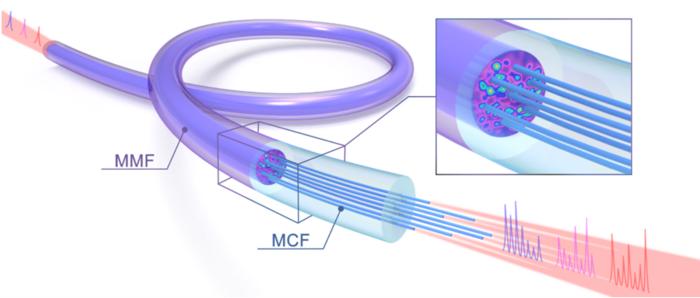
Figure | Evolution of light pulse in multimode and multicore fiber.
68
SHARES
622
VIEWS
Share on FacebookShare on Twitter
ADVERTISEMENT

Accurate high-speed measurements of wavelength are fundamental to optical research and industrial applications, such as environmental monitoring, biomedical analysis, and material characterization. Recent studies have shown that a disordered scattering medium such as a multimode fiber can generate a wavelength-dependent speckle pattern, which can provide a high spectral resolution and broad operational bandwidth in a compact structure. However, the measurement speeds of current speckle spectrometers are constrained by cameras, which limits their applications.

Figure | Evolution of light pulse in multimode and multicore fiber.

Credit: by Zheng Gao, Ting Jiang, Mingming Zhang, Yuxuan Xiong, Hao Wu, and Ming Tang.

Accurate high-speed measurements of wavelength are fundamental to optical research and industrial applications, such as environmental monitoring, biomedical analysis, and material characterization. Recent studies have shown that a disordered scattering medium such as a multimode fiber can generate a wavelength-dependent speckle pattern, which can provide a high spectral resolution and broad operational bandwidth in a compact structure. However, the measurement speeds of current speckle spectrometers are constrained by cameras, which limits their applications.

In a new paper published in Light: Advanced Manufacturing, a team of scientists, led by Professor Ming Tang and Dr. Hao Wu from Huazhong University of Science and Technology, China, with doctoral students Zheng Gao and Ting Jiang as co-first authors, have developed an ultrafast wavemeter based on multimode and multicore fibers, which employs spectral–spatial–temporal mapping. By integrating the speckle pattern characteristics of multimode fibers with the sampling capabilities of multicore fibers, this new method achieves a spectral measurement speed of 100MHz without compromising accuracy. These scientists summarize the operational principle of their wavemeter:

“To break through this speed limitation, we introduced multicore fibers, proposing an innovative spectral-space-time mapping scheme. We fused multicore fibers to the output end of multimode fibers, using each core to sample the speckle pattern, effectively transforming the intensity distribution into a pulse signal sequence. As a result, high-speed single-pixel photodetectors replaced traditional cameras, overcoming the frame rate limitations and achieving a leap in measurement speed.”

“We experimentally demonstrated a measurement rate of 100 MHz while maintaining a high resolution of 2.7pm. This measurement method has significant potential for application in many fields.”the scientists forecast.


Journal

Light: Advanced Manufacturing

DOI

10.37188/lam.2024.013

Share27Tweet17
Previous Post

Long-term outcomes in patients using protocol-directed active surveillance for prostate cancer

Next Post

Trends in diagnosed PTSD and acute stress disorder in college students

Related Posts

Georgia Tech Scientists Successfully Synthesize Moon Rock in the Laboratory — Space
Space

Georgia Tech Scientists Successfully Synthesize Moon Rock in the Laboratory

June 10, 2026
NIST Broadens Chemical Fingerprint Database to Enhance Identification of Unknown Substances — Space
Space

NIST Broadens Chemical Fingerprint Database to Enhance Identification of Unknown Substances

June 9, 2026
Radial Migration Drives Galactic Disc Expansion, Study Finds — Space
Space

Radial Migration Drives Galactic Disc Expansion, Study Finds

June 9, 2026
Scientists Track the “Urban Pulse” from Space — Space
Space

Scientists Track the “Urban Pulse” from Space

June 8, 2026
MIT astronomers identify the universe’s earliest flickering quasar — Space
Space

MIT astronomers identify the universe’s earliest flickering quasar

June 8, 2026
Early Earth’s Impact History Shaped Conditions Favorable for Life — Space
Space

Early Earth’s Impact History Shaped Conditions Favorable for Life

June 8, 2026
Next Post

Trends in diagnosed PTSD and acute stress disorder in college students

  • Mothers who receive childcare support from maternal grandparents show more parental warmth, finds NTU Singapore study

    Mothers who receive childcare support from maternal grandparents show more parental warmth, finds NTU Singapore study

    27654 shares
    Share 11058 Tweet 6911
  • University of Seville Breaks 120-Year-Old Mystery, Revises a Key Einstein Concept

    1059 shares
    Share 424 Tweet 265
  • Bee body mass, pathogens and local climate influence heat tolerance

    682 shares
    Share 273 Tweet 171
  • Researchers record first-ever images and data of a shark experiencing a boat strike

    545 shares
    Share 218 Tweet 136
  • Groundbreaking Clinical Trial Reveals Lubiprostone Enhances Kidney Function

    531 shares
    Share 212 Tweet 133
Science

Embark on a thrilling journey of discovery with Scienmag.com—your ultimate source for cutting-edge breakthroughs. Immerse yourself in a world where curiosity knows no limits and tomorrow’s possibilities become today’s reality!

RECENT NEWS

  • 3D Printing Biocemented Porous Structures with Precision
  • Activating Light Switch Protein Enhances Cancer’s Vulnerability to Treatment
  • Sympathetic Signaling Eases ARDS via HDC/SLC7A11 Axis
  • Glyphosate Exposure Linked to Pregnancy Hormone Disruption

Categories

  • Agriculture
  • Anthropology
  • Archaeology
  • Athmospheric
  • Biology
  • Biotechnology
  • Blog
  • Bussines
  • Cancer
  • Chemistry
  • Climate
  • Earth Science
  • Editorial Policy
  • Marine
  • Mathematics
  • Medicine
  • Pediatry
  • Policy
  • Psychology & Psychiatry
  • Science Education
  • Social Science
  • Space
  • Technology and Engineering

Subscribe to Blog via Email

Enter your email address to subscribe to this blog and receive notifications of new posts by email.

Join 5,146 other subscribers

© 2025 Scienmag - Science Magazine

Welcome Back!

Login to your account below

Forgotten Password?

Retrieve your password

Please enter your username or email address to reset your password.

Log In
No Result
View All Result
  • HOME
  • SCIENCE NEWS
  • CONTACT US

© 2025 Scienmag - Science Magazine

Discover more from Science

Subscribe now to keep reading and get access to the full archive.

Continue reading
