

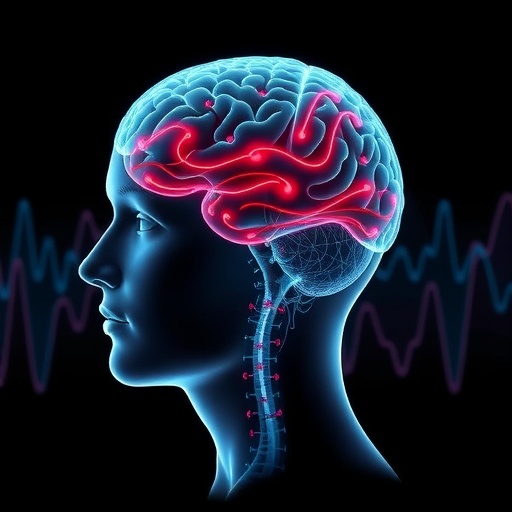
In the world of neuroscience, the ability to understand and manipulate brain activity at a granular level has long been a sought-after goal. Recent advances promise to push the boundaries of brain stimulation techniques further than ever before. The latest groundbreaking protocol, developed by Zrenner, Belardinelli, and Ziemann, marks a significant evolutionary step by combining real-time neurophysiological monitoring with precise brain stimulation. This method synchronizes transcranial magnetic stimulation (TMS) pulses to the brain’s endogenous oscillatory states measured via electroencephalography (EEG), enabling unprecedented control over brain plasticity.
Brain oscillations represent cyclical fluctuations in neural activity generated by large populations of neurons firing in synchrony. These oscillatory patterns are not merely epiphenomena but are central to a host of cognitive, sensory, and motor functions. Additionally, the brain’s responsiveness to external stimuli critically depends on these rapid rhythms governing neuronal excitability. Innovations that align brain stimulation to the ongoing oscillatory phase hold the promise of enhancing the efficacy and specificity of neuromodulation.
Historically, TMS—a noninvasive technique employing rapidly changing magnetic fields to induce electrical currents in the cortex—has been applied in a ballistic or temporally blind manner, without accounting for the brain’s intrinsic state at the moment of stimulation. However, mounting empirical evidence suggests that the brain’s instantaneous oscillatory phase profoundly influences how it reacts to TMS pulses. By timing stimulation to the phase of these oscillations, neuromodulation can be tuned to the brain’s moment-to-moment excitability window, leading to more robust and enduring neuroplastic effects.
The protocol places strong emphasis on the integration of EEG with TMS, known as EEG–TMS. EEG is used here not only as a passive recording tool but as a real-time monitoring and controlling system. This requires technical sophistication where EEG signals are reconstructed in source space via detailed anatomical models derived from MRI scans. Such source reconstruction enhances spatial accuracy, enabling researchers to identify and target specific cortical oscillations, which might otherwise be lost in the electrical noise and mixing inherent in scalp EEG signals.
The workflow involves several meticulously coordinated steps. It begins with obtaining high-resolution brain MRI images, which undergo segmentation to distinguish anatomical regions essential for building accurate forward and inverse models necessary for source localization. This step ensures that EEG signals can be precisely attributed to their cortical origins. Following anatomical modeling, baseline EEG recording without TMS validates the presence and characteristics of the target oscillation to ensure reliability and phase predictability.
Once the oscillatory feature of interest is reliably detected, the main experiment integrates real-time EEG analysis with the delivery of TMS pulses. A highly optimized computational pipeline calculates the phase of ongoing oscillations with millisecond accuracy and triggers TMS at predefined phases. This closed-loop system contrasts starkly with conventional open-loop TMS approaches, where timing is fixed or random relative to brain activity, thus lacking physiological relevance.
The advantage of this phase-locked stimulation is twofold. First, by synchronizing TMS with high-excitability oscillatory phases, the brain exhibits an increased sensitivity to induced electric fields, potentiating synaptic modifications. Second, by aligning with the natural rhythmicity of neural circuits, the induced plastic changes likely integrate more seamlessly with ongoing brain processes, potentially leading to longer-lasting therapeutic outcomes. Early data indicate that this approach may surpass traditional TMS in the induction of long-term potentiation or depression, mechanisms underlying learning and recovery.
This innovative methodology also opens the door to personalized brain stimulation therapies. Different individuals exhibit unique oscillatory profiles shaped by genetics, age, pathology, or cognitive state. Real-time EEG–TMS allows for adapting stimulation parameters to these individualized profiles, offering a tailored intervention that could improve treatment precision for neurological and psychiatric conditions such as depression, stroke, or epilepsy.
The implementation of this protocol necessitates moderate computational proficiency and standard neuroimaging and electrophysiological equipment. Neuroscientists work with TMS-compatible EEG systems capable of providing synchronized online data output, integrated with neuronavigation tools that guide coil positioning over targeted brain regions with anatomical precision. The entire procedure, including MRI acquisition, EEG baseline recording, and EEG–TMS sessions, spans approximately ten hours, reflecting its complexity but also its reproducibility given the right resources.
Importantly, this protocol represents an open framework adaptable to various oscillatory features, including frequency bands like alpha, beta, or gamma, and different cortical areas depending on desired functional outcomes. The flexibility also extends to clinical research, allowing the exploration of pathological oscillations in disease states and their modulation through phase-targeted stimulation.
The significance of this pioneering work transcends the technical. It showcases a paradigm shift from reactive to proactive neuromodulation strategies, where brain stimulation is no longer administered blindly but dynamically guided by the brain’s own activity patterns. Such precision neuroscience has profound implications for cognitive enhancement, neurorehabilitation, and the treatment of mental health disorders, promising interventions that are both scientifically grounded and clinically transformative.
Moreover, the real-time EEG–TMS approach exemplifies the merging of neurophysiology, neuroengineering, and computational neuroscience. It demonstrates how interdisciplinary collaboration can yield tools that harness the brain’s rhythmic nature, pushing the boundaries of what is possible in both basic research and translational applications.
The field of brain stimulation has evolved through the decades from rudimentary electrical currents to sophisticated magnetic coils. The integration of real-time brain state monitoring and stimulation triggers a new era, emphasizing not just where and how much stimulation is applied, but precisely when it is delivered within the brain’s temporal dynamics. This temporal specificity is arguably as crucial as spatial targeting in achieving desired neuromodulatory effects.
As this protocol is adopted and refined, it will be critical to explore its effects across different populations and disorders. Questions about optimal oscillatory targets, stimulation intensities, and long-term outcomes remain open, offering fertile ground for future investigations. Additionally, ethical considerations about manipulating brain states in real-time will require careful handling as the technology moves closer to clinical and possibly consumer applications.
In conclusion, the protocol detailed by Zrenner and colleagues offers a robust, technically sophisticated avenue to harness the brain’s oscillatory landscape for precisely timed, personalized, and potentially more effective neurostimulation. This milestone advances the frontier of neurotechnology by transforming brain stimulation from a static intervention into a dynamic, brain-state-responsive process, with profound implications for neuroscience research and clinical practice.
Subject of Research:
Oscillatory brain state-dependent stimulation using combined electroencephalography and transcranial magnetic stimulation.
Article Title:
Oscillatory brain state-dependent stimulation with transcranial magnetic stimulation combined with electroencephalography.
Article References:
Zrenner, C., Belardinelli, P. & Ziemann, U. Oscillatory brain state-dependent stimulation with transcranial magnetic stimulation combined with electroencephalography. Nat Protoc (2026). https://doi.org/10.1038/s41596-025-01309-7
Image Credits:
AI Generated


