


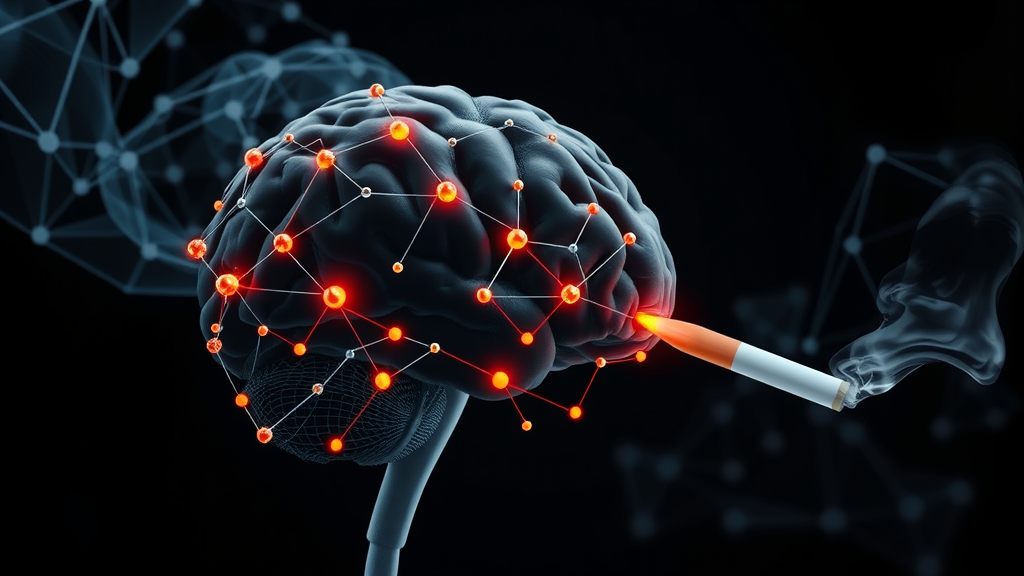
People living with psychotic disorders such as schizophrenia smoke at rates that stagger public health researchers: in many clinical cohorts, the majority of patients are regular tobacco users, compared with roughly one in five adults in the general population. The consequences are devastating. Cardiovascular disease, respiratory illness, and smoking-related cancers remain the leading causes of premature death in this population, shaving decades off average life expectancy. For years, the driver of this elevated smoking has been framed largely in behavioral and social terms, with self-medication hypotheses suggesting that nicotine temporarily relieves cognitive deficits, medication side effects, or the distressing symptoms of psychosis itself. A new neuroimaging study published in Schizophrenia, the Nature Partner Journal dedicated to the disorder, shifts the frame inward, to the intrinsic architecture of the brain itself. The research reports that the strength of functional connectivity within the parietal portion of the default mode network, a large-scale circuit best known for its activity during rest and internally directed thought, is associated with tobacco use in people with psychotic illness.
The default mode network has occupied a central place in cognitive neuroscience since its discovery in the early 2000s, when positron emission tomography and, later, functional magnetic resonance imaging revealed a set of regions that consistently decrease their activity during demanding external tasks and increase it during quiet rest. This network, anchored in the medial prefrontal cortex, the posterior cingulate cortex, the precuneus, and the inferior parietal lobule, is thought to support autobiographical memory retrieval, envisioning the future, self-referential processing, and mind-wandering. In schizophrenia, decades of imaging work have documented disruptions in this network’s connectivity, which have been linked to disturbances in self-monitoring, hallucination severity, and disorganized thought. What the new study adds is a bridge between this circuitry and one of the most consequential health behaviors in the disorder: smoking.
The researchers approached the question using resting-state functional connectivity analysis, a technique that measures the degree to which spatially distributed brain regions fluctuate together in their blood-oxygen-level-dependent signals while participants lie quietly in the scanner. Synchronized low-frequency fluctuations are interpreted as a signature of functional coupling, even though they do not directly measure anatomical wiring. By parcellating the cortex and extracting connectivity profiles associated with the default mode network, the team was able to quantify how strongly parietal nodes of this circuit communicated with the rest of the network and with other major systems, including the frontoparietal control network and the salience network, which are implicated in cognitive control and in switching between internal and external attention.
Across the study sample, the strength of parietal default mode connectivity emerged as a statistically reliable correlate of tobacco use measures, which for many participants included biologically verified indicators such as cotinine levels, the primary metabolite of nicotine, rather than relying solely on self-report. This methodological point matters enormously. Self-reported smoking in psychiatric populations is notoriously unreliable, shaped by stigma, recall difficulty, and cognitive impairment, and studies that depend on it risk both overestimation and underestimation of true exposure. By anchoring the smoking phenotype in objective biochemical measures where available, the analysis strengthens the claim that the brain-behavior association is genuine rather than an artifact of reporting bias.
Why should a network associated with daydreaming and self-referential thought care about nicotine? One plausible explanation lies in the interplay between the default mode network and dopaminergic signaling. Nicotine acts on nicotinic acetylcholine receptors that modulate dopamine release in the mesolimbic pathway, the reward circuitry that reinforces drug-taking. In psychosis, this dopaminergic system is already dysregulated, with the prevailing neurobiological models of schizophrenia positing aberrant striatal dopamine synthesis and release as a proximate cause of positive symptoms. Nicotine’s ability to transiently normalize aspects of this signaling, or to dampen sensory gating deficits, has long been cited in self-medication accounts. The new findings suggest that individual differences in the intrinsic organization of the default mode network may reflect, or even partly determine, the degree to which nicotine exerts reinforcing and normalizing effects in a given brain.
A complementary interpretation comes from the cognitive domain. The default mode network and the frontoparietal control network are engaged in a dynamic antagonist relationship: when the former is active, the latter is typically suppressed, and effective cognitive performance requires the orchestration of switching between internally and externally directed states. Smoking initiation and maintenance depend on executive functions, including the capacity to inhibit impulses, delay gratification, and weigh long-term health consequences against immediate relief. If parietal default mode connectivity indexes the rigidity of internal focus or the difficulty of disengaging from internally generated thought, then individuals with stronger or atypical coupling may find external, health-protective control processes harder to deploy, making tobacco use more likely to persist. In this framing, connectivity is not a cause of smoking in a simple causal chain but a marker of the neurocognitive soil in which the behavior takes root.
The psychosis context amplifies both the scientific and clinical significance of these results. Roughly three-quarters of people with schizophrenia who smoke do so heavily, and smoking accounts for the majority of the excess mortality observed in the disorder. Yet smokers with psychosis are less likely to receive smoking cessation counseling, less likely to be prescribed pharmacotherapy such as varenicline or bupropion, and more likely to relapse after quitting attempts. If neural measures such as default mode connectivity could stratify patients by the likely neurobiological drivers of their smoking, clinicians might eventually tailor interventions accordingly, deploying more intensive combined behavioral and pharmacological strategies for those whose circuit profiles indicate a strongly entrenched pattern. The present study does not yet support such clinical deployment, but it supplies the kind of mechanistic correlate that personalized approaches require.
As with all resting-state connectivity research, important caveats frame the interpretation. Functional connectivity is correlational; the cross-sectional design of the analysis cannot determine whether atypical parietal connectivity predisposes individuals to smoking, whether chronic nicotine exposure reshapes the network over time, or whether both are downstream of a third factor such as illness severity, medication exposure, or shared genetic risk. Longitudinal designs, within-person repeated imaging, and causal modeling techniques, including studies in animal models where nicotine exposure can be experimentally controlled, will be needed to disentangle these possibilities. Sample heterogeneity, medication effects, and the modest effect sizes typical of brain-wide association studies further caution against overreading any single result. Still, the consistency of the default mode network’s involvement across cognitive, symptomatic, and now behavioral domains in psychosis builds a cumulative case that this circuit is a genuine hub of individual difference in the disorder.
For the broader field, the study exemplifies a trend in psychiatric neuroscience toward connecting large-scale intrinsic brain organization with real-world health behaviors, rather than with abstract laboratory measures alone. Smoking is among the most modifiable risk factors in severe mental illness, and understanding its neural correlates is a step toward interventions that could meaningfully extend lives. The finding that the brain’s daydreaming circuitry carries information about tobacco use in psychosis is a reminder that even the most habitual and seemingly volitional behaviors are embedded in the biology of the disorders themselves, and that dismantling smoking’s grip on this vulnerable population may ultimately require working with, rather than around, the architecture of the psychotic brain.
Subject of Research: Resting-state parietal default mode network functional connectivity and its association with tobacco use in psychotic disorders
Article Title: Parietal default mode network connectivity is associated with tobacco use in psychosis
Article References: Bai, Y., Kittleson, A. R., Rogers, B. P., Huang, A., Woodward, N. D., Heckers, S., Sheffield, J. M., Vandekar, S., & Ward, H. B. (2026). Parietal default mode network connectivity is associated with tobacco use in psychosis. Schizophrenia. https://doi.org/10.1038/s41537-026-00797-0
Image Credits: AI Generated
DOI: 10.1038/s41537-026-00797-0
Keywords: schizophrenia, psychosis, default mode network, tobacco use, nicotine, functional connectivity, resting-state fMRI, neuroimaging, dopamine, smoking cessation, parietal cortex, severe mental illness
Cite Scienmag News
Cassandra Pierce. (September 12, 2026). Brain Network Tied to Daydreaming May Shape Smoking Habits in Psychosis. Scienmag. https://scienmag.com/brain-network-tied-to-daydreaming-may-shape-smoking-habits-in-psychosis/
Cassandra Pierce. "Brain Network Tied to Daydreaming May Shape Smoking Habits in Psychosis." Scienmag, 12 September 2026, https://scienmag.com/brain-network-tied-to-daydreaming-may-shape-smoking-habits-in-psychosis/. Accessed 17 October 2026.
Cassandra Pierce. "Brain Network Tied to Daydreaming May Shape Smoking Habits in Psychosis." Scienmag. September 12, 2026. https://scienmag.com/brain-network-tied-to-daydreaming-may-shape-smoking-habits-in-psychosis/


