


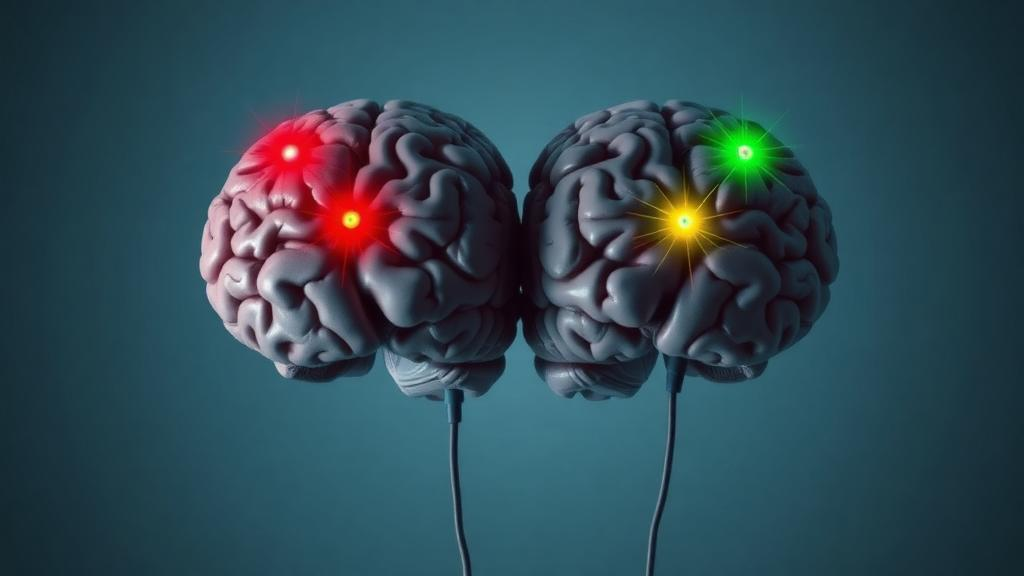
Every day, we face decisions in which the same action promises both a payoff and a potential price. Crossing a busy street saves time but risks an accident; accepting a new job brings a higher salary but unfamiliar stress. Neuroscientists have long suspected that a folded strip of cortex above the eye sockets, the orbitofrontal cortex, is where these approach-avoidance conflicts get resolved. Now, for the first time, researchers have watched that resolution unfold in real time inside the human brain, and what they found is a striking anatomical duel: two neighboring regions of the orbitofrontal cortex pulling in opposite directions, flickering between discrete neural states until one wins and a choice is made.
The study, published in Nature Neuroscience, took advantage of a rare scientific opportunity. Six patients at the University of California, San Francisco and Washington University in St. Louis had already been implanted with stereotactic electroencephalography depth electrodes for clinical reasons, either drug-resistant epilepsy or treatment-resistant psychiatric conditions. Because standard clinical practice routes these electrodes through the orbitofrontal cortex from lateral to medial, the researchers could simultaneously record neural activity across the entire medial-lateral span of the region in awake, behaving humans, something functional MRI has never been able to do reliably. The orbitofrontal cortex sits directly above bone and air-filled sinuses, which distorts fMRI signals, and the slow blood-oxygen response it measures cannot resolve the millisecond-scale computations that precede a decision.
While the electrodes recorded, the patients played a video-game-style task built in the Unity game engine. Each trial placed the player at the entrance of a corridor containing lit bombs and lit treasure chests. The number of lit bombs indicated how many rubies could be lost if the bombs exploded, which happened on 40 percent of approached trials; the number of lit chests indicated how many rubies could be gained, with chests opening on 70 percent of trials that reached them. Players had six seconds to decide whether to advance down the corridor or skip to the next one. Avoiding carried no gain and no loss. The probabilities were fixed and fully explained beforehand, so every trial posed a clean, known trade-off between potential reward and potential punishment.
The behavioral data were textbook. Players decided quickly, averaging about 1.3 seconds, and their choices were best captured by a prospect theory model, the framework Kahneman and Tversky developed to describe how humans weigh gains and losses. Five of the six participants showed loss aversion, weighting potential losses more heavily than equivalent gains, and utility functions were nonlinear for both outcomes. Reaction times and a Shannon-entropy measure of decision conflict both scaled inversely with the magnitude of subjective value: offers near indifference, such as seven treasure chests against four bombs, produced the slowest, most conflicted decisions, while lopsided offers were dispatched almost instantly.
The neural recordings revealed something no one had directly observed before in humans. The researchers focused on high-frequency activity, oscillations between 70 and 150 hertz that track the collective firing of local neural ensembles. In the 300 milliseconds before a choice, electrodes near the medial orbital sulcus, a fold of tissue in the medial orbitofrontal cortex, showed a burst of increased activity that was stronger on approach trials than on avoidance trials. Electrodes in the lateralmost centimeter and a half of recorded tissue showed the exact opposite: a suppression of activity that was deeper before approach decisions. Electrode position along the medial-lateral axis inversely correlated with pre-decision activity, and the decision-encoding sign flipped systematically from positive near the sulcus to negative roughly 24 millimeters away.
Critically, this gradient was not just a disguised reflection of value. Because the orbitofrontal cortex is known to encode subjective value, the team ran a battery of control analyses. Variance partitioning showed that the upcoming decision explained unique variance in neural activity beginning 400 milliseconds before the choice, over and above anything accounted for by subjective value. An offer-balanced analysis, restricted to ambiguous offers that participants sometimes approached and sometimes avoided, preserved the opposing medial and lateral signals. A two-stage residual regression that first stripped out reward and punishment information left the anatomical gradient intact, while neither reward nor punishment encoding itself showed any medial-lateral organization. The decision signal, in other words, was genuinely about the choice, not merely about the stakes.
The mirrored activity raised an obvious question: were the two regions talking to each other? Noise correlation analysis across 486 electrode pairs found 63 pairs whose trial-to-trial fluctuations were anticorrelated, 45 of which survived Bonferroni correction. These pairs were not random; one electrode sat near the medial orbital sulcus and the other significantly farther lateral, with a mean separation of nearly 18 millimeters. Granger causality tests detected short-lag directed influences in both directions for most pairs, and direct electrical stimulation of the medial region evoked cortico-cortical potentials in 20 of 25 lateral electrodes, while stimulating lateral tissue evoked responses in 20 of 22 medial electrodes. Together, the findings demonstrate functional connectivity across the axis, consistent with, though not proof of, the mutual inhibition that theoretical models of binary choice require.
To give the data a computational shape, the team adapted a two-node mean-field model in which a medial plus node and a lateral minus node inhibit each other. Rewards excite the plus node and punishments inhibit it, and the system settles into one of two attractor basins: a high-activity approach state or a low-activity avoid state. When reward and punishment inputs compete, the model becomes bistable, with two shallow basins separated by an unstable point, and the network stochastically flips between states. Parameter optimization, fitted only to behavior and never to neural data, predicted that single-trial dynamics should alternate between discrete states and that the switching should intensify as conflict rises. Penalizing bistability in the model produced systematically worse behavioral fits, suggesting the brain really does exploit this unstable regime.
The neural data matched those predictions with remarkable fidelity. A Lasso-regularized logistic decoder, trained on high-frequency activity in the 600 milliseconds before the button press, predicted the upcoming choice with 65.5 percent accuracy, significantly above chance in all six participants, and still reached 60.5 percent when value was residualized out. Electrodes with positive decoding coefficients clustered medially and those with negative coefficients laterally, recapitulating the encoding gradient. Applied at 10-millisecond resolution, the decoder exposed rapid, discrete alternations between approach-like and avoid-like states within single trials, each lasting on average about 72 milliseconds. These were not gradual ramps: the magnitude of the neural transient accompanying a switch into the approach state was identical whether the switch came early or late in the trial, favoring discrete attractor dynamics over noisy evidence accumulation of the kind described in perceptual decision models.
State occupancy became biased toward the eventual choice only in the final 450 to 500 milliseconds before the response, and the number of states visited per trial and the rate of transitions both rose robustly with decision conflict, even within a fixed pre-decision window that controlled for reaction time. The findings carry clinical weight as well as theoretical ones. The orbitofrontal cortex is an emerging stimulation target for refractory depression, and previous work found that high-frequency stimulation of the lateral, but not medial, orbitofrontal cortex improved mood in patients with epilepsy. In the new framework, suppressing the lateral node would shut down activity tuned toward avoidance, offering a mechanistic account of why that intervention works and pointing toward more refined anatomical targets. For now, the study delivers something rarer: a live view of the mind changing its own, one flickering neural state at a time.
Subject of Research: Medial and lateral orbitofrontal cortex contributions to human approach-avoidance decision-making measured with intracranial electroencephalography
Article Title: Intracranial recordings in humans reveal differential contributions of medial and lateral orbitofrontal cortex to approach–avoidance decision-making
Article References: Starkweather, C. K., Willbrand, E. H., Sellers, K., Hullett, P. W., Krystal, A. D., Lee, A. M., Weiner, K. S., Willie, J. T., Brunner, P., Hsu, M., Chang, E. F., & Knight, R. T. (2026). Intracranial recordings in humans reveal differential contributions of medial and lateral orbitofrontal cortex to approach–avoidance decision-making. Nature Neuroscience. https://doi.org/10.1038/s41593-026-02444-4
Image Credits: AI Generated
DOI: 10.1038/s41593-026-02444-4
Keywords: orbitofrontal cortex, approach-avoidance conflict, decision-making, intracranial EEG, high-frequency activity, attractor dynamics, prospect theory, loss aversion, mutual inhibition, stereotactic electroencephalography, neural decoding, Nature Neuroscience
Cite Scienmag News
Cassandra Pierce. (October 8, 2026). Brain electrodes reveal a tug-of-war between two orbitofrontal regions as we decide to take risks or play it safe. Scienmag. https://scienmag.com/brain-electrodes-reveal-a-tug-of-war-between-two-orbitofrontal-regions-as-we-decide-to-take-risks-or-play-it-safe/
Cassandra Pierce. "Brain electrodes reveal a tug-of-war between two orbitofrontal regions as we decide to take risks or play it safe." Scienmag, 8 October 2026, https://scienmag.com/brain-electrodes-reveal-a-tug-of-war-between-two-orbitofrontal-regions-as-we-decide-to-take-risks-or-play-it-safe/. Accessed 8 October 2026.
Cassandra Pierce. "Brain electrodes reveal a tug-of-war between two orbitofrontal regions as we decide to take risks or play it safe." Scienmag. October 8, 2026. https://scienmag.com/brain-electrodes-reveal-a-tug-of-war-between-two-orbitofrontal-regions-as-we-decide-to-take-risks-or-play-it-safe/


