
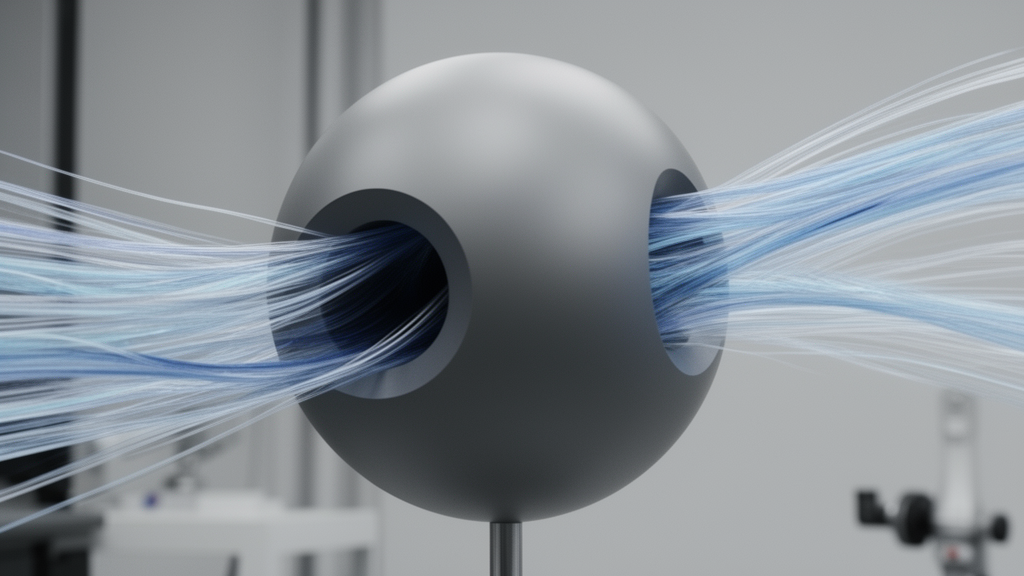
Engineers studying how fluids move around blunt objects have a new data point to consider: what happens when the object has a hole drilled straight through its middle. A study published in Scientific Reports examines incompressible viscous flow around a sphere containing a central cylindrical bore, at a Reynolds number of 300, and maps how two design variables — the borehole diameter and the angle at which the flow strikes the sphere — alter the wake behind it.
The research was motivated by a practical concern in ocean engineering: cracks in and around bluff bodies can pose safety hazards, and a bore through a sphere offers a controlled way to study how such openings disturb the surrounding flow. The authors systematically explored the effects of borehole diameter and attack angle on three linked quantities: vortex shedding, flow separation, and drag coefficients.
At low attack angles, the findings show that enlarging the borehole markedly changes the primary shedding frequency of the vortices, which in turn modifies their structural characteristics. Total drag was also observed to increase with larger borehole diameters, a direct consequence of how the through-hole reshapes the flow field around the body.
At higher attack angles, the geometry of the bore matters in a different way. Because the borehole sits close to the separation point, its diameter affects where flow separation begins. The influence of the attack angle was most pronounced for larger borehole diameters, where the study recorded clear alterations in both vortex shedding and flow separation patterns.
The drag coefficient told a similar story. The magnitude of the borehole diameter amplified the effect of the angle of attack on drag, meaning that a bigger hole made the sphere’s resistance to the flow more sensitive to how it was oriented relative to the incoming stream.
The bore also acts as a channel for jet-like flow through the sphere, and this has consequences for stability. When the borehole diameter is sufficiently small, the jet-like flow intensifies instability in the flow around the sphere. That instability follows a distinctive pattern as the orientation changes: it initially escalates with increasing angle of attack, reaches a peak at 45 degrees, and then diminishes as the angle continues to increase.
Together, the results indicate that neither borehole size nor orientation can be considered in isolation. The two parameters interact: the diameter determines how strongly the angle of attack influences shedding, separation, and drag, while the angle determines how the bore’s jet-like flow destabilizes the wake. For ocean engineering applications where cracks and openings in submerged structures are a safety concern, the study provides a systematic map of those interactions at a single Reynolds number of 300.
The article was published as an accepted manuscript shared early to provide faster access to peer-reviewed research, carrying a permanent DOI and subject to further edits before the final version of record appears.
Subject of Research: Fluid dynamics of flow around a sphere with a central cylindrical bore
Article Title: Influence of borehole diameter and attack angle on the flow around a perforated sphere
Article References: Li, J., Wei, J., Lu, C., Yan, M., Lytvynenko, D., & Xu, P. (2026). Influence of borehole diameter and attack angle on the flow around a perforated sphere. Scientific Reports. https://doi.org/10.1038/s41598-026-77956-x
Image Credits: AI Generated
DOI: 10.1038/s41598-026-77956-x
Keywords: fluid dynamics, vortex shedding, flow separation, drag coefficient, bluff body, sphere, borehole diameter, attack angle, Reynolds number, ocean engineering, jet flow, Scientific Reports
Cite Scienmag News
Audrey Campbell. (October 28, 2026). Borehole size and angle reshape how air flows around a drilled sphere. Scienmag. https://scienmag.com/borehole-size-and-angle-reshape-how-air-flows-around-a-drilled-sphere/
Audrey Campbell. "Borehole size and angle reshape how air flows around a drilled sphere." Scienmag, 28 October 2026, https://scienmag.com/borehole-size-and-angle-reshape-how-air-flows-around-a-drilled-sphere/. Accessed 30 October 2026.
Audrey Campbell. "Borehole size and angle reshape how air flows around a drilled sphere." Scienmag. October 28, 2026. https://scienmag.com/borehole-size-and-angle-reshape-how-air-flows-around-a-drilled-sphere/