

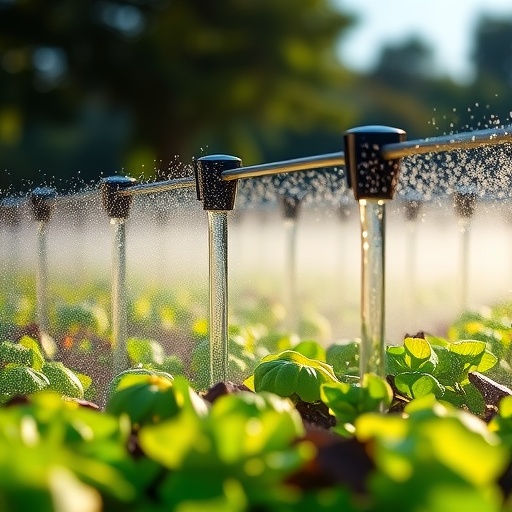
As climate change continues to alter weather patterns and water availability, researchers are increasingly focused on developing innovative strategies to optimize water usage in agriculture. One such study, spearheaded by Singha, Sahoo, and Govind, delves into the realm of stochastic optimization and ensemble learning as pivotal tools in crafting robust irrigation solutions. This investigation aims to enhance water productivity while simultaneously adapting to a fluctuating climate. Their findings, which promise to reshape the landscape of agricultural water management, have far-reaching implications for farmers worldwide.
The first key aspect of this research is the incorporation of stochastic optimization techniques. Stochastic optimization is distinguished by its ability to account for uncertainty, a critical component when dealing with weather variability. Traditional deterministic models often fall short in dynamic environments where climate conditions can change rapidly. The researchers propose that by integrating stochastic methods, farmers can develop irrigation systems that are not only efficient but also resilient to unforeseen changes in weather patterns.
Ensemble learning, a powerful machine learning technique, is the second cornerstone of this study. Unlike single models that rely on one set of assumptions, ensemble learning combines multiple methodologies to produce a more accurate and reliable outcome. In this context, the researchers utilized ensemble learning to predict water needs more accurately. By synthesizing various models and data sources, they could produce an irrigation advisory system that significantly outperforms traditional predictive models.
The practical implementation of these theoretical advancements is equally crucial. The researchers designed a framework to integrate these sophisticated computational approaches into existing agricultural practices. Farmers often struggle with access to real-time data and analytics, but this study aims to provide a user-friendly platform that delivers tailored irrigation recommendations. These recommendations are based on a combination of satellite data, weather forecasts, and soil moisture levels, ensuring that water is applied in the right amounts at the right times.
Moreover, the study emphasizes the importance of local context in irrigation practices. Different regions vary widely in terms of climate, soil types, and crop varieties, which necessitates a nuanced approach to water management. This research acknowledges those differences, allowing for localized updates to irrigation advisories that reflect the specific needs and conditions of each farming operation. By empowering farmers with such customized insights, water efficiency can be significantly improved, leading to enhanced crop yields and sustainability.
The repercussions of improved water productivity are profound. Increasing water use efficiency not only supports agricultural output but also conserves valuable water resources, aligning with global sustainability goals. As the world faces escalating water scarcity due to climate change, optimizing irrigation becomes more critical than ever. The researchers underscore that conserving water in agriculture, one of the largest consumers of freshwater, is essential for ensuring food security in a world with a growing population.
The study also sheds light on the interplay between technology and traditional farming methods. While high-tech solutions dominate discussions around agricultural innovation, the integration of these advanced systems must be approached thoughtfully. Farmers are often hesitant to adopt new technologies without evidence of their efficacy and practicality. To address these concerns, the researchers highlight the importance of training programs and support systems that accompany the deployment of their new advisory tool. Ensuring farmers are well-equipped to use the technology will be key to its success.
Furthermore, the collaborative aspect of the research illustrates that effective water management is not solely an agricultural issue but requires multi-sectoral cooperation. Stakeholders including governments, NGOs, and educational institutions must work together to create a supportive ecosystem. Policy frameworks should incentivize water-saving technologies and practices, while educational initiatives can enhance farmers’ understanding of climate impacts on water availability.
As the study anticipates the future, there remains a strong need for continued research in adaptive agricultural practices. While the current findings are promising, the dynamic nature of climate change necessitates ongoing exploration and refinement of strategies. The researchers advocate for a cycle of feedback and continuous improvement, wherein field data from farmers informs ongoing model adjustments. This iterative approach could hone irrigation advisory systems to stay relevant amidst changing climatic conditions.
In terms of broader implications, the intersection of climate change and water management in agriculture poses significant challenges that require urgent attention. As events such as droughts and floods become more frequent, adaptive measures are critical not just for individual farms but for the resilience of food systems globally. The methodologies proposed in this research might serve as a blueprint for similar initiatives worldwide, creating a network of informed and adaptive agricultural practices.
Ultimately, the journey from research to application underscores a vital narrative about the role of science in addressing real-world problems. The innovative blending of stochastic optimization and ensemble learning symbolizes the potential for technology to support sustainable development. As this research unfolds, it not only contributes to the academic discourse but also delivers a tangible pathway toward more resilient agricultural practices in the face of climate uncertainty.
In conclusion, Singha, Sahoo, and Govind provide a significant contribution to the field of agricultural water management through their innovative research on stochastic optimization and ensemble learning. By addressing the critical need for efficient irrigation strategies in a changing climate, their work illuminates a hopeful path forward. As the agricultural sector grapples with the severe consequences of climate change, the findings from this research could be heralded as a vital step toward securing food production and preserving precious water resources for generations to come.
Subject of Research: Stochastic optimization and ensemble learning for irrigation advisory in agriculture.
Article Title: Stochastic optimization and ensemble learning towards robust irrigation advisory to enhance water productivity under a changing climate.
Article References:
Singha, C., Sahoo, S. & Govind, A. Stochastic optimization and ensemble learning towards robust irrigation advisory to enhance water productivity under a changing climate.
Discov Sustain (2026). https://doi.org/10.1007/s43621-025-02562-2
Image Credits: AI Generated
DOI: https://doi.org/10.1007/s43621-025-02562-2
Keywords: Stochastic optimization, ensemble learning, irrigation, water productivity, climate change, agriculture.


