

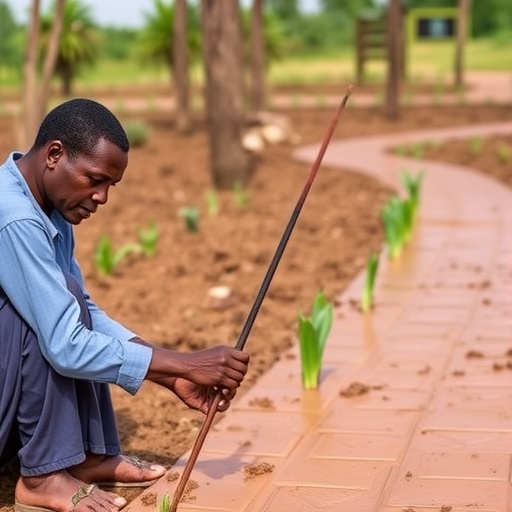
In the lush landscapes of Ethiopia’s Gambella region, an agricultural transformation is silently taking root. Farmers, once solely dependent on rain-fed agriculture, are now embracing the innovative practice of small-scale irrigation. This shift is not merely a trend; it represents a pivotal movement toward sustainable farming that is poised to revolutionize food production in one of Africa’s most fertile areas. The research conducted by Chuol, Dol, and Kelbassa delves into the intricacies of this adoption process, shedding light on the broader implications for food security, economic stability, and environmental sustainability.
Agriculture in the Gambella region has historically been dictated by the fickle cycles of rainfall. Farmers faced significant challenges, including droughts and unpredictable wet seasons that jeopardized their yields and livelihoods. With a large portion of the community relying on subsistence farming, any disruption to the agricultural cycle posed dire consequences. The introduction of small-scale irrigation systems offers a formidable solution to these challenges, allowing farmers to mitigate risks associated with climate variability. By harnessing water resources more efficiently, these farmers can cultivate their crops at times that were previously unviable, effectively expanding their planting and harvesting windows.
The essence of small-scale irrigation in the Gambella region can be attributed to its accessibility and affordability. Traditional large-scale irrigation schemes can be prohibitively expensive and complex, often leaving smallholder farmers without viable options. In contrast, small-scale irrigation systems, such as drip and sprinkler irrigation, can be implemented with relatively low initial investments. Furthermore, these methods are adaptable to various farming contexts, making them a perfect fit for the diverse agricultural practices observed among Gambella farmers. The local communities have begun recognizing the potential of such systems, as they empower farmers to take control of their agricultural destinies.
Research indicates that the adoption of small-scale irrigation has significantly enhanced crop yields across various farmers in Gambella. A study conducted on-site revealed that those farmers who adopted these irrigation techniques reported increases in their production levels by as much as 50%. The results are not just quantitative; they symbolize renewed hope for food security in a region that has struggled with famine and low agricultural productivity. With improved yields, farmers can not only feed their families but also contribute to local markets, thus bolstering the regional economy.
The societal impacts of adopting small-scale irrigation extend beyond mere agriculture. Enhancing food production lays the groundwork for a more balanced diet and improved nutrition for families. Moreover, the rise in agricultural productivity encourages local entrepreneurship, as surplus crops can lead to the formation of small businesses. Farmers begin to diversify their income sources through value-added products and services, further stimulating economic growth within the community. This chain reaction illustrates how a single agricultural practice can be a catalyst for broader socio-economic advancement.
Despite the clear advantages, the research highlights that the transition to small-scale irrigation is not without its challenges. A significant barrier identified among farmers includes a lack of access to knowledge and resources. Many farmers have limited information about the best practices for irrigation, which can lead to inefficient water usage or even crop failure. Education and training programs are critical components for the successful implementation of these irrigation systems. When farmers acquire the necessary skills and information to optimize their operations, the chance of successful adoption increases exponentially.
In addition to education, the adoption of small-scale irrigation systems also relies heavily on community support and collaboration. Many farmers operate within tight-knit communities where information sharing and collective problem-solving are essential. Engaging local farmers in cooperative groups fosters an environment of trust and support, enabling them to share resources, knowledge, and even the costs associated with implementing irrigation systems. The research underlines the vital role of community networks in enhancing the transport of information and promoting sustainable practices within the agricultural community.
Environmental sustainability is another important aspect of the small-scale irrigation movement in Gambella. By utilizing efficient irrigation systems, farmers can significantly reduce water wastage and minimize the ecological footprint of their agricultural practices. Sustainable irrigation can also mitigate issues related to soil erosion and degradation, which directly impact land health and crop longevity. These environmentally friendly practices are integral to maintaining the rich biodiversity and ecosystems that are vital to the region’s natural resources.
The study provides compelling evidence that the adoption of small-scale irrigation can lead to broader shifts in agricultural policies at both local and national levels. For policymakers in Ethiopia, the findings underscore the necessity to support smallholder farmers through training initiatives, financial assistance, and infrastructures to encourage the proliferation of irrigation solutions. Such investments not only promise immediate benefits for farmers but also facilitate long-term agricultural resilience, securing food for future generations.
Another critical dimension of this study is the impact on women’s involvement in agriculture. In many parts of Ethiopia, women bear the brunt of agricultural work, often with limited access to resources or decision-making power. The introduction of small-scale irrigation systems can empower these women by providing them with the means to enhance their agricultural production. When women are given the tools and autonomy to manage their crops efficiently, they become vital contributors to their families’ incomes, leading to improved living standards and greater gender equity.
As we look toward the future, the potential of small-scale irrigation adoption in the Gambella region shines brightly. The intersection of technology, education, community engagement, and environmental sustainability sets a promising stage for agricultural advancement. This research illuminates pathways toward achieving not only food security but also economic stability and community empowerment in one of Ethiopia’s most promising agricultural frontiers.
By harnessing both local knowledge and innovative practices, the farmers of Gambella are not just participants in this agricultural revolution—they are the architects of their agricultural futures. The success of their journey encourages similar movements across varying contexts, showing that with the right resources and community collaboration, societies can effectively combat agricultural challenges posed by climate change and resource scarcity. Ultimately, the ripple effects of small-scale irrigation in Gambella could serve as a blueprint for nations grappling with food security in the 21st century.
Subject of Research: Small-scale irrigation adoption among farmers in Gambella region, Ethiopia.
Article Title: Small-Scale Irrigation Adoption: A Pathway to Sustainable Agriculture in Gambella
Article References:
Chuol, C.B., Dol, P.B., Kelbassa, A.G. et al. Small-scale irrigation adoption among farmers in Gambella region, Ethiopia. Discov Sustain (2026). https://doi.org/10.1007/s43621-026-02675-2
Image Credits: AI Generated
DOI:
Keywords: irrigation, sustainable agriculture, food security, community empowerment, women’s involvement, climate change


